Co-Designing Collaborative Generative AI Tools for Freelancers
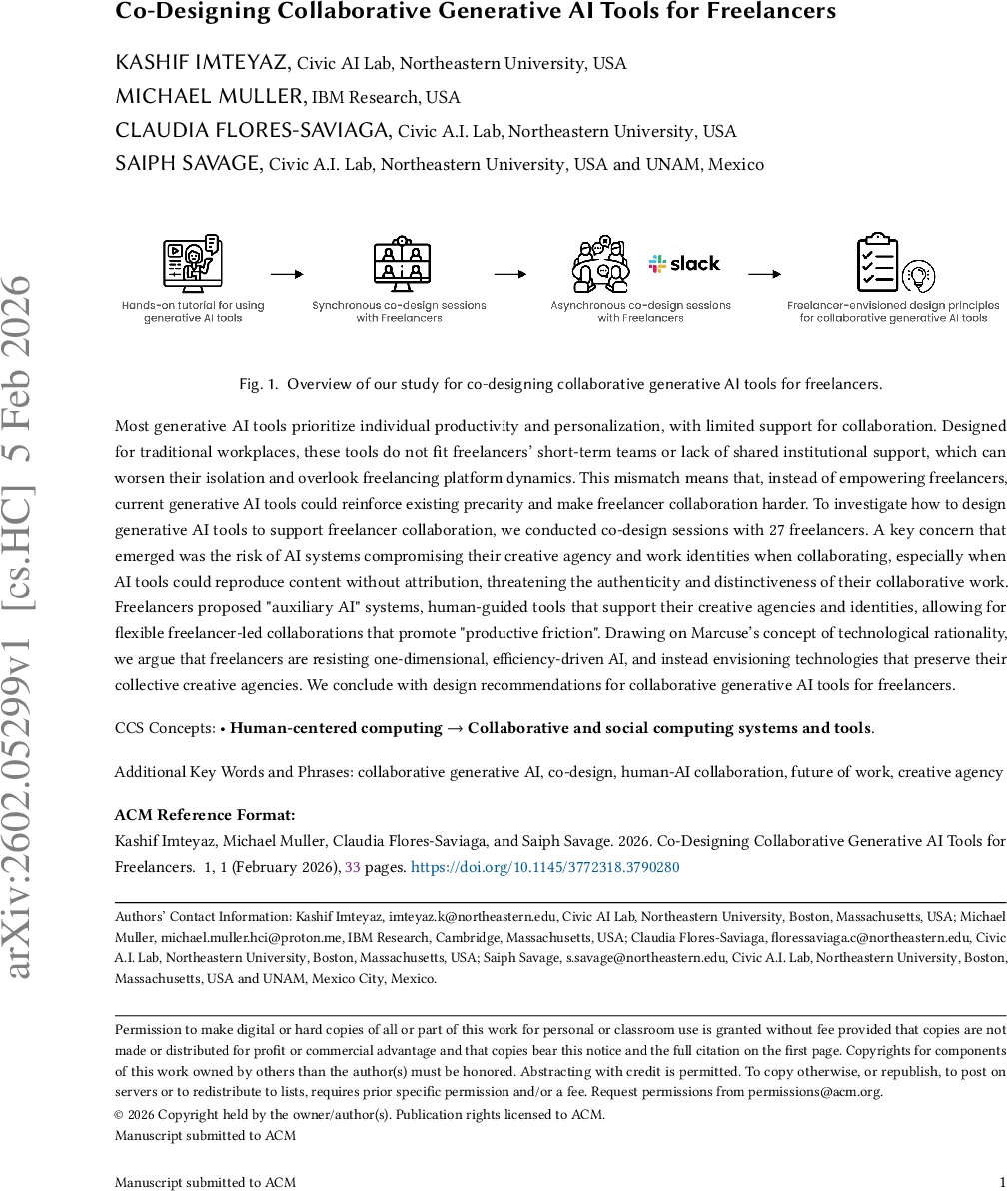
Most generative AI tools prioritize individual productivity and personalization, with limited support for collaboration. Designed for traditional workplaces, these tools do not fit freelancers’ short-term teams or lack of shared institutional support, which can worsen their isolation and overlook freelancing platform dynamics. This mismatch means that, instead of empowering freelancers, current generative AI tools could reinforce existing precarity and make freelancer collaboration harder. To investigate how to design generative AI tools to support freelancer collaboration, we conducted co-design sessions with 27 freelancers. A key concern that emerged was the risk of AI systems compromising their creative agency and work identities when collaborating, especially when AI tools could reproduce content without attribution, threatening the authenticity and distinctiveness of their collaborative work. Freelancers proposed “auxiliary AI” systems, human-guided tools that support their creative agencies and identities, allowing for flexible freelancer-led collaborations that promote “productive friction”. Drawing on Marcuse’s concept of technological rationality, we argue that freelancers are resisting one-dimensional, efficiency-driven AI, and instead envisioning technologies that preserve their collective creative agencies. We conclude with design recommendations for collaborative generative AI tools for freelancers.
💡 Research Summary
The paper investigates the mismatch between current generative AI tools—largely engineered for individual productivity in traditional organizational settings—and the collaborative needs of freelancers, who typically work in temporary, decentralized teams without institutional support. Drawing on Herbert Marcuse’s concept of technological rationality, the authors argue that existing AI systems prioritize efficiency and control, thereby suppressing the dialogic, iterative processes essential for meaningful freelancer collaboration and risking the erosion of creative agency and work identity.
To explore alternative designs, the authors conducted a series of remote co‑design workshops with 27 freelancers representing developers, designers, writers, project managers, and virtual assistants. The methodology combined “Future Workshops” with AI‑generated design probes (e.g., DALL‑E images) to surface participants’ lived experiences, critique current tools, and envision new possibilities. Participants identified three core shortcomings of today’s generative AI: (1) lack of situated, context‑aware output, leading to generic suggestions that do not fit the fluid nature of freelance projects; (2) a tendency toward over‑reliance that diminishes critical thinking and group creativity; and (3) the risk of undermining authorship because AI‑generated content often lacks attribution, threatening both individual and collective identity.
In response, freelancers proposed the notion of “auxiliary AI” – a class of tools that act as supportive collaborators rather than decisive agents. Auxiliary AI would (a) recognize the collaborative context (project stage, role distribution, platform constraints) and provide tailored prompts; (b) automatically embed metadata (author, contribution level, version) into every generated artifact to ensure transparent attribution; and (c) deliberately preserve “productive friction” by presenting ideas as suggestions that require human negotiation, modification, or rejection, thus preventing blind automation.
Based on these insights, the authors formulate four design recommendations:
- Context‑aware interfaces – dashboards that surface real‑time project metadata, allowing AI to adapt its assistance to the evolving team dynamics.
- Transparent attribution mechanisms – built‑in provenance tracking that logs AI contributions alongside human inputs, supporting both legal ownership and psychological ownership.
- Friction‑by‑design collaboration flows – structured interaction loops where AI proposals trigger explicit human critique steps, encouraging debate and co‑construction.
- Platform‑agnostic integration – API‑based connectors that let freelancers employ auxiliary AI across multiple gig platforms (e.g., Upwork, Fiverr) without being locked into a single ecosystem.
The paper contributes three main scholarly advances: (1) an empirical mapping of how technological rationality manifests in generative AI tools and hampers freelancer collaboration; (2) a nuanced ethical analysis highlighting threats to creative agency and identity; and (3) concrete, theory‑grounded design guidelines for building collaborative generative AI that respects and amplifies human creativity rather than replacing it.
In conclusion, the study demonstrates that freelancers are not passive recipients of AI‑driven efficiency; they actively resist one‑dimensional rationality and envision AI as an auxiliary partner that safeguards collective agency. By embedding critical theory into participatory design, the authors provide a roadmap for future AI systems that can genuinely support the fragile, fluid, and often precarious collaborative practices of the growing freelance workforce.
Comments & Academic Discussion
Loading comments...
Leave a Comment