Infinitely many new solutions for a nonlinear coupled Schrödinger system
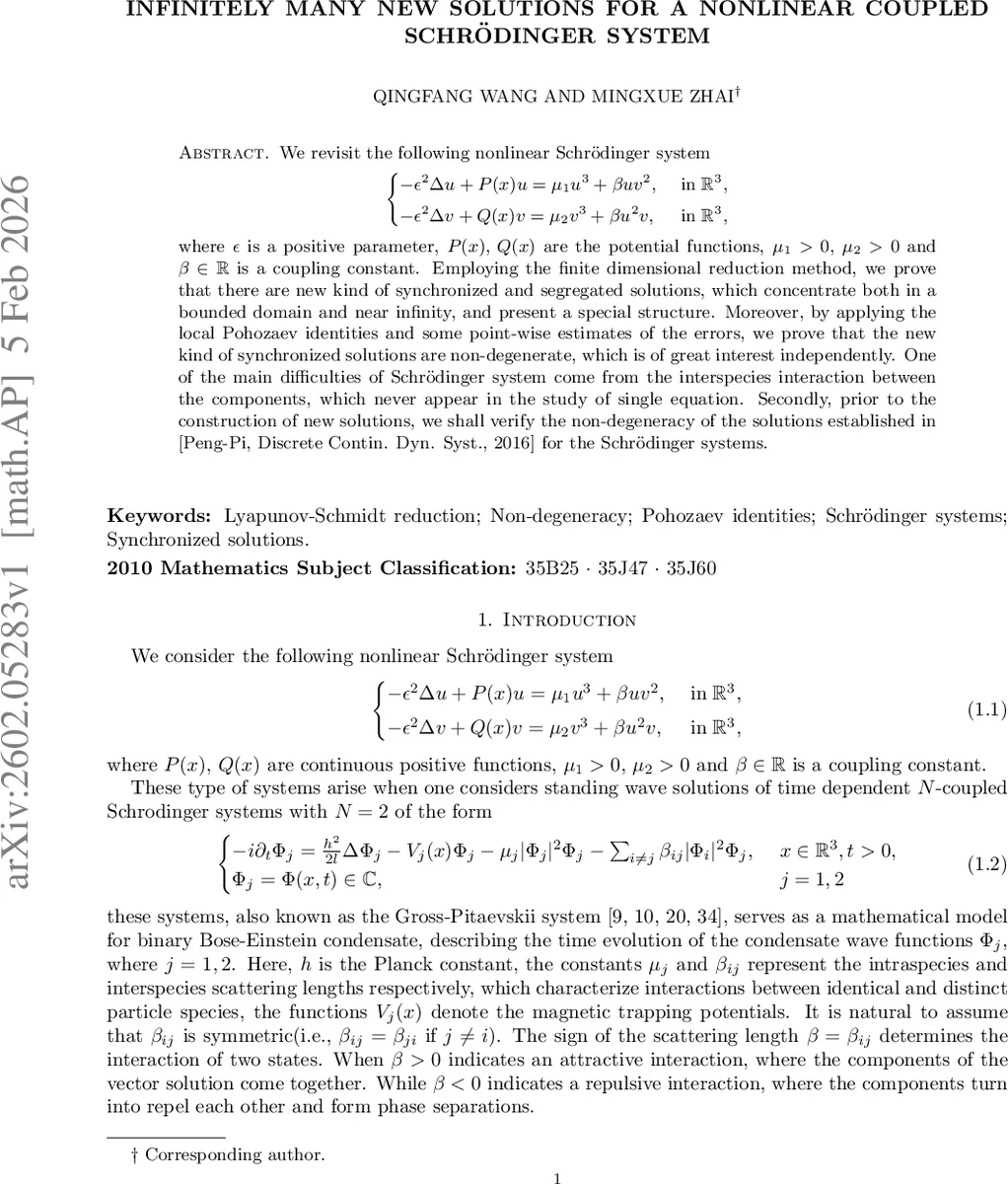
We revisit the following nonlinear Schrödinger system \begin{align*}\begin{cases} -ε^{2}Δu +P(x) u= μ_1 u^3 +βuv^2, &\text{in};\mathbb {R}^3,\ -ε^{2}Δv+Q(x) v= μ_2 v^3 +βu^2v, &\text{in};\mathbb{ R}^3, \end{cases} \end{align*} where $ε$ is a positive parameter, $P(x),,Q(x)$ are the potential functions, $μ_1>0$, $μ_2>0$ and $β\in\mathbb R$ is a coupling constant. Employing the finite dimensional reduction method, we prove that there are new kind of synchronized and segregated solutions, which concentrate both in a bounded domain and near infinity, and present a special structure. Moreover, by applying the local Pohozaev identities and some point-wise estimates of the errors, we prove that the new kind of synchronized solutions are non-degenerate, which is of great interest independently. One of the main difficulties of Schrödinger system come from the interspecies interaction between the components, which never appear in the study of single equation. Secondly, prior to the construction of new solutions, we shall verify the non-degeneracy of the solutions established in [Peng-Pi, Discrete Contin. Dyn. Syst., 2016] for the Schrödinger systems.
💡 Research Summary
The paper studies the three‑dimensional coupled nonlinear Schrödinger system
\
Comments & Academic Discussion
Loading comments...
Leave a Comment