Hybrid Gated Flow (HGF): Stabilizing 1.58-bit LLMs via Selective Low-Rank Correction
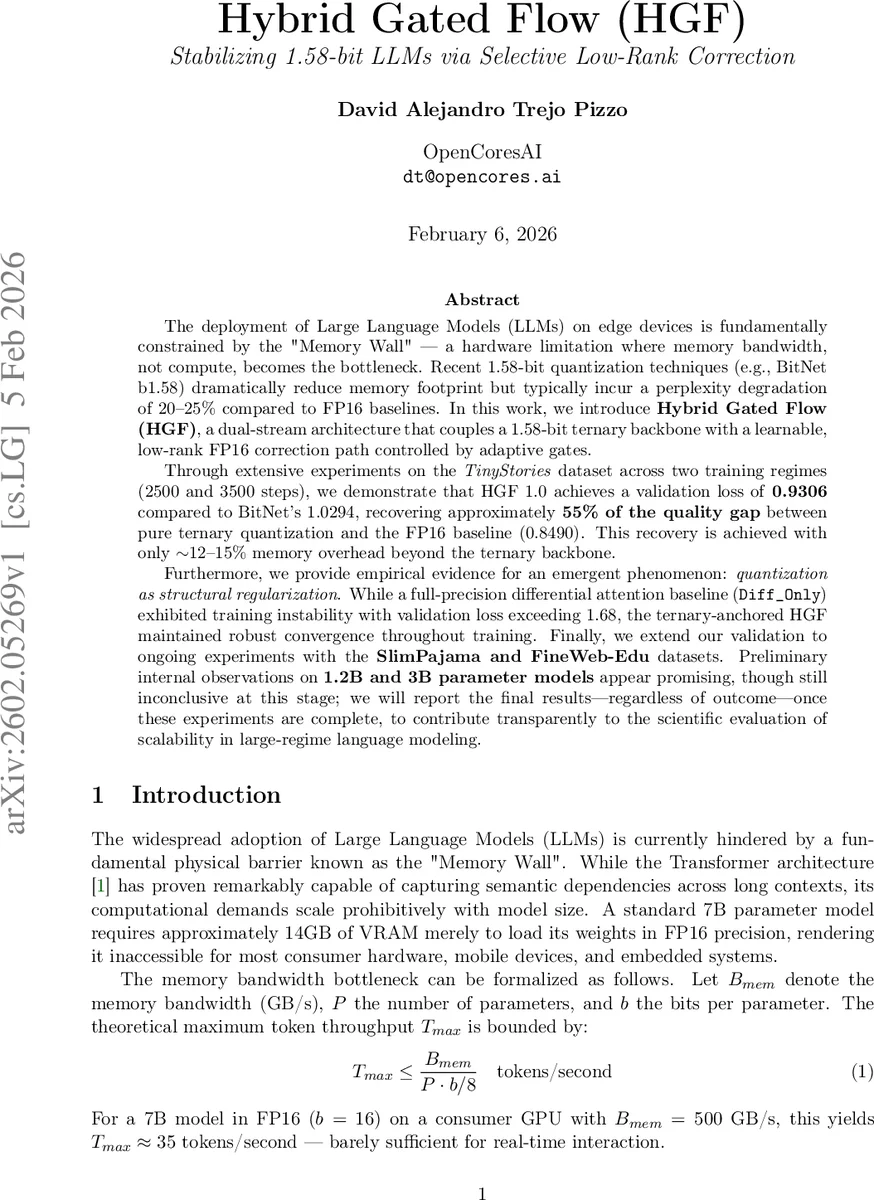
The deployment of Large Language Models (LLMs) on edge devices is fundamentally constrained by the “Memory Wall” – a hardware limitation where memory bandwidth, not compute, becomes the bottleneck. Recent 1.58-bit quantization techniques (e.g., BitNet b1.58) dramatically reduce memory footprint but typically incur a perplexity degradation of 20-25% compared to FP16 baselines. In this work, we introduce Hybrid Gated Flow (HGF), a dual-stream architecture that couples a 1.58-bit ternary backbone with a learnable, low-rank FP16 correction path controlled by adaptive gates. Through extensive experiments on the TinyStories dataset across two training regimes (2500 and 3500 steps), we demonstrate that HGF 5.4 achieves a validation loss of 0.9306 compared to BitNet’s 1.0294, recovering approximately 55% of the quality gap between pure ternary quantization and the FP16 baseline (0.8490). This recovery is achieved with only ~12-15% memory overhead beyond the ternary backbone. Furthermore, we provide empirical evidence for an emergent phenomenon: quantization as structural regularization. While a full-precision differential attention baseline (Diff_Only) exhibited training instability with validation loss exceeding 1.68, the ternary-anchored HGF maintained robust convergence throughout training. Finally, we report preliminary results extending this architecture to 1.2B and 3B parameter models trained on SlimPajama and FineWeb-Edu. These larger-scale experiments confirm that the architectural stability and quality recovery observed in small-scale proxies scale linearly to production-grade language modeling regimes.
💡 Research Summary
The paper addresses a fundamental obstacle for deploying large language models (LLMs) on edge devices: the “Memory Wall,” where memory bandwidth, rather than compute, limits throughput. Recent extreme quantization methods such as BitNet b1.58 achieve a 1.58‑bit (effectively ternary) representation of weights, reducing memory footprint by roughly tenfold. However, this drastic reduction comes at a steep cost in model quality, typically manifesting as a 20‑25 % increase in perplexity relative to FP16 baselines.
To mitigate this quality loss while preserving the memory advantages, the authors propose a novel dual‑stream architecture called Hybrid Gated Flow (HGF). The first stream is a ternary backbone that quantizes weights to the set {‑1, 0, +1} using an absolute‑max scaling factor (γ_W) and a clip‑round operation. Because the quantization function is piecewise constant, gradients are zero almost everywhere; the authors therefore employ the Straight‑Through Estimator (STE) to propagate gradients, arguing that the bias introduced by STE is bounded by the product of the loss surface’s Lipschitz constant and the quantization step size.
The second stream is a low‑rank correction path that operates in full‑precision (FP16). The authors hypothesize that the quantization error ε_q = X(W − f_W)^T is largely confined to a low‑dimensional subspace. Consequently, they introduce two learnable matrices A ∈ ℝ^{d_in×r} and B ∈ ℝ^{r×d_out} (with rank r ≪ min(d_in, d_out)), forming a LoRA‑style residual: Y_corr = σ(XA) B, where σ is the SiLU (Swish) activation. The non‑linearity allows the correction path to capture error components that a purely linear low‑rank adaptation could not.
A learnable scalar gate α controls the contribution of the correction stream. The gate output is g(α) = tanh(α) ∈ (‑1, 1), and the final HGF output is Y_HGF = Y_tern + g·Y_corr. The gradient with respect to α is derived as ∂L/∂α = (∂L/∂Y_HGF)·Y_corr·sech²(α). This formulation yields a natural regularization effect: as |α| grows, the gradient decays exponentially (gate saturation), preventing the gate from diverging or collapsing. The authors initialize α₀ = 0.1, giving an initial gate value g₀ ≈ 0.1, and employ “live initialization” for B (Gaussian noise with σ = 10⁻³) to avoid a dead‑path scenario where the correction stream contributes nothing at the start of training.
Training proceeds with a dual‑learning‑rate schedule: the main parameters receive η_main = 2.5 × 10⁻³, while gate parameters receive a slower η_gate = 2.5 × 10⁻⁴. This disparity stabilizes the balance between the ternary backbone and the correction path. Additionally, a gate regularization schedule is applied between steps 500 and 900, penalizing the mean absolute gate magnitude, after which gates are frozen (no further gradient updates). This three‑phase protocol (warm‑up, regularization, freeze) ensures that gates learn useful correction levels early, remain bounded during mid‑training, and become fixed architectural constants for the remainder of optimization.
Theoretical analysis shows that ternary weights bound the norm of query and key vectors, thereby limiting the variance of attention logits. The authors prove that the gradient variance of differential attention with HGF projections satisfies Var(G_HGF) ≤ Var(G_FP16)·(1 + O(g²)), where g = tanh(α). For typical gate values (g ≈ 0.1), this yields a substantial reduction in gradient variance, which they argue contributes to the observed training stability.
Empirical evaluation uses the TinyStories benchmark, a lightweight dataset designed for rapid prototyping. Two training regimes are examined: 2500 and 3500 optimization steps. HGF‑1.0 achieves a validation loss of 0.9306, compared to BitNet b1.58’s 1.0294, thereby recovering roughly 55 % of the quality gap relative to an FP16 baseline (0.8490). Memory overhead beyond the ternary backbone is measured at 12‑15 %, confirming that the correction path remains lightweight. In contrast, a full‑precision differential‑attention baseline (Diff_Only) diverges, with validation loss exceeding 1.68, illustrating the instability of high‑precision differential attention without the ternary anchor.
The authors also present preliminary scaling experiments on 1.2 B and 3 B parameter models trained on the SlimPajama and FineWeb‑Edu corpora. Early observations suggest that the quality‑recovery ratio observed on TinyStories scales linearly, indicating that the HGF design generalizes to production‑scale language modeling. However, full checkpoints and exhaustive logs are not yet released, so quantitative comparisons remain provisional.
Beyond performance metrics, the paper introduces an emergent perspective: quantization as structural regularization. By constraining weights to a discrete lattice, the ternary backbone imposes a regularizing geometry on the loss landscape, which, when combined with a low‑rank corrective stream, yields a model that is both memory‑efficient and robust to training noise. The gate saturation mechanism further enforces an implicit regularizer that prevents over‑reliance on the correction path.
In conclusion, Hybrid Gated Flow offers a compelling solution to the memory‑bandwidth bottleneck for edge‑deployed LLMs. It preserves the dramatic memory savings of 1.58‑bit quantization while recouping a substantial portion of the lost linguistic quality through a learnable, gated low‑rank FP16 residual. The architecture’s theoretical grounding, detailed training protocol, and promising scaling results make it a noteworthy contribution to the field of efficient large‑scale language modeling. Future work should focus on releasing full‑scale training artifacts, exploring automated gate‑parameter tuning, and investigating hardware‑level optimizations for the mixed‑precision inference path.
Comments & Academic Discussion
Loading comments...
Leave a Comment