Evolution of cataclysmic variables under different magnetic braking prescriptions
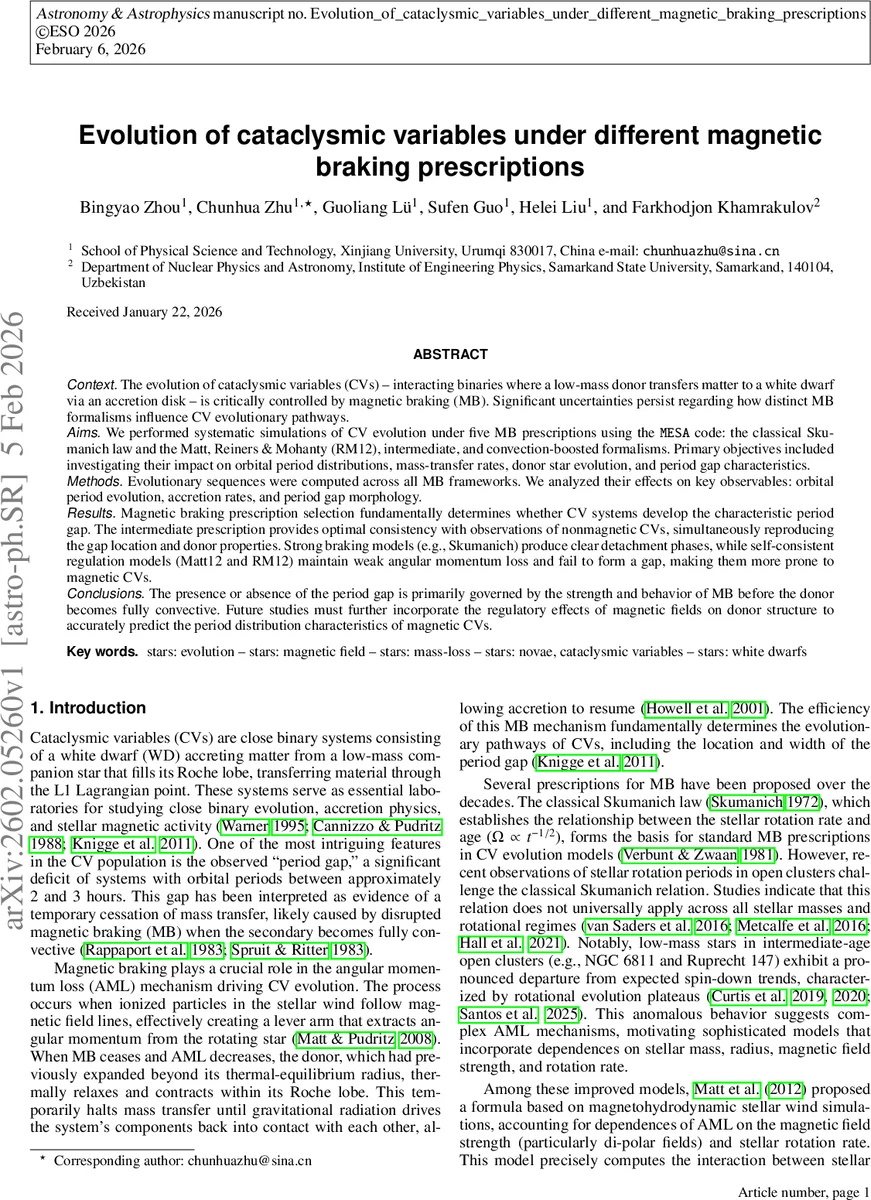
Context. The evolution of cataclysmic variables (CVs) - interacting binaries where a low-mass donor transfers matter to a white dwarf via an accretion disk - is critically controlled by magnetic braking (MB). Significant uncertainties persist regarding how distinct MB formalisms influence CV evolutionary pathways. Aims. We performed systematic simulations of CV evolution under five MB prescriptions using the MESA code: the classical Skumanich law and the Matt, Reiners & Mohanty (RM12), intermediate, and convection-boosted formalisms. Primary objectives included investigating their impact on orbital period distributions, mass-transfer rates, donor star evolution, and period gap characteristics. Methods. Evolutionary sequences were computed across all MB frameworks. We analyzed their effects on key observables: orbital period evolution, accretion rates, and period gap morphology. Results. Magnetic braking prescription selection fundamentally determines whether CV systems develop the characteristic period gap. The intermediate prescription provides optimal consistency with observations of nonmagnetic CVs, simultaneously reproducing the gap location and donor properties. Strong braking models (e.g., Skumanich) produce clear detachment phases, while self-consistent regulation models (Matt12 and RM12) maintain weak angular momentum loss and fail to form a gap, making them more prone to magnetic CVs. Conclusions. The presence or absence of the period gap is primarily governed by the strength and behavior of MB before the donor becomes fully convective. Future studies must further incorporate the regulatory effects of magnetic fields on donor structure to accurately predict the period distribution characteristics of magnetic CVs.
💡 Research Summary
**
This paper presents a systematic investigation of how different magnetic‑braking (MB) prescriptions affect the long‑term evolution of cataclysmic variables (CVs). Using the state‑of‑the‑art stellar‑evolution code MESA (version 15140), the authors compute binary evolution tracks for a grid of white‑dwarf (WD) masses (0.6–1.0 M⊙) and main‑sequence donor masses (0.6–1.2 M⊙) at solar metallicity. The donor is modeled with a full stellar structure that responds to Roche‑lobe overflow, while the WD is treated as a point mass. Mass transfer follows the exponential prescription of Ritter (1988) and is assumed to be fully non‑conservative: all transferred material is expelled from the vicinity of the WD via isotropic re‑emission, carrying away the specific orbital angular momentum of the accretor. Angular‑momentum loss (AML) includes contributions from gravitational‑wave radiation, mass‑loss, and magnetic braking.
Five MB formulations are implemented and compared:
- Skumanich law – the classic Ω³ R⁴ M scaling (γ_mb = 4) derived from the empirical spin‑down of solar‑type stars.
- Matt 2012 (Matt12) – an MHD‑based prescription that incorporates magnetic field strength, Rossby number, and a saturation term; calibrated constants K₁, K₂, and m control the lever‑arm length.
- Reiners & Mohanty 2012 (RM12) – a radius‑dominated model that emphasizes the weakening of MB when the donor becomes fully convective.
- Intermediate model (Van et al. 2019) – a phenomenological “middle‑ground” law obtained by moderating the power‑law exponents of the Skumanich relation.
- Boosted model – similar to the intermediate case but with stronger exponents, yielding a more aggressive AML.
The authors explore a broad parameter space, varying initial masses and orbital periods (all systems start at P ≈ 0.4 d). They compute the evolution of orbital period, mass‑transfer rate (Ṁ), and the donor’s mass‑radius relation, and compare the results with observational samples from the Sloan Digital Sky Survey, Gaia, and dedicated CV catalogs (e.g., Pala et al. 2020, 2022; Sarkar et al. 2024).
Key Findings
-
Period Gap Formation: Strong‑braking prescriptions (Skumanich and Boosted) drive the donor to expand well beyond its thermal equilibrium radius, leading to a detached phase when the donor’s convective envelope deepens and MB weakens. This produces a clear period gap between ≈2–3 h, matching the classic observational feature. The gap width and depth are somewhat larger than observed for the Boosted case, indicating an over‑efficient AML.
-
Intermediate Model: By reducing the MB strength relative to Skumanich but keeping it sufficiently high, the intermediate prescription reproduces the observed gap location (≈2.2–2.8 h) and width (≈0.5 h). It also yields donor mass‑radius relations and Ṁ values that align with the empirical distributions of non‑magnetic CVs. Hence, the intermediate law provides the best overall fit to the current data set.
-
Matt12 and RM12: Both prescriptions predict relatively weak AML before the donor becomes fully convective. Consequently, the donor never detaches; the system remains in contact throughout its evolution, and no period gap appears. The resulting Ṁ is modestly lower than in the strong‑braking cases but remains above the gravitational‑wave‑driven regime. This behavior is consistent with the evolutionary pathways expected for magnetic CVs (polars and intermediate polars), where strong WD magnetic fields can suppress the formation of a conventional accretion disk and alter AML.
-
Dependence on Initial Masses: For low‑mass donors (≤0.8 M⊙) all prescriptions converge because the donors are already largely convective, limiting the impact of MB. For more massive donors (≥1.0 M⊙) the differences become pronounced; the Skumanich and Boosted models generate higher Ṁ and earlier gap formation, while Matt12/RM12 maintain contact.
Limitations and Future Work
The study assumes a fixed magnetic field geometry and does not couple the donor’s dynamo evolution to the AML law, which is a crucial omission for magnetic CVs. The isotropic re‑emission model keeps the WD mass constant, ignoring possible WD mass growth and its feedback on the orbital evolution. Metallicity and initial rotation rate are held constant, whereas both are known to affect magnetic activity and wind properties. The authors suggest that incorporating a self‑consistent magnetic‑field evolution, allowing for partial mass retention by the WD, and performing Bayesian population synthesis against the ever‑growing Gaia‑CV catalog will be essential next steps.
Conclusion
The paper convincingly demonstrates that the choice of magnetic‑braking prescription fundamentally shapes CV evolutionary tracks, especially the existence and characteristics of the 2–3 hour period gap. Among the five models examined, the intermediate MB law offers the closest match to the observed properties of non‑magnetic CVs, while the weaker Matt12 and RM12 prescriptions naturally explain the absence of a gap in magnetic systems. This work provides a valuable benchmark for future theoretical and observational studies aiming to unravel the complex interplay between stellar magnetism, wind‑driven angular‑momentum loss, and binary evolution.
Comments & Academic Discussion
Loading comments...
Leave a Comment