Exterior sound field estimation based on physics-constrained kernel
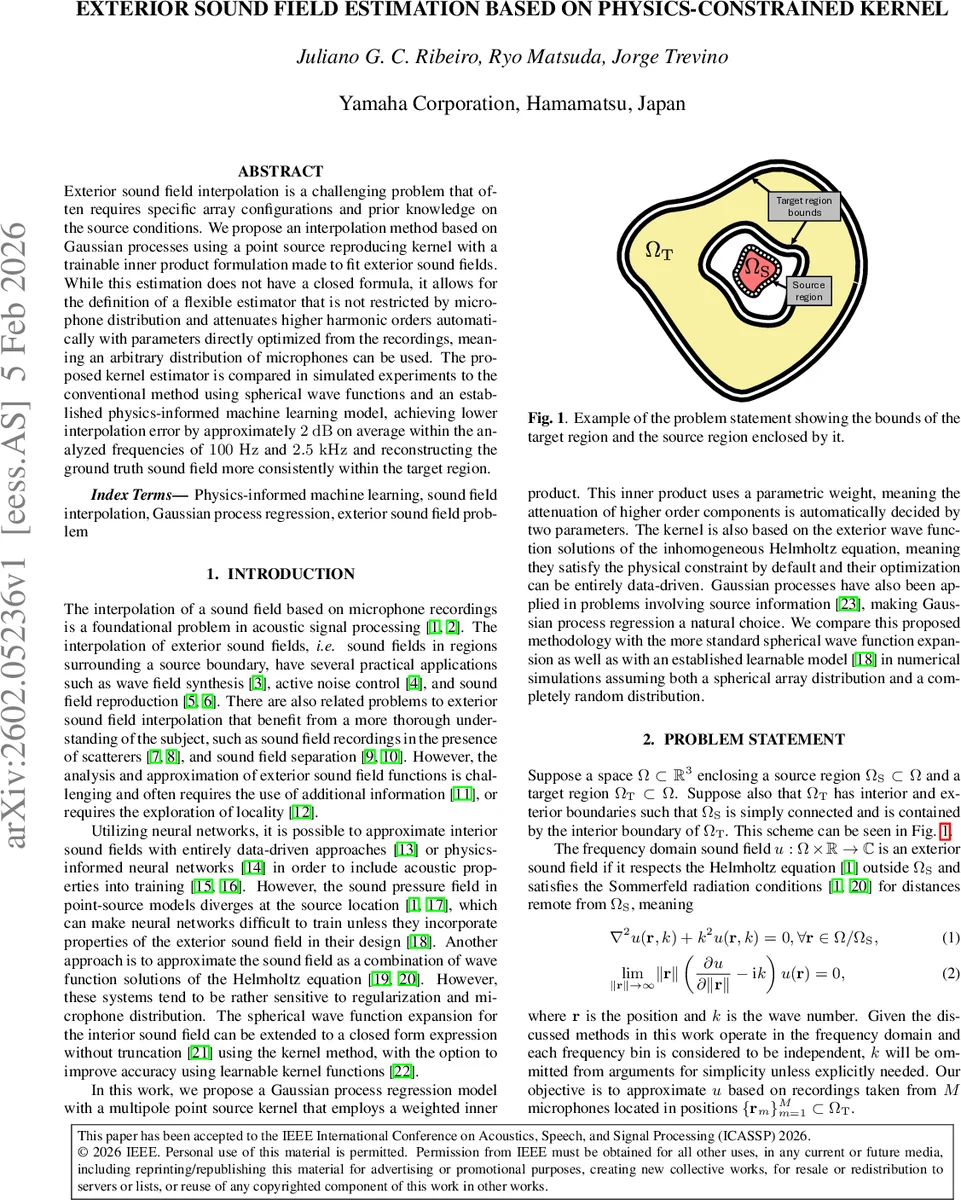
Exterior sound field interpolation is a challenging problem that often requires specific array configurations and prior knowledge on the source conditions. We propose an interpolation method based on Gaussian processes using a point source reproducing kernel with a trainable inner product formulation made to fit exterior sound fields. While this estimation does not have a closed formula, it allows for the definition of a flexible estimator that is not restricted by microphone distribution and attenuates higher harmonic orders automatically with parameters directly optimized from the recordings, meaning an arbitrary distribution of microphones can be used. The proposed kernel estimator is compared in simulated experiments to the conventional method using spherical wave functions and an established physics-informed machine learning model, achieving lower interpolation error by approximately 2 dB on average within the analyzed frequencies of 100 Hz and 2.5 kHz and reconstructing the ground truth sound field more consistently within the target region.
💡 Research Summary
The paper addresses the problem of interpolating exterior acoustic fields—sound pressure distributions that exist outside a source region and satisfy the Helmholtz equation together with Sommerfeld radiation conditions. Traditional approaches for this task either rely on spherical wave‑function (SWF) expansions or on physics‑informed neural networks such as the Point Neuron Network (PNN). The SWF method expands the field in a basis of outgoing spherical Hankel functions multiplied by spherical harmonics, truncating the series at an order limited by the number of microphones. This truncation makes the method sensitive to microphone placement and regularization, especially when the array is irregular. The PNN, on the other hand, learns a set of virtual point sources (centers) and associated complex weights, but the singular nature of point‑source Green’s functions makes training difficult unless the model explicitly incorporates the physics of exterior fields.
To overcome these limitations, the authors propose a Gaussian‑process‑based estimator that uses a physics‑constrained reproducing kernel. The kernel is built from the exact solutions of the inhomogeneous Helmholtz equation—specifically the product of spherical Hankel functions (h_\nu(k|r|)) and spherical harmonics (Y_\mu^\nu(\hat r)). Because the Hankel functions diverge at the origin, the authors introduce a radial weighting function \
Comments & Academic Discussion
Loading comments...
Leave a Comment