Existence and symmetry of extremals for the high order Hardy-Sobolev-Maz'ya inequalities
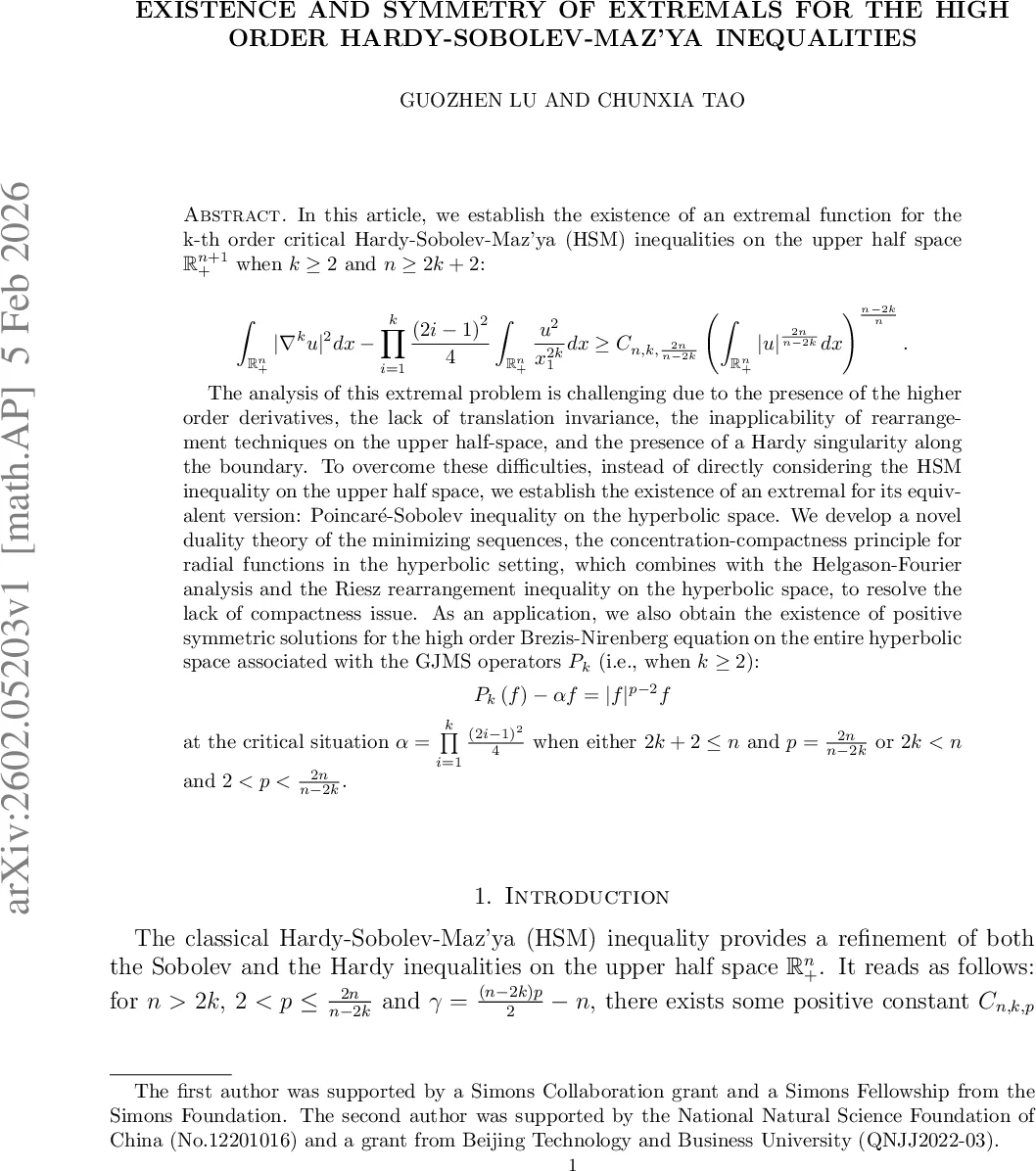
In this article, we establish the existence of an extremal function for the k-th order critical Hardy-Sobolev-Maz’ya (HSM) inequalities on the upper half space $\mathbb{R}^{n+1}{+}$ when $k\ge 2$ and $n\geq 2k+2$: $$\int{\mathbb{R}^{n}{+}}|\nabla^{k}u|^2dx-\prod{i=1}^{k}\frac{\left(2i-1\right)^2}{4}\int_{\mathbb{R}^{n}{+}}\frac{u^2}{x_1^{2k}}dx\geq C{n,k,\frac{2n}{n-2k}} \left(\int_{\mathbb{R}^{n}{+}}|u|^{\frac{2n}{n-2k}}dx\right)^{\frac{n-2k}{n}}. $$ The analysis of this extremal problem is challenging due to the presence of the higher order derivatives, the lack of translation invariance, the inapplicability of rearrangement techniques on the upper half-space, and the presence of a Hardy singularity along the boundary. To overcome these difficulties, instead of directly considering the HSM inequality on the upper half space, we establish the existence of an extremal for its equivalent version: Poincaré-Sobolev inequality on the hyperbolic space. We develop a novel duality theory of the minimizing sequences, the concentration-compactness principle for radial functions in the hyperbolic setting, which combines with the Helgason-Fourier analysis and the Riesz rearrangement inequality on the hyperbolic space, to resolve the lack of compactness issue. As an application, we also obtain the existence of positive symmetric solutions for the high order Brezis-Nirenberg equation on the entire hyperbolic space associated with the GJMS operators $P_k$ (i.e., when $k\ge 2$): $$ P{k}\left(f\right)-αf=|f|^{p-2}f $$ at the critical situation $α=\prod\limits_{i=1}^{k}\frac{\left(2i-1\right)^2}{4}$ when either $2k+2\leq n$ and $p=\frac{2n}{n-2k}$ or $2k<n$ and $2<p<\frac{2n}{n-2k}$.
💡 Research Summary
The paper addresses the long‑standing open problem of whether the optimal constant in the critical k‑th order Hardy‑Sobolev‑Maz’ya (HSM) inequality on the upper half‑space ℝⁿ₊ is attained, and if so, what the extremal function looks like. For orders k ≥ 2 and dimensions n ≥ 2k + 2, the authors prove the existence of a positive extremal and establish its radial symmetry. Direct methods fail because higher‑order derivatives destroy translation invariance and classical rearrangement techniques are unavailable on ℝⁿ₊. To circumvent these obstacles the authors transfer the problem to an equivalent Poincaré‑Sobolev inequality on the hyperbolic ball Bⁿ, where the GJMS operator Pₖ plays the role of the k‑th order differential operator.
The core of the analysis consists of several innovative steps. First, a duality framework is built for minimizing sequences of the functional associated with the hyperbolic inequality, allowing the authors to control concentration phenomena via the Helgason‑Fourier transform. Second, a concentration‑compactness principle is developed specifically for the hyperbolic setting. By constructing a radially decreasing minimizing sequence—using the hyperbolic Riesz rearrangement and a Polya‑Szegő‑type inequality—the authors rule out vanishing. To exclude dichotomy they exploit a quantitative relationship between the minimizing sequences for the Poincaré‑Sobolev inequality and those for a related integral inequality, together with the strict inequality C_{n,k,2*}<S_{n,k} (the HSM constant is strictly smaller than the k‑th order Sobolev constant when n ≥ 2k + 2).
These tools guarantee that a minimizing sequence is tight and converges strongly in the appropriate Sobolev space H(Bⁿ). The limit function f₀ attains the infimum, is positive, and depends only on the hyperbolic distance from a point P∈Bⁿ; thus it is radially symmetric and monotone decreasing about P. Pulling back to the half‑space via the conformal map yields an extremal u₀ for the original HSM inequality on ℝⁿ₊, again positive, radially symmetric about a boundary point, and monotone decreasing away from it.
As an application, the authors consider the high‑order Brezis‑Nirenberg equation on the whole hyperbolic space:
Pₖ(f) − αf = |f|^{p‑2}f, with α = ∏_{i=1}^{k}(2i‑1)²/4.
When either n ≥ 2k + 2 and p = 2n/(n‑2k) (critical case) or n > 2k and 2 < p < 2n/(n‑2k) (subcritical case), the existence of a positive, radially symmetric solution follows directly from the extremal result. This constitutes the first existence theorem for positive symmetric solutions of high‑order Brezis‑Nirenberg problems with the critical Hardy potential on the entire hyperbolic space.
In summary, the paper establishes the existence and symmetry of extremals for high‑order HSM inequalities, introduces a novel hyperbolic concentration‑compactness framework, and applies these findings to obtain new results for nonlinear elliptic equations involving GJMS operators and Hardy singularities. The techniques open avenues for further investigations on non‑compact manifolds, other conformally invariant operators, and boundary‑value problems with singular potentials.
Comments & Academic Discussion
Loading comments...
Leave a Comment