Local Cohomological Defect and a Conjecture of Mustata-Popa
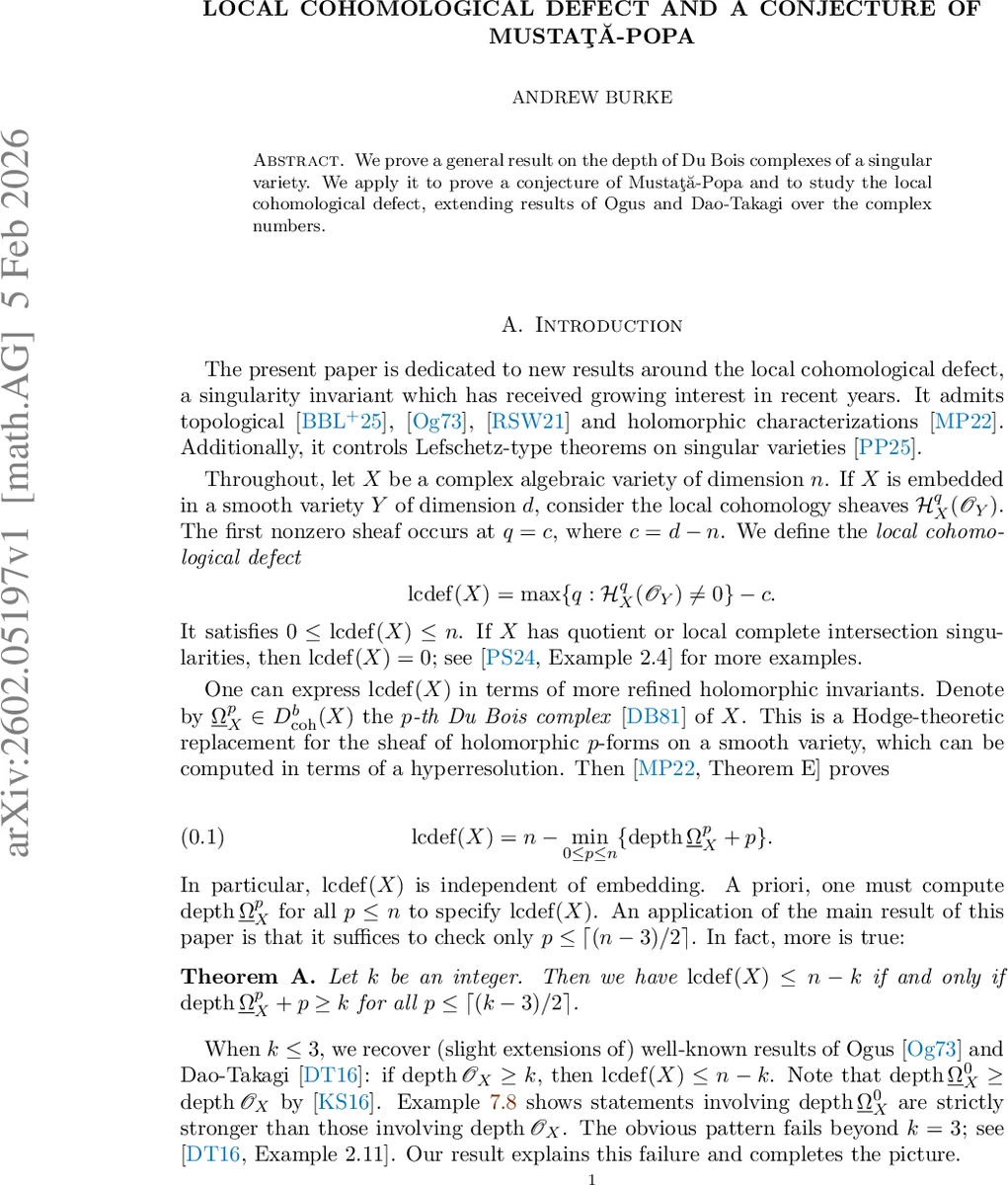
We prove a general result on the depth of Du Bois complexes of a singular variety. We apply it to prove a conjecture of Mustata-Popa and to study the local cohomological defect, extending results of Ogus and Dao-Takagi over the complex numbers.
💡 Research Summary
The paper studies the relationship between the depth of Du Bois complexes on a singular complex algebraic variety X and the so‑called local cohomological defect (lcdef), a numerical invariant measuring the failure of the first non‑vanishing local cohomology sheaf to appear at the expected codimension. For an embedding X⊂Y with dim Y=d and dim X=n, the defect is defined as lcdef(X)=max{q : H⁽q⁾X(O_Y)≠0}−(d−n). Earlier work showed that lcdef(X)=0 for quotient or local complete‑intersection singularities, and that lcdef can be expressed via Du Bois complexes by the formula lcdef(X)=n−min{0≤p≤n}{depth Ω^p_X + p}.
The main contributions are twofold. First, the authors prove a general depth theorem for Du Bois complexes (Theorem B). It states that if depth Ω^p_X + p≥k for all p≤m, then the same inequality automatically holds for all p≥k−m−2. Consequently, to verify the inequality for all p it suffices to check it only up to ⌈(k−3)/2⌉. This refines earlier results of Ogus (k≤3) and Dao‑Takagi (isolated singularities) and explains why the pattern breaks down for larger k.
Second, they apply this depth theorem to settle a conjecture of Mustata‑Popa (Conjecture C). The conjecture predicts that depth O_X≥j+2 forces the vanishing of a certain higher direct image sheaf, which is equivalent to depth Ω^j_X≥2. By taking m=0 in Theorem B they obtain the stronger statement: depth Ω⁰_X≥j+2 ⇒ depth Ω^j_X≥2. This covers all previously known cases (isolated singularities, rational singularities off a finite set) and removes the need for any embedding‑independent hypotheses.
The paper also introduces a family of invariants called p‑defects, pdef(X,d), defined as the largest index where the d‑th perversity truncation of the dual of the constant Hodge module has non‑zero cohomology. The extreme cases are pdef(X,0)=cdef(X) (the constructible defect) and pdef(X,n)=lcdef(X). Using these, Theorem F gives a precise criterion for lcdef(X)≤n−k in terms of depth Ω^p_X for p≤m together with a bound on pdef(X,k−2m−4). This unifies and extends results of Dao‑Takagi (torsion Picard groups) and Park‑Popa (bounds for k=5).
Technical tools include Saito’s identification of Du Bois complexes with graded de Rham pieces of the trivial Hodge module QH_X, the theory of mixed Hodge modules (weights, filtrations, duality), and a new abstract vanishing statement (Proposition 6.5) for graded de Rham pieces. The authors also give a direct proof (Theorem 7.1) of the equivalence between the topological and holomorphic definitions of lcdef, answering a question raised in Mustata‑Popa’s earlier work.
Overall, the paper provides a powerful new framework for controlling local cohomological defects via partial depth information of Du Bois complexes, resolves the Mustata‑Popa conjecture in full generality, and introduces the p‑defect hierarchy as a refined measure of singularity complexity. These results are likely to have further applications in the study of singularities, Hodge theory, and birational geometry.
Comments & Academic Discussion
Loading comments...
Leave a Comment