Electromagnetic Response of a Half-Filled Chern Band near Topological Criticality
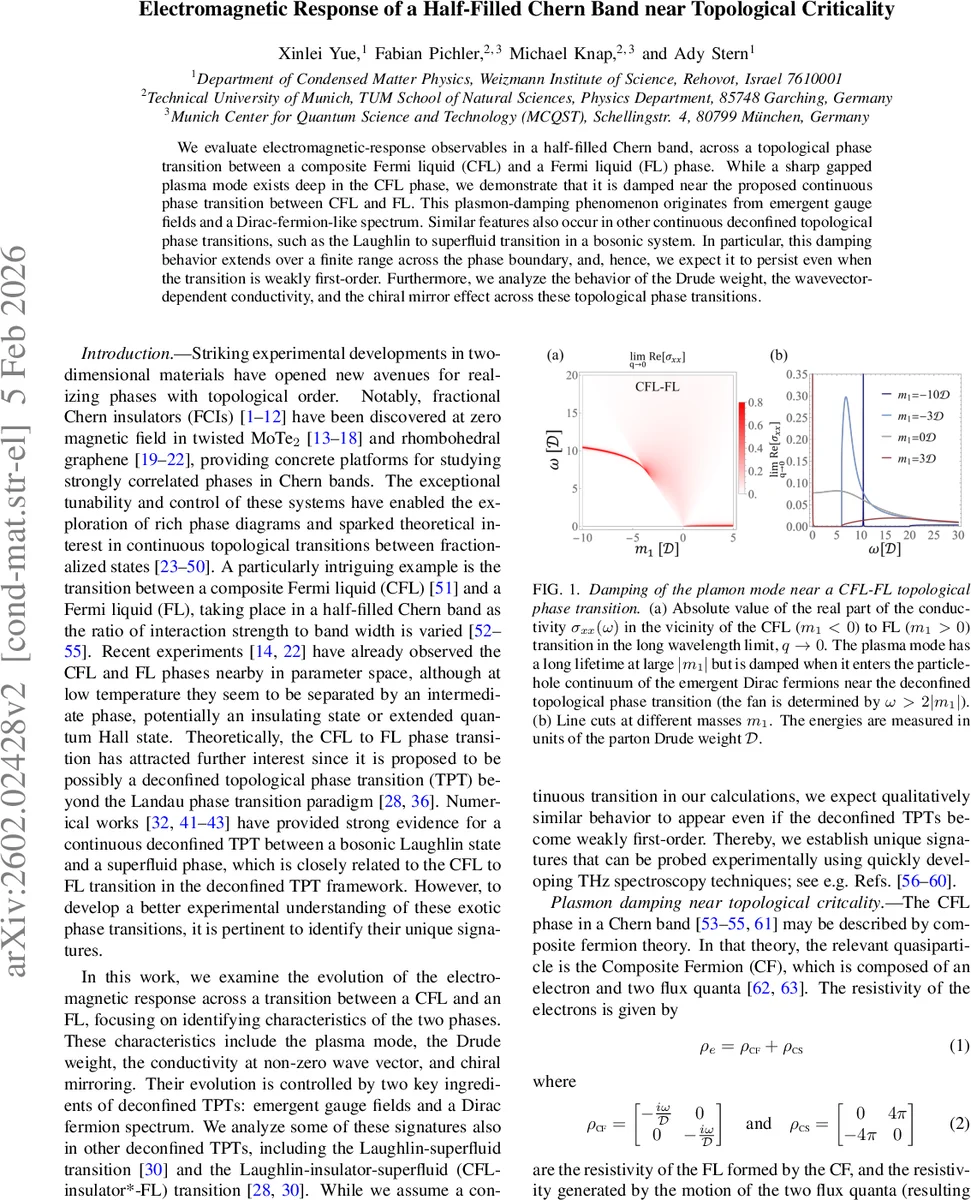
We evaluate electromagnetic-response observables in a half-filled Chern band, across a topological phase transition between a composite Fermi liquid (CFL) and a Fermi liquid (FL) phase. While a sharp gapped plasma mode exists deep in the CFL phase, we demonstrate that it is damped near the proposed continuous phase transition between CFL and FL. This plasmon-damping phenomenon originates from emergent gauge fields and a Dirac-fermion-like spectrum. Similar features also occur in other continuous deconfined topological phase transitions, such as the Laughlin to superfluid transition in a bosonic system. In particular, this damping behavior extends over a finite range across the phase boundary, and, hence, we expect it to persist even when the transition is weakly first-order. Furthermore, we analyze the behavior of the Drude weight, the wavevector-dependent conductivity, and the chiral mirror effect across these topological phase transitions.
💡 Research Summary
This paper investigates the electromagnetic response of a half‑filled Chern band as it undergoes a topological phase transition (TPT) between a composite Fermi liquid (CFL) and a conventional Fermi liquid (FL). The authors place the transition within the framework of a deconfined quantum critical point, where emergent gauge fields and Dirac‑fermion‑like excitations dominate the low‑energy physics.
Model and methodology – The electron is fractionalized into three partons: a composite fermion f that carries the physical charge, and two neutral partons d₁ and d₂ that represent the two flux quanta attached to the electron in the standard CFL picture. Each neutral parton fills a Chern band with Chern numbers C₁ and C₂, respectively, and couples to its own emergent gauge field (aμ for d₁, bμ for d₂). The physical electron resistivity follows the Ioffe‑Larkin rule ρₑ = ρ_CF + ρ₁ + ρ₂, where ρ_CF is the resistivity of the f‑fermions and ρ₁, ρ₂ are the resistivity tensors of the filled Chern bands. In the CFL phase C₁ = C₂ = +1, while in the FL phase C₁ = −C₂ = +1, so the total Chern number changes by two across the transition.
Critical theory – Near the transition the gap of one neutral parton (chosen to be d₁) closes. Its low‑energy description is that of two massive Dirac fermions with a common mass m₁. The sign of m₁ distinguishes the two phases: m₁ < 0 corresponds to the CFL, m₁ > 0 to the FL, and m₁ = 0 is the critical point. Integrating out the massive Dirac fermions generates a Chern‑Simons term plus a Maxwell term for the emergent gauge fields, which in turn modify the electron conductivity.
Plasmon behavior – In the deep CFL regime the electron plasma mode is gapped at ωₚ = 4πD, where D is the Drude weight of the composite fermions. This “gapped plasmon” coexists with a vanishing electronic Drude weight (Dₑ → 0). In the FL side the plasma mode is gapless with a √q dispersion. As m₁ approaches zero the Dirac partons become gapless, providing a particle‑hole continuum that overlaps the plasmon frequency. Consequently the plasmon acquires a finite lifetime and its spectral weight broadens. The authors show, via explicit calculations of σₓₓ(ω) at q → 0, that the sharp peak present for large |m₁| disappears already for |m₁| ≲ πD and becomes completely overdamped at the critical point. Importantly, this damping persists over a finite window of m₁, implying that even a weakly first‑order transition would retain observable plasmon broadening.
Drude weight and q‑dependent conductivity – The electronic Drude weight evolves continuously: Dₑ = 0 in the CFL, rises as Dₑ ≈ D + Δ₁⁻¹ when m₁ > 0, and matches the composite‑fermion Drude weight deep in the FL. Moreover, the longitudinal conductivity at finite wavevector displays the hallmark CFL scaling Re σₓₓ ∝ q for a range of frequencies (16π²(q/k_F)³ < ω/D < 4πq/k_F). Near the transition the Dirac gap shrinks, the particle‑hole continuum opens at lower q, and the linear‑in‑q regime shrinks dramatically, providing another experimental signature of the critical point.
Chiral mirror (optical) effect – If the composite‑fermion band carries a non‑zero Berry curvature, the CF Hall conductance σ_CF,xy is finite. The electron resistivity tensor then has a determinant that vanishes at a frequency ω₀ = D/σ_CF,xy. At ω₀ the conductivity matrix has a zero eigenvalue, leading to perfect transmission for one circular polarization (the “chiral mirror” effect) and total reflection for the opposite handedness. The frequency ω₀ varies smoothly across the transition because it depends only on the f‑parton sector, which remains regular.
Indirect transitions and the “insulator” phase* – The authors also discuss scenarios where the Chern number of d₁ changes via an intermediate C = 0 state, which requires breaking translational symmetry (unit‑cell doubling). In this insulating* phase the neutral parton’s resistivity diverges, rendering the charge conductivity zero, while the f‑fermions remain gapless and transport heat. Because the two Dirac masses can differ (m₁′ ≠ m₁″), two distinct plasma modes appear on either side of the insulator*–FL transition, yet both exhibit the same damping mechanism.
Extension to bosonic deconfined TPTs – The same formalism applies to a half‑filled bosonic Chern band undergoing a Laughlin (ν = 1/2) to superfluid transition. Here the boson is fractionalized into two fermionic partons d₁, d₂. When both are in C = +1 insulating states the system is a bosonic Laughlin state; when they become gapless the system becomes a superfluid. The plasma mode again softens and broadens near the critical point, confirming that plasmon damping is a universal hallmark of deconfined topological criticality.
Experimental relevance – The paper emphasizes that the predicted signatures—plasmon broadening, Drude‑weight evolution, q‑linear conductivity, and chiral‑mirror transmission—are accessible with modern terahertz (THz) spectroscopy and momentum‑resolved optical probes. Because the damping persists over a finite parameter range, it should be observable even if the idealized continuous transition is replaced by a weakly first‑order crossover in real materials such as twisted MoTe₂ or rhombohedral graphene.
In summary, the work provides a comprehensive theoretical description of how emergent gauge fields and Dirac‑type parton excitations reshape the electromagnetic response across a deconfined CFL‑FL transition, and it identifies several robust, experimentally testable fingerprints of topological criticality.
Comments & Academic Discussion
Loading comments...
Leave a Comment