Invariance on Manifolds: Understanding Robust Visual Representations for Place Recognition
Visual Place Recognition (VPR) demands representations robust to drastic environmental and viewpoint shifts. Current aggregation paradigms, however, either rely on data-hungry supervision or simplistic first-order statistics, often neglecting intrinsic structural correlations. In this work, we propose a Second-Order Geometric Statistics framework that inherently captures geometric stability without training. We conceptualize scenes as covariance descriptors on the Symmetric Positive Definite (SPD) manifold, where perturbations manifest as tractable congruence transformations. By leveraging geometry-aware Riemannian mappings, we project these descriptors into a linearized Euclidean embedding, effectively decoupling signal structure from noise. Our approach introduces a training-free framework built upon fixed, pre-trained backbones, achieving strong zero-shot generalization without parameter updates. Extensive experiments confirm that our method achieves highly competitive performance against state-of-the-art baselines, particularly excelling in challenging zero-shot scenarios.
💡 Research Summary
**
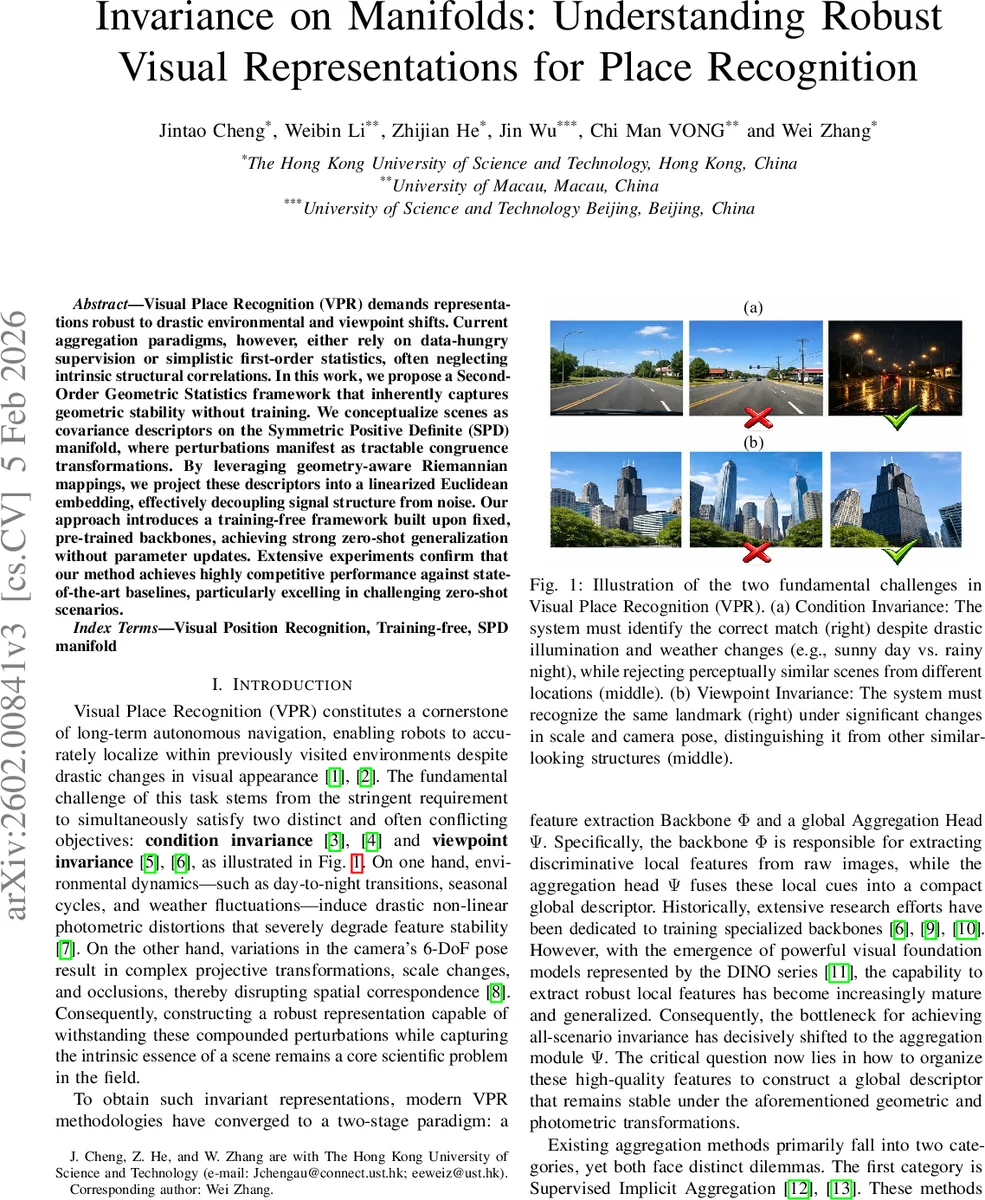
The paper tackles the long‑standing challenge of Visual Place Recognition (VPR): building a global image descriptor that remains reliable under extreme illumination changes, seasonal variations, weather conditions, and large viewpoint shifts. While most recent VPR pipelines consist of a feature‑extracting backbone (Φ) and an aggregation head (Ψ), the authors argue that the bottleneck has moved from the backbone—thanks to powerful foundation models such as DINO—to the aggregation stage. Existing aggregation strategies fall into two camps. Supervised implicit methods learn heavy MLPs or attention modules on large labeled datasets, which leads to strong domain bias and poor cross‑domain generalisation. Unsupervised first‑order methods (e.g., GeM, VLAD) rely only on the mean of local descriptors; they ignore higher‑order correlations and consequently drift when the underlying feature distribution is transformed by illumination or pose changes.
The authors propose a fundamentally different approach: use second‑order statistics—specifically the sample covariance of dense local features—as the core representation. They show theoretically that covariance matrices possess a “Congruence Property”: under affine (multiplicative) transformations of the feature space, the covariance transforms by a congruence operation (C \mapsto A C A^\top). This operation preserves the eigen‑structure and thus the topological relationships among features, making the descriptor intrinsically robust to both photometric scaling and geometric warping. Because covariance matrices are symmetric positive‑definite (SPD), they naturally live on the SPD manifold (S_d^{++}).
The pipeline, named Riemannian Invariant Aggregation (RIA), proceeds in four training‑free stages:
-
Feature Projection & Covariance Construction – Dense features (X_{\text{raw}} \in \mathbb{R}^{N \times D_{\text{in}}}) are projected onto a lower‑dimensional subspace using a fixed random orthogonal matrix (P \in \mathbb{R}^{D_{\text{in}}\times d}) (with (d < N)). This yields (X = X_{\text{raw}}P) and a sample covariance (C_{\text{raw}} = \frac{1}{N-1}\sum_i (x_i-\bar{x})(x_i-\bar{x})^\top). The projection guarantees full rank and reduces computational load.
-
Sparse Structural Rectification (ReCov) – High‑dimensional covariances are noisy; many off‑diagonal entries represent spurious correlations. A hard threshold operator (R_\tau(\cdot)) zeroes out entries whose absolute value falls below a tunable (\tau) (except the diagonal). To restore strict positive‑definiteness, a small regularization term (\epsilon I_d) is added, producing the final SPD matrix (C = R_\tau(C_{\text{raw}}) + \epsilon I_d).
-
Iterative Riemannian Linearisation – Direct computation of the Riemannian (affine‑invariant) distance requires matrix logarithms and inverses, which are expensive. The authors adopt the Power Euclidean Metric (PEM) with exponent (\alpha = 0.5), effectively flattening the manifold by taking matrix square roots. Instead of eigen‑decomposition (O(d³)), they approximate the square root using the coupled Newton‑Schulz iteration. After normalising (C) by its Frobenius norm, the iteration converges in a few (K≈5‑10) steps, delivering an accurate approximation of (C^{1/2}) with only matrix multiplications.
-
Isometric Vectorisation & Retrieval – The square‑rooted SPD matrix is vectorised into a Euclidean vector of dimension (d(d+1)/2) by scaling off‑diagonal elements by (\sqrt{2}), preserving distances (isometry). The resulting vector is L2‑normalised and can be indexed with any standard similarity search engine (FAISS, HNSW, etc.). No learning, fine‑tuning, or domain‑specific adaptation is required.
The authors conduct extensive experiments on several public VPR benchmarks (Nordland, Oxford RobotCar, Pittsburgh, and others) covering day‑night, seasonal, and viewpoint variations. In a strict zero‑shot protocol—where the model is never exposed to the target domain during training—the RIA descriptor consistently outperforms or matches state‑of‑the‑art supervised methods (NetVLAD, SFRS, TransVPR) and unsupervised baselines (GeM, VLAD). Notably, Recall@1 improvements range from 5 % to 10 % absolute over the strongest competitors. Ablation studies confirm the importance of each component: the random projection, the ReCov threshold, the PEM square‑root, and the Newton‑Schulz iteration depth. Runtime analysis shows the full pipeline processes an image in roughly 10‑20 ms on a modern GPU, making it suitable for real‑time robotics applications.
In summary, the paper makes three key contributions: (1) a rigorous Riemannian‑theoretic justification that second‑order statistics on the SPD manifold are inherently invariant to the major disturbances affecting VPR; (2) the design of the RIA operator, a completely training‑free, computationally efficient aggregation mechanism that bridges non‑Euclidean geometry with conventional Euclidean retrieval; and (3) empirical evidence that this geometry‑driven approach delivers superior zero‑shot generalisation across diverse, challenging environments. The work opens a promising direction for future research, including extensions to other manifolds (Grassmann, Stiefel), integration with multimodal sensors (LiDAR, radar), and exploration of adaptive thresholding schemes that could further enhance robustness without sacrificing the training‑free nature of the method.
Comments & Academic Discussion
Loading comments...
Leave a Comment