Toward the noncommutative minimal model program for Fano varieties
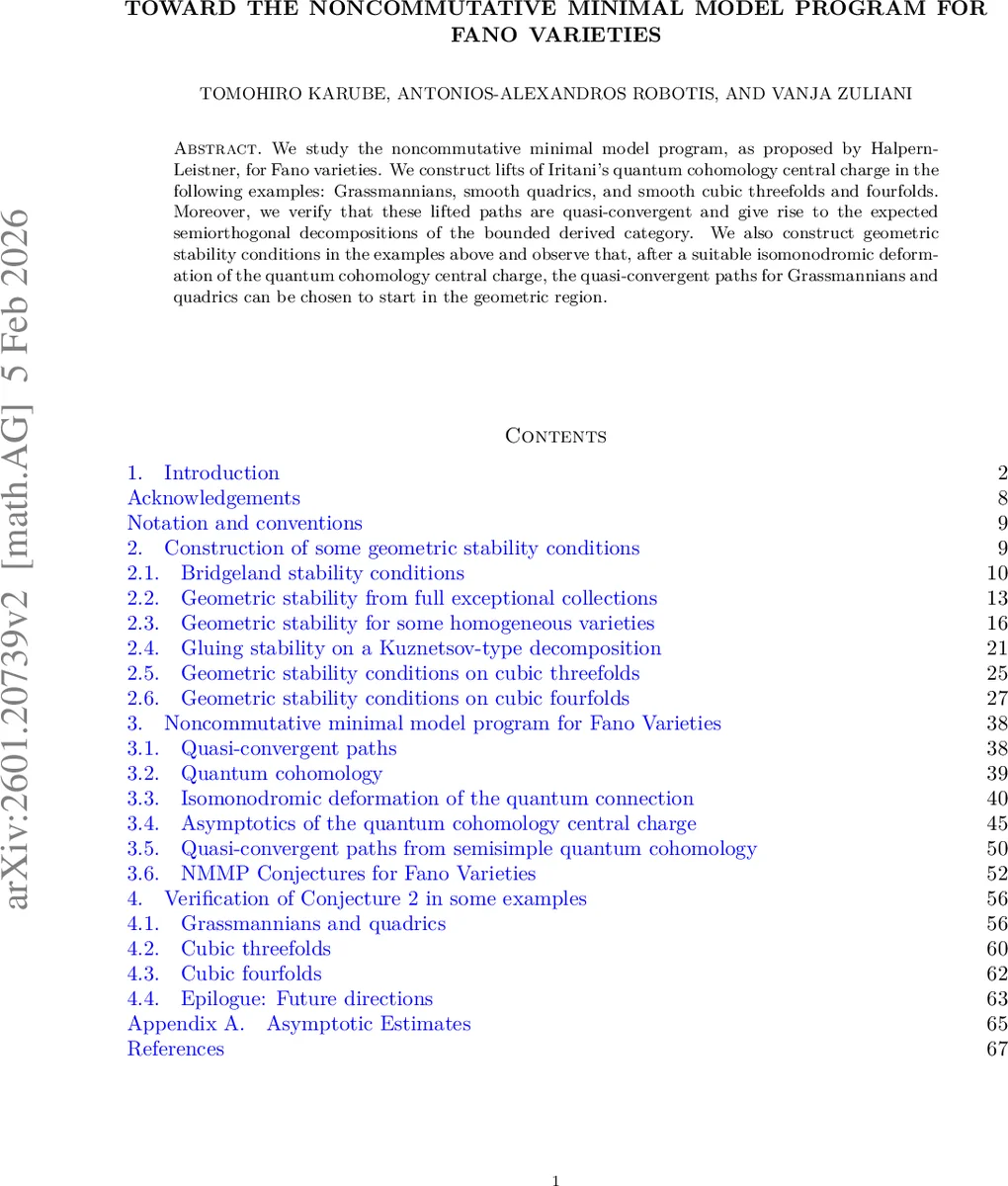
We study the noncommutative minimal model program, as proposed by Halpern-Leistner, for Fano varieties. We construct lifts of Iritani’s quantum cohomology central charge in the following examples: Grassmannians, smooth quadrics, and smooth cubic threefolds and fourfolds. Moreover, we verify that these lifted paths are quasi-convergent and give rise to the expected semiorthogonal decompositions of the bounded derived category. We also construct geometric stability conditions in the examples above and observe that, after suitable isomonodromic deformation of the quantum cohomology central charge, the quasi-convergent paths for Grassmannians and quadrics can be chosen to start in the geometric region.
💡 Research Summary
This paper develops the non‑commutative minimal model program (NMMP) for smooth Fano varieties, following the framework introduced by Halpern‑Leistner. The authors focus on constructing lifts of Iritani’s quantum cohomology central charge to Bridgeland stability conditions on the derived category D^b(X) and on proving that the resulting paths are quasi‑convergent, thereby producing the expected semi‑orthogonal decompositions (SODs). The main examples treated are Grassmannians, smooth quadric hypersurfaces, and smooth cubic threefolds and fourfolds.
The work is organized into four major parts. The introductory section explains the NMMP philosophy: a contraction f : X → Y (with Y a point in the Fano case) should correspond to a canonical SOD of D^b(X) obtained from a family of stability conditions whose central charges solve the quantum differential equation (QDE) of X. The authors recall Bridgeland’s deformation theorem, which reduces the problem of deforming a stability condition to deforming its central charge, and they introduce the quantum connection ∇_τ on the trivial H^(X)‑bundle. The Euler operator E_τ = c_1(X) in the small quantum cohomology locus plays a crucial role; its eigenvalues determine a decomposition of H^(X) into subspaces A_λ, which are expected to lift to categorical pieces D_λ in the SOD.
Section 2 constructs geometric stability conditions in several new settings. Using full exceptional collections on Grassmannians and quadrics, together with the gluing technique of Collins‑Polishchuk, the authors produce stability conditions whose central charges factor through the algebraic cohomology H^*_{alg}(X). They extend these methods to weighted projective stacks and Hilbert schemes of points on ℙ^2 and ℙ^1 × ℙ^1, obtaining “almost geometric” stability conditions. For cubic threefolds and fourfolds (the latter without a plane), they adapt Kuznetsov‑type semi‑orthogonal decompositions and prove the existence of genuine geometric stability conditions, with central charges factoring through K_0 → K_0^{top}.
Section 3 connects the quantum side to stability conditions. After reviewing the QDE and its irregular singularity at w = 0, the authors define the fundamental solution Φ_{τ,w} and the associated central charge Z_{τ,w} = (2πw)^{dim X/2} Z_X Φ_{τ,w}. They then lift Z_{τ,w} to a family σ_{τ,w} of stability conditions on a sector S ⊂ ℂ^*. The path w = t e^{iφ} (t > 0) yields σ_{τ,t,φ}, which they prove is quasi‑convergent as t → 0. The limiting behavior of Im log Z_{τ,t,φ}(E) for objects E determines the SOD D^b(X)=⟨D_λ⟩_{λ∈|σ(E_τ)|}, with the ordering dictated by the imaginary parts of the eigenvalues of the Euler operator. The authors formulate three conjectures (A, B, C) that encapsulate the expected dependence on τ and φ, the mutation‑equivalence of the resulting SODs, and the existence of an isomonodromic deformation of the quantum connection that produces geometric stability conditions in a prescribed annulus.
Section 4 verifies these conjectures in the concrete examples. For Grassmannians and quadrics, the quantum cohomology is semisimple, the Gamma II conjecture holds, and the lifted paths reproduce the standard exceptional collections after mutation. For cubic threefolds and fourfolds, the quantum cohomology is not semisimple, yet the authors construct explicit isomonodromic deformations and show that the lifted paths still yield the Kuznetsov component as one of the SOD factors. They also demonstrate that after a suitable isomonodromic deformation, the quasi‑convergent paths for Grassmannians and quadrics can be chosen to start inside the geometric region, where all skyscraper sheaves are stable of the same phase.
The paper concludes with an epilogue outlining future directions, including extensions to higher‑dimensional Fano complete intersections, connections to Landau‑Ginzburg models via mirror symmetry, and potential applications to birational geometry through wall‑crossing in the stability manifold.
In summary, the authors achieve three major breakthroughs: (1) they provide the first systematic construction of geometric Bridgeland stability conditions for higher‑dimensional Fano varieties beyond projective space; (2) they establish a precise bridge between Iritani’s quantum cohomology central charge and paths in the stability manifold, including the role of isomonodromic deformations; and (3) they verify that these paths generate the semi‑orthogonal decompositions predicted by the NMMP, thereby giving concrete evidence that the non‑commutative minimal model program can be realized in the Fano setting.
Comments & Academic Discussion
Loading comments...
Leave a Comment