Tuning the strength of emergent correlations in a Brownian gas via batch resetting
We study a gas of $N$ diffusing particles on the line subject to batch resetting: at rate $r$, a uniformly random subset of $m$ particles is reset to the origin. Despite the absence of interactions, the dynamics generates a nonequilibrium stationary state (NESS) with long-range correlations. We obtain exact results, both for the NESS and for the time dependence of the correlations, which are valid for arbitrary $m$ and $N$. By varying $m$, the system interpolates between an uncorrelated regime ($m=1$) and the fully synchronous resetting case ($m=N$). For all $1<m<N$, correlations exhibit a non-monotonic time dependence due to the emergence of an intrinsic decorrelation mechanism. In the stationary state, the correlation strength can be tuned by varying $m$, and it displays a transition at a critical value $N_c=6$. Our predictions extend straightforwardly to any spatial dimension $d$ and the critical value $N_c=6$ remains the same in all dimensions. Our predictions are testable in existing experimental setups on optically trapped colloidal particles.
💡 Research Summary
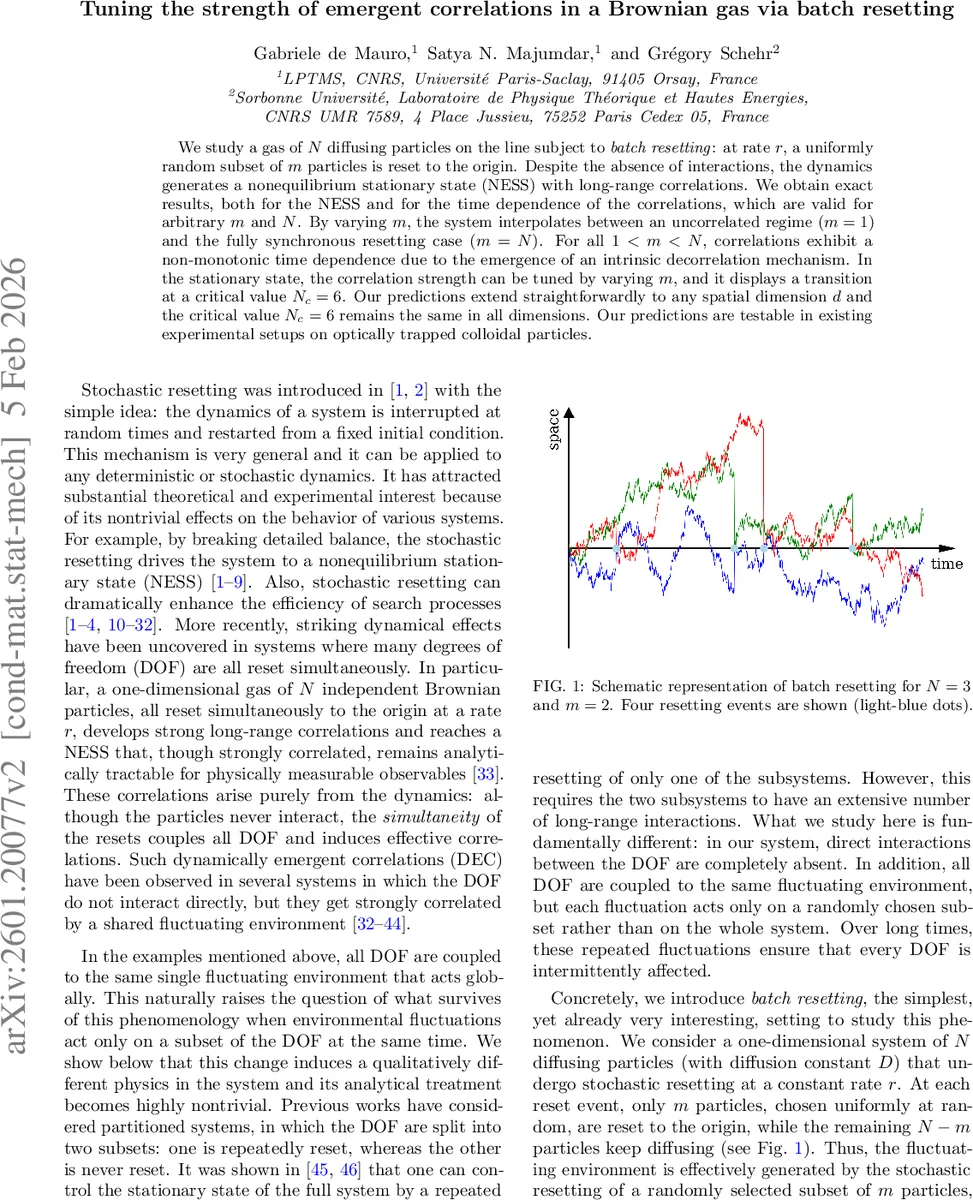
In this work the authors investigate a simple yet rich stochastic model of N independent Brownian particles on a line that are subjected to “batch resetting”. At a constant rate r, a resetting event occurs; during each event a uniformly random subset of exactly m particles is instantaneously placed at the origin, while the remaining N–m particles continue diffusing. The limiting cases m = 1 (single‑particle resetting) and m = N (full‑synchronised resetting) recover previously studied models, but the intermediate regime 1 < m < N had not been analytically explored.
Because only a fraction of the particles are reset at any given time, the system no longer possesses the renewal structure that makes the fully synchronised case tractable. To overcome this difficulty the authors formulate a Fokker–Planck equation for the joint probability density function (JPDF) in Fourier space. The equation reads
∂ₜ ˜Pₘ(k,t)=−D k² ˜Pₘ−r ˜Pₘ+r (N choose m)⁻¹ ∑{Sₘ} ˜P{N−m}(k_{S_c},t),
where Sₘ denotes a particular set of m particles that are reset, S_c its complement, and k_{S_c} is the wave‑vector with components belonging to Sₘ set to zero. This structure is hierarchical: the evolution of the m‑particle marginal involves only lower‑order marginals, allowing a recursive solution.
In the stationary state the time derivative vanishes, yielding a closed set of algebraic equations. Exact expressions are obtained for the one‑point marginal
˜P₁ᵐ(k)=1/(1+ℓₘ²k²), ℓₘ²=D/(r m/N),
and for the two‑point marginal
˜P₂ᵐ(k₁,k₂)=
Comments & Academic Discussion
Loading comments...
Leave a Comment