Perihelion Asymmetry in the Water Production Rate of the Interstellar Object 3I/ATLAS
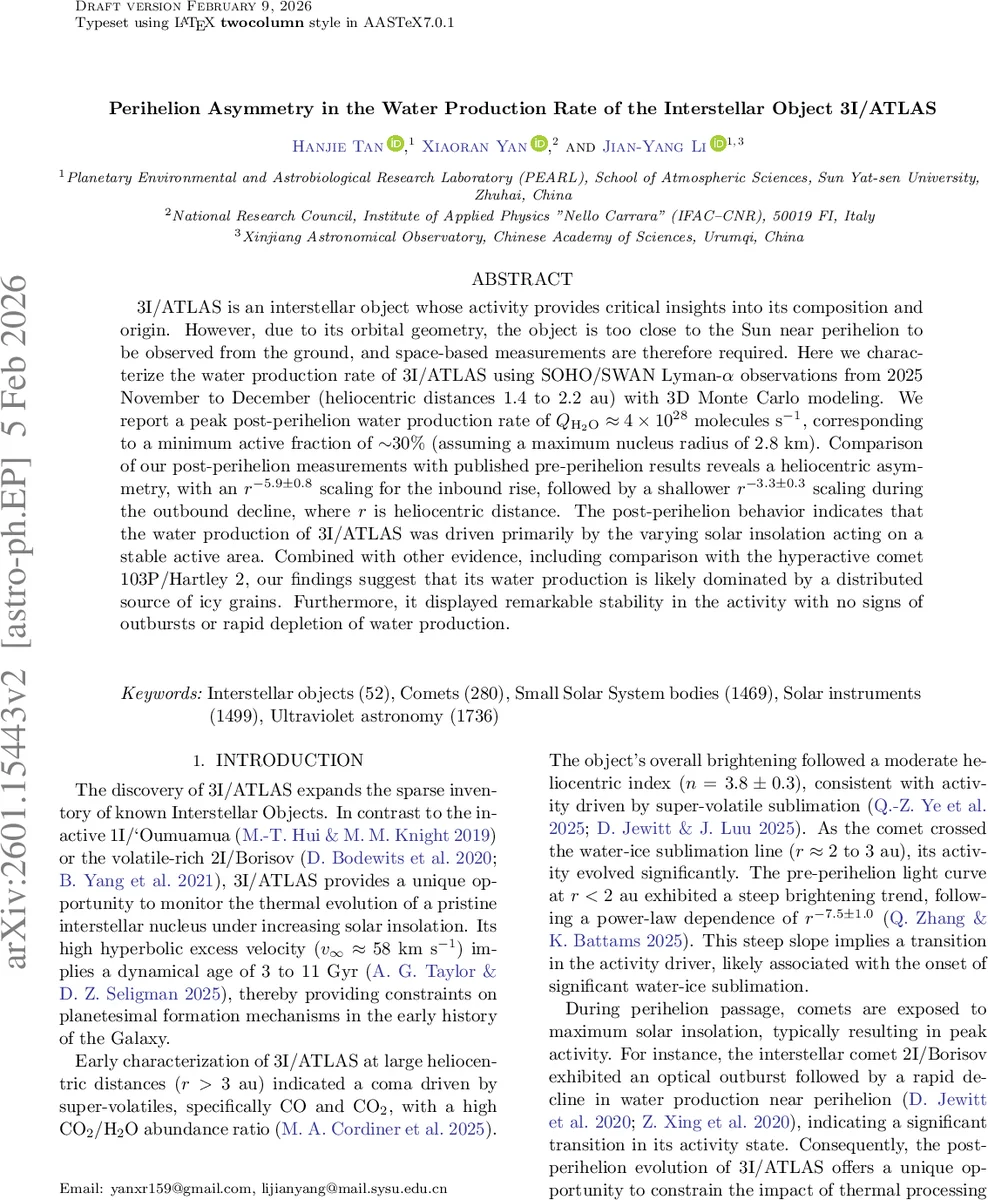
3I/ATLAS is an interstellar object whose activity provides critical insights into its composition and origin. However, due to its orbital geometry, the object is too close to the Sun near perihelion to be observed from the ground, and space-based measurements are therefore required. Here we characterize the water production rate of 3I/ATLAS using SOHO/SWAN Lyman-$α$ observations from 2025 November to December (heliocentric distances 1.4 to 2.2 au) with 3D Monte Carlo modeling. We report a peak post-perihelion water production rate of $Q_{\mathrm{H_2O}} \approx 4 \times 10^{28}$ molecules~s$^{-1}$, corresponding to a minimum active fraction of $\sim$30% (assuming a maximum nucleus radius of 2.8 km). Comparison of our post-perihelion measurements with published pre-perihelion results reveals a heliocentric asymmetry, with an $r^{-5.9 \pm 0.8}$ scaling for the inbound rise, followed by a shallower $r^{-3.3 \pm 0.3}$ scaling during the outbound decline, where $r$ is heliocentric distance. The post-perihelion behavior indicates that the water production of 3I/ATLAS was driven primarily by the varying solar insolation acting on a stable active area. Combined with other evidence, including comparison with the hyperactive comet 103P/Hartley 2, our findings suggest that its water production is likely dominated by a distributed source of icy grains. Furthermore, it displayed remarkable stability in the activity with no signs of outbursts or rapid depletion of water production.
💡 Research Summary
The paper presents a detailed investigation of the water production rate of the interstellar object 3I/ATLAS using space‑based observations from the SOHO/SWAN Lyman‑α instrument during the post‑perihelion interval of 2025 November–December, when the comet was at heliocentric distances of 1.4–2.2 au and inaccessible to ground‑based telescopes. Sixteen high‑quality full‑sky Lyman‑α maps were selected after rigorous filtering to remove contamination from interplanetary hydrogen, bright UV stars, instrumental noise, and spacecraft structures. A calibration factor of 1.28 was applied to account for a revised absolute sensitivity, and a conservative 25 % systematic uncertainty was adopted for the absolute flux calibration.
Water production rates were derived with a three‑dimensional, time‑dependent Monte Carlo Particle Trajectory Model (MCPTM). The model simulates the photodissociation chain H₂O → OH → H, incorporating excess velocities of 20 km s⁻¹ (first step) and 8 km s⁻¹ (second step), as well as realistic photochemical lifetimes (τ_H₂O ≈ 8.2 × 10⁴ s at 1 au, scaled as r²). The fluorescence efficiency (g‑factor) was computed for each observation using the high‑resolution solar Lyman‑α line profile, the Swings effect, and daily solar Lyman‑α irradiance from the LISIRD database. An iterative predictor‑corrector scheme was used to converge on Q_H₂O, propagating uncertainties from calibration, g‑factor, lifetimes, velocity distributions, aperture effects, and statistical noise, resulting in total uncertainties of 30–40 %.
The peak post‑perihelion water production rate was found to be Q_H₂O ≈ 4 × 10²⁸ molecules s⁻¹. Assuming the maximum nucleus radius of 2.8 km (constrained by HST imaging), the active fraction f_A is ≈ 0.30, corresponding to an effective active area of about 30 km². This high and stable active fraction indicates that a substantial portion of the water is released from a distributed source rather than directly from the nucleus surface.
By compiling pre‑perihelion water production measurements from Swift, Nan\cay, SPHEREx, JWST, and other facilities, the authors demonstrate a pronounced perihelion asymmetry. The inbound (pre‑perihelion) production follows a steep power law Q ∝ r⁻⁵·⁹ ± 0·⁸, while the outbound (post‑perihelion) decline follows a shallower Q ∝ r⁻³·³ ± 0·³. The post‑perihelion slope is consistent with the theoretical water‑ice sublimation rate scaling (Z_H₂O ∝ r⁻²·⁷), suggesting that after perihelion the activity is governed primarily by solar insolation acting on a relatively constant active area. The lack of any detected outbursts or rapid depletion further supports a stable, distributed source of icy grains, reminiscent of the hyperactive comet 103P/Hartley 2.
The discussion emphasizes that 3I/ATLAS, despite its high hyperbolic excess velocity (~58 km s⁻¹) and inferred dynamical age of 3–11 Gyr, exhibits water production behavior similar to hyperactive Solar System comets. This implies that interstellar planetesimals can retain abundant fine‑scale icy material capable of sustaining strong, long‑lasting activity. The findings have important implications for the composition and internal structure of interstellar objects and provide a benchmark for future space‑based monitoring of such bodies.
Comments & Academic Discussion
Loading comments...
Leave a Comment