Global stability of vacuum for the relativistic Vlasov-Maxwell-Boltzmann system
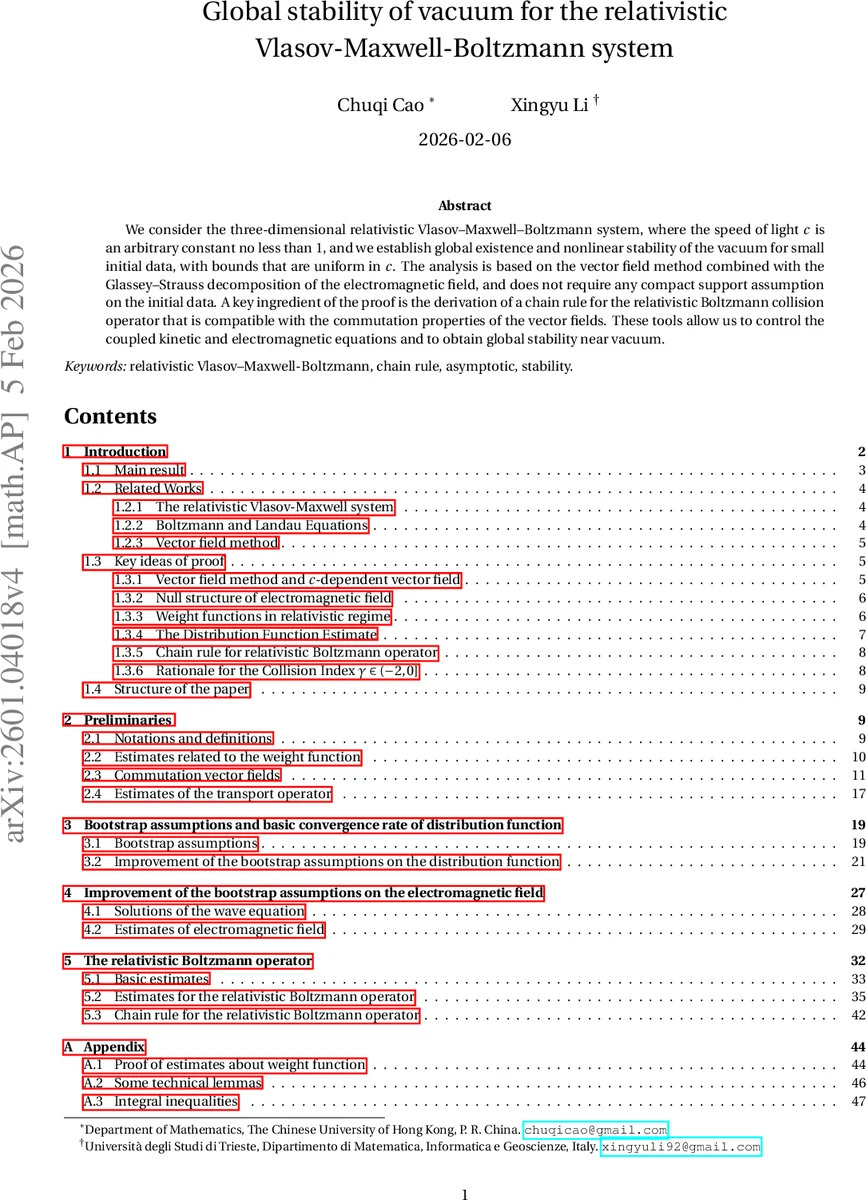
We consider the three-dimensional relativistic Vlasov-Maxwell-Boltzmann system, where the speed of light $c$ is an arbitrary constant no less than 1, and we establish global existence and nonlinear stability of the vacuum for small initial data, with bounds that are uniform in $c$. The analysis is based on the vector field method combined with the Glassey-Strauss decomposition of the electromagnetic field, and does not require any compact support assumption on the initial data. A key ingredient of the proof is the derivation of a chain rule for the relativistic Boltzmann collision operator that is compatible with the commutation properties of the vector fields. These tools allow us to control the coupled kinetic and electromagnetic equations and to obtain global stability near vacuum.
💡 Research Summary
The paper establishes the global existence and nonlinear stability of the vacuum for the three‑dimensional relativistic Vlasov‑Maxwell‑Boltzmann (RVMB) system with an arbitrary speed of light (c\ge 1). The authors consider small initial data measured in a weighted (L^\infty) norm with high spatial and velocity derivatives, without requiring compact support. Under these assumptions they prove that a unique global solution exists and satisfies optimal decay rates: the velocity moments of the distribution function decay like ((1+t+|x|)^{-3}) for multi‑indices up to order 18, while the electric and magnetic fields decay like ((1+t+|x|)^{-3}/(1+|t-|x|/c|)) (the magnetic field carries an extra factor of (c)).
The analysis hinges on three main technical ingredients. First, a vector‑field method adapted to the relativistic setting is employed. The authors introduce a family of differential operators (time and space translations, rotations, and Lorentz boosts) that commute with the transport part of the Vlasov equation and with the Maxwell equations up to controllable error terms. Importantly, the vector fields are chosen so that all estimates are uniform in (c), allowing a seamless passage to the non‑relativistic limit.
Second, the Glassey‑Strauss decomposition of the electromagnetic field is used to separate the radiative (wave) component from the Coulomb‑type component. By representing the wave part via Kirchhoff’s formula and exploiting its null structure, the authors obtain the sharp ((1+t+|x|)^{-3}) decay for the radiative field. The Coulomb part is controlled through weighted Sobolev estimates involving the charge and current densities generated by the distribution function.
Third, and most novel, the paper derives a chain‑rule identity for the relativistic Boltzmann collision operator: \
Comments & Academic Discussion
Loading comments...
Leave a Comment