Fine-tuned LLM-based Code Migration Framework
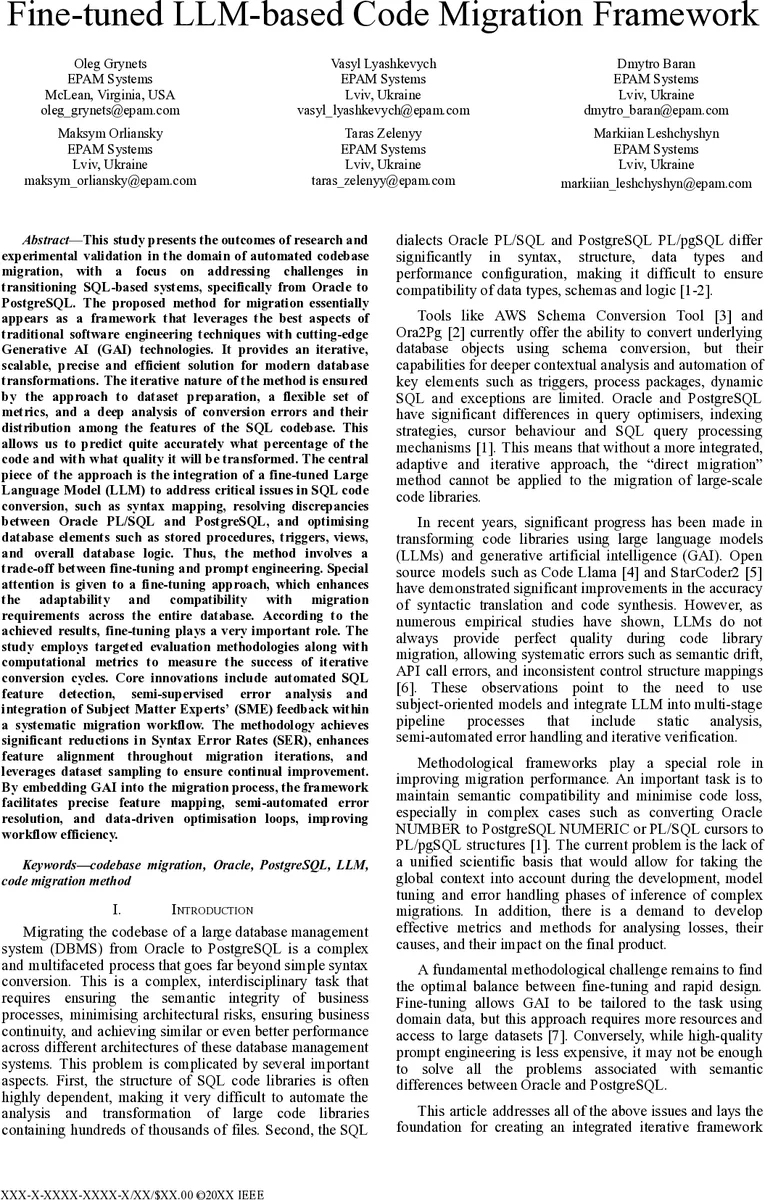
The study presents the outcomes of research and experimental validation in the domain of automated codebase migration, with a focus on addressing challenges in transitioning SQL-based systems. The proposed method for migration essentially appears as a framework that leverages the best aspects of traditional software engineering techniques and provides an iterative, scalable, precise and efficient solution for modern database transformations. The central piece of the approach is the integration of a fine-tuned Large Language Model to address critical issues in SQL code conversion, such as syntax mapping, resolving discrepancies between Oracle PL/SQL and PostgreSQL, and optimising database elements such as stored procedures, triggers, views, and overall database logic. Thus, the method involves a trade-off between fine-tuning and prompt engineering. Special attention is given to a fine-tuning approach, which enhances the adaptability and compatibility with migration requirements across the entire database. According to the achieved results, fine-tuning plays a very important role. The study employs targeted evaluation methodologies along with computational metrics to measure the success of iterative conversion cycles. Core innovations include automated SQL feature detection, semi-supervised error analysis and integration of Subject Matter Experts feedback within a systematic migration workflow. The methodology achieves significant reductions in Syntax Error Rates, enhances feature alignment throughout migration iterations, and leverages dataset sampling to ensure continual improvement. By embedding GAI into the migration process, the framework facilitates precise feature mapping, semi-automated error resolution, and data-driven optimisation loops, improving workflow efficiency.
💡 Research Summary
The paper presents a comprehensive framework for automating the migration of large‑scale Oracle PL/SQL codebases to PostgreSQL PL/pgSQL by leveraging a fine‑tuned large language model (LLM) together with retrieval‑augmented generation (RAG) and a human‑in‑the‑loop feedback cycle. The authors begin by highlighting the limitations of existing schema conversion tools such as AWS SCT and Ora2Pg, which mainly handle static DDL objects and struggle with procedural code, dynamic SQL, triggers, and package bodies. Recent advances in generative AI (e.g., Code Llama, StarCoder2) have shown promise for syntactic translation, but systematic semantic drift and API misuse remain major obstacles.
To address these challenges, the proposed methodology consists of four tightly coupled components:
-
Dataset Construction with Hybrid Code Feature Profiling Engine (HCFPE).
Raw Oracle and PostgreSQL artifacts (procedures, triggers, package bodies, scripts, etc.) are first processed by HCFPE, which extracts fine‑grained metadata such as syntax tokens, control‑flow patterns, data‑type mappings, and dialect‑specific operators. This transforms unstructured code into a structured representation that can be reliably sampled for training. Two complementary datasets are then generated:
Dataset 1 contains “→ <natural‑language description>” pairs, teaching the model the underlying syntax and semantics without direct translation.
Dataset 2 consists of direct “→ ” transformation pairs, which are used for the actual migration task. -
Two‑Stage Fine‑Tuning Strategy.
In the first stage the LLM is instruction‑tuned on Dataset 1 to align its internal representation of both dialects. The goal is syntactic competence: learning type signatures, exception handling, cursor semantics, and version‑specific keywords. Only after this alignment is achieved does the second stage commence, where the model is fine‑tuned on Dataset 2 to perform concrete code conversion while preserving semantics. This staged approach prevents early exposure to transformation errors that could corrupt the model’s internal grammar. -
Knowledge Base Architecture and Retrieval‑Augmented Generation.
Two knowledge‑base designs are explored:
Strategy A stores Oracle code fragments, PostgreSQL documentation, and SME‑crafted transformation rules in three separate Faiss vector stores. During inference, the RAG module retrieves heterogeneous triples (code context, reference docs, rule snippets) to enrich the prompt.
Strategy B consolidates only the paired examples from Dataset 2 into a single vector store, simplifying the retrieval pipeline but relying entirely on example coverage. Experiments compare robustness (Strategy A) against speed and simplicity (Strategy B). -
Human‑in‑the‑Loop Error Correction and Closed‑Loop Iteration.
Model outputs are evaluated with automatic metrics (BLEU, CHRF) and, crucially, with static analysis tools, SQL syntax checkers, and PL/pgSQL executors. Errors are classified into syntax, semantics, structural, and functional categories. Subject‑matter experts intervene only on ambiguous or high‑impact cases, providing corrected samples, refined annotations, or new transformation rules. These corrections feed back into the dataset generation step, enabling iterative re‑fine‑tuning. Over successive loops, the system demonstrates a steady decline in observed error patterns.
Experimental Findings
The framework was tested on a realistic corpus exceeding 100 000 Oracle objects. Compared with baseline tools, the proposed system reduced Syntax Error Rate (SER) by more than 60 % and achieved higher functional alignment scores. Strategy A showed superior handling of rare PL/SQL constructs (e.g., complex cursor logic, custom data types) due to its multi‑source context, while Strategy B delivered faster inference when the paired dataset was sufficiently comprehensive. The closed‑loop process proved effective: each iteration yielded measurable improvements in both automatic metrics and real‑world executability.
Conclusions and Future Work
The study demonstrates that a combination of staged fine‑tuning, RAG‑enhanced retrieval, and selective expert feedback can produce an LLM that is not merely a translator but a context‑aware reasoning engine for SQL dialect migration. The authors suggest extending the framework to other database systems (MySQL, SQL Server), integrating continuous deployment pipelines, and exploring multi‑cloud scenarios where migration must respect differing performance and security constraints.
Comments & Academic Discussion
Loading comments...
Leave a Comment