Sine laws on semigroups with an involutive anti-automorphism: A Levi--Civita approach via left translations
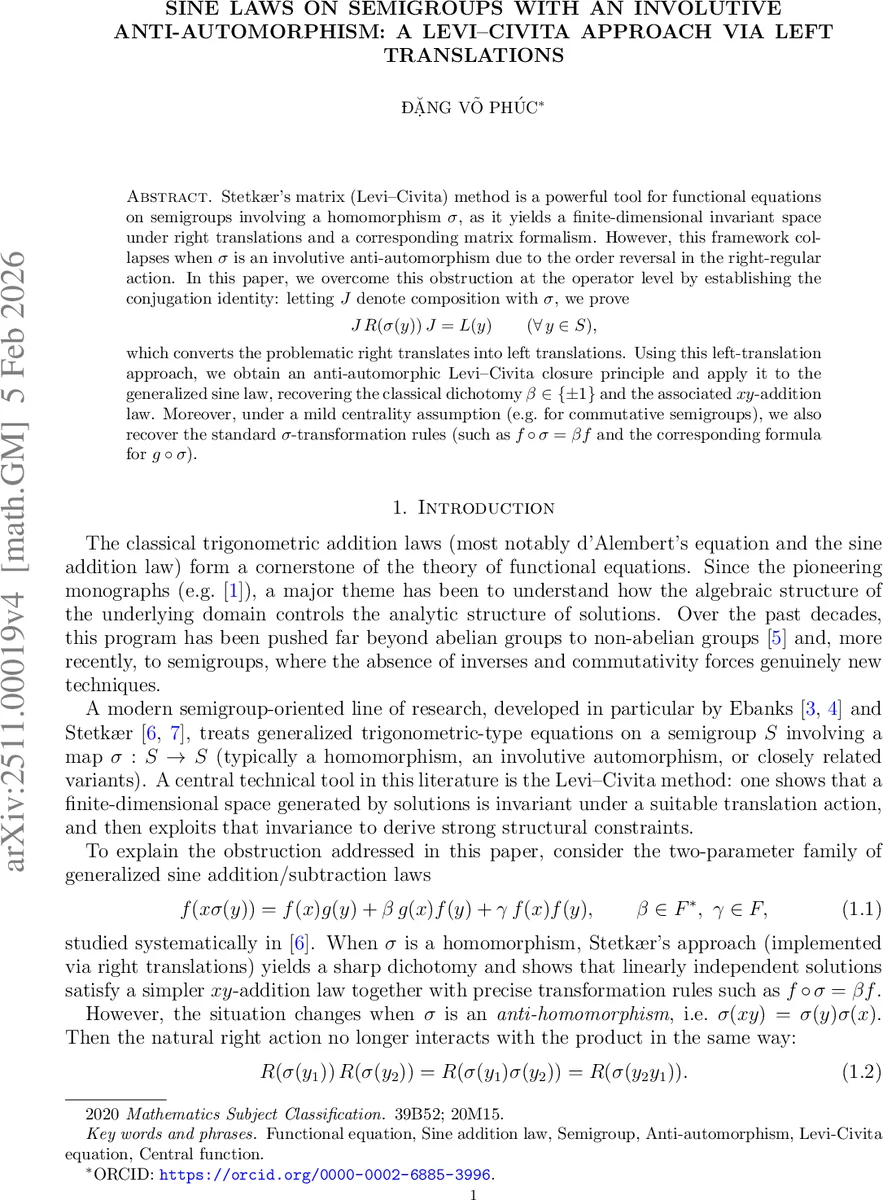
Stetkær’s matrix (Levi–Civita) method is a powerful tool for functional equations on semigroups involving a homomorphism $σ$, as it yields a finite-dimensional invariant space under right translations and a corresponding matrix formalism. However, this framework collapses when $σ$ is an involutive anti-automorphism due to the order reversal in the right-regular action. In this paper, we overcome this obstruction at the operator level by establishing the conjugation identity: letting $J$ denote composition with $σ$, we prove [ J,R(σ(y)),J=L(y)\qquad(\forall,y\in S), ] which converts the problematic right translates into left translations. Using this left-translation approach, we obtain an anti-automorphic Levi–Civita closure principle and apply it to the generalized sine law, recovering the classical dichotomy $β\in{\pm1}$ and the associated $xy$-addition law. Moreover, under a mild centrality assumption (e.g.\ for commutative semigroups), we also recover the standard $σ$-transformation rules (such as $f\circσ=βf$ and the corresponding formula for $g\circσ$).
💡 Research Summary
The paper investigates functional equations on semigroups S equipped with an involutive anti‑automorphism σ (i.e., σ(xy)=σ(y)σ(x) and σ²=id). In the classical Levi‑Civita (or Stetkær matrix) approach, one exploits the fact that the finite‑dimensional space generated by solutions is invariant under right translations R(y)h(x)=h(xy). This invariance yields a matrix representation and strong structural constraints for equations involving a homomorphism σ. However, when σ is an anti‑automorphism, the right‑regular action interacts poorly with σ: R(σ(y₁))R(σ(y₂))=R(σ(y₂y₁)), so the usual right‑translation invariance collapses because the order of composition is reversed.
The authors overcome this obstacle by working at the operator level. They introduce the linear involution J on the function space F(S,F) defined by (Jh)(x)=h(σ(x)). Since σ is bijective and involutive, J²=id. Lemma 3.1 proves the key conjugation identity
J R(σ(y)) J = L(y) for every y∈S,
where L(y)h(x)=h(yx) is the left‑regular representation. This identity converts the problematic right translates into left translates, restoring the translation‑invariance mechanism required for a Levi‑Civita analysis.
Theorem 3.2 (the anti‑automorphic Levi‑Civita closure theorem) states that for an equation of the form
f(xσ(y)) = f(x)h₁(y) + g(x)h₂(y),
with {f,g} and {h₁,h₂} each linearly independent, the span V=⟨f,g⟩ is invariant under all operators R(σ(y)). Equivalently, the conjugated space Vσ=J(V)=⟨Jf,Jg⟩ is invariant under left translations L(y). This result mirrors the classical closure principle but now holds in the anti‑automorphic setting.
The main application is the generalized sine law
f(xσ(y)) = f(x)g(y) + β g(x)f(y) + γ f(x)f(y) (β∈F*, γ∈F),
with f and g linearly independent. Lemma 4.1 (a coefficient dichotomy) shows that the constant β must belong to {0,1} in the homomorphic case; the anti‑automorphic case requires a finer analysis because β can also be –1.
The authors split the analysis into two cases:
- β = –1. By setting h = g+γf and u = –g, the sine law rewrites as f(xσ(y)) = f(x)h(y)+u(x)f(y), which is of the Levi‑Civita type (3.1). Applying Theorem 3.2 yields invariance of V=⟨f,g⟩ under R(σ(·)). Subsequent manipulations (using the anti‑automorphism property of σ and the existence of a central element c with f(c)≠0) lead to the conclusions:
- f∘σ = –f,
- g∘σ = g + a f for some a∈F,
- γ must be zero. Consequently the original equation reduces to
f(xy) = f(x)g(y) + g(x)f(y) + a f(x)f(y),
with the transformation rules above. This recovers the classical “odd” case of the sine law.
- β ≠ –1. By redefining g₁ = g + γ 1 + βf, the equation becomes f(xσ(y)) = f(x)g₁(y)+β g₁(x)f(y). Applying Theorem 3.2 again yields invariance of ⟨f,g₁⟩. Comparing expressions obtained from different factorizations (using σ’s anti‑automorphism) forces β² = 1. Since β≠–1 by assumption, we obtain β = 1, and the σ‑transformation rules simplify to
f∘σ = f, g∘σ = g.
Thus the “even” case of the sine law is recovered, with no extra term a.
Both cases demonstrate that, despite the presence of an anti‑automorphism, the parameter β is forced to be ±1, exactly as in the classical (automorphic) setting; no new exceptional regimes appear. The centrality hypothesis (existence of c∈Z(S) with f(c)≠0) is only needed to derive the explicit σ‑transformation for g; in commutative semigroups this condition is automatically satisfied.
The paper concludes with concrete examples where σ is matrix transposition, group inversion, or other natural anti‑automorphisms. In these settings the conjugation identity J R(σ(y)) J = L(y) can be verified directly, illustrating the practicality of the operator‑level approach.
In summary, by shifting the perspective from right to left translations via the involution J, the authors restore the Levi‑Civita framework for anti‑automorphic semigroups, obtain a clean closure principle, and fully classify solutions of the generalized sine law, confirming that the classical dichotomy β ∈ {±1} persists unchanged.
Comments & Academic Discussion
Loading comments...
Leave a Comment