Note on shifted primes with large prime factors
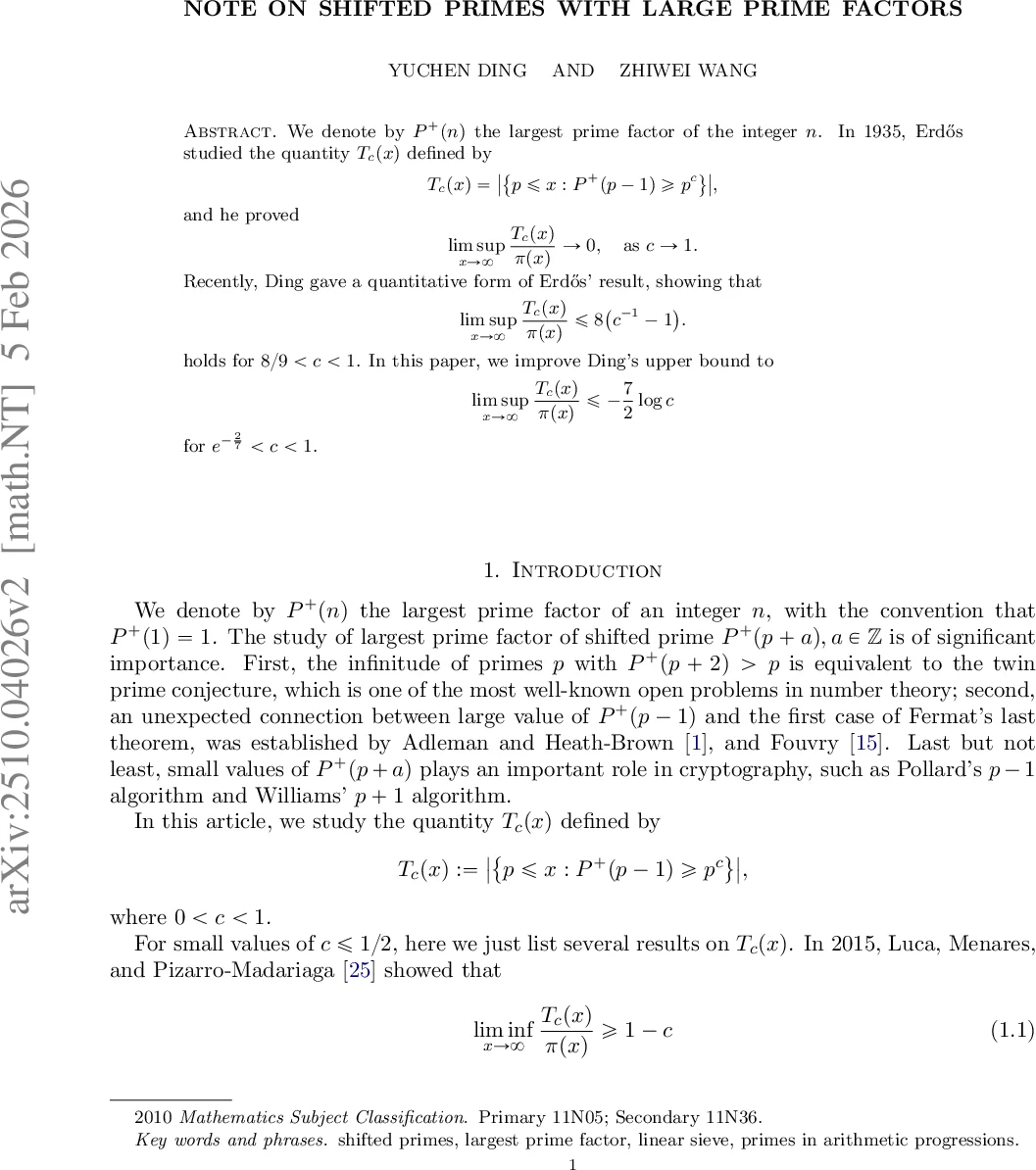
We denote by $P^+(n)$ the largest prime factor of the integer $n$. In 1935, Erd\H os studied the quantity $T_c(x)$ defined by $$ T_c(x)=\big|\big{p\le x: P^+(p-1)\ge p^c\big}\big|, $$ and he proved $$ \limsup_{x\rightarrow \infty}\frac{T_c(x)}{π(x)}\rightarrow 0, \quad \text{as~}c\rightarrow 1. $$ Recently, Ding gave a quantitative form of Erd\H os’ result, showing that $$ \limsup_{x\rightarrow \infty}\frac{T_c(x)}{π(x)}\le 8\big(c^{-1}-1\big). $$ holds for $8/9< c<1$. In this paper, we improve Ding’s upper bound to $$ \limsup_{x\rightarrow \infty}\frac{T_c(x)}{π(x)}\le -\frac{7}{2}\log c $$ for $e^{-\frac{2}{7}}< c<1$.
💡 Research Summary
The paper studies the distribution of primes (p) for which the largest prime factor of the shifted integer (p-1) is unusually large, namely (P^{+}(p-1)\ge p^{c}) with a fixed exponent (c) close to 1. Erdős (1935) proved qualitatively that the proportion of such primes tends to zero as (c\to1). More recently, Ding (2023) gave a quantitative bound \
Comments & Academic Discussion
Loading comments...
Leave a Comment