Improved Constructions and Lower Bounds for Maximally Recoverable Grid Codes
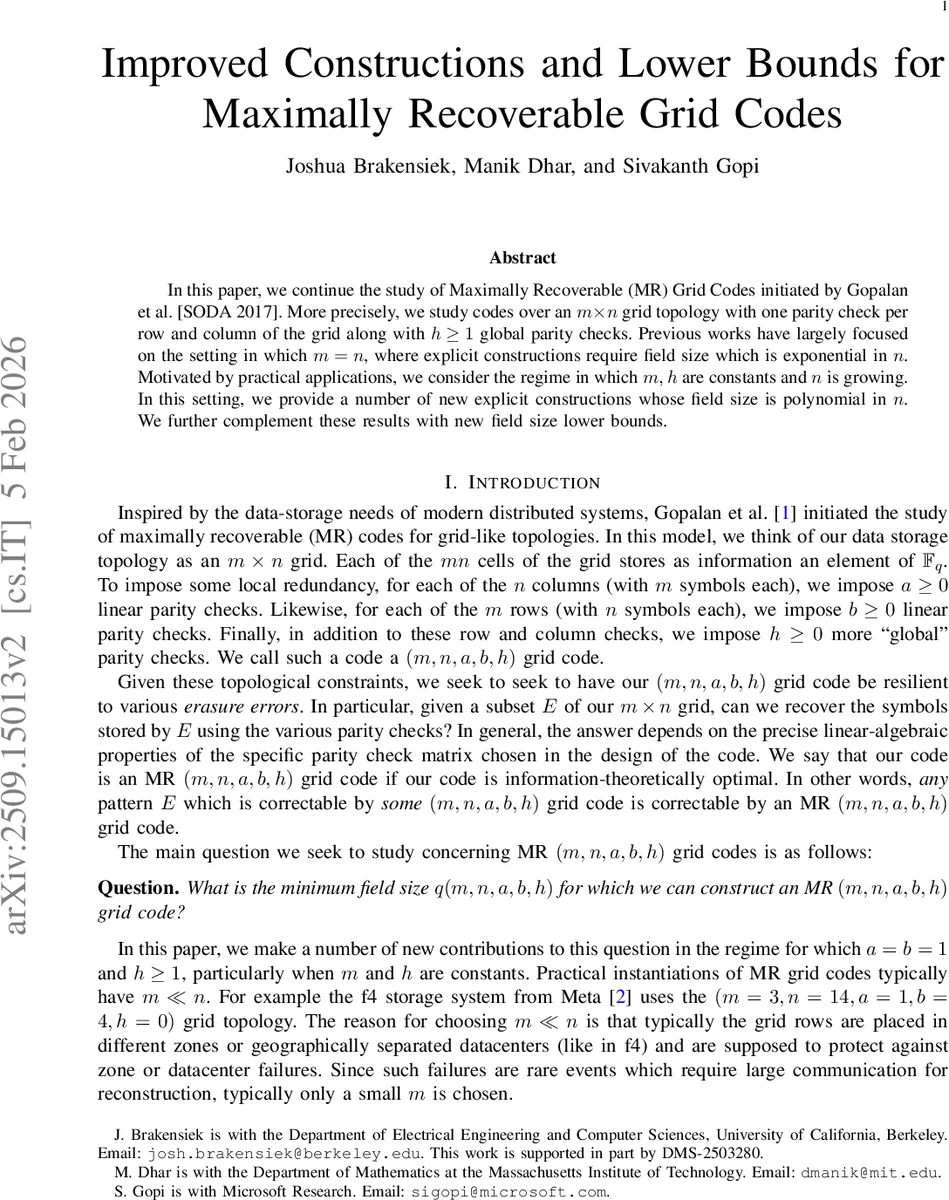
In this paper, we continue the study of Maximally Recoverable (MR) Grid Codes initiated by Gopalan et al. [SODA 2017]. More precisely, we study codes over an $m \times n$ grid topology with one parity check per row and column of the grid along with $h \ge 1$ global parity checks. Previous works have largely focused on the setting in which $m = n$, where explicit constructions require field size which is exponential in $n$. Motivated by practical applications, we consider the regime in which $m,h$ are constants and $n$ is growing. In this setting, we provide a number of new explicit constructions whose field size is polynomial in $n$. We further complement these results with new field size lower bounds.
💡 Research Summary
This paper studies maximally recoverable (MR) grid codes on an m × n grid where each row and each column carries a single local parity (a = b = 1) and there are h ≥ 1 global parities. Prior work focused on the square case m = n, where explicit constructions required a field size exponential in n. Motivated by real‑world storage systems that typically have m ≪ n, the authors fix m and h as constants and let n grow, and they ask for the smallest field size q that permits an MR code.
The main contributions are threefold. First, for h = 1 they give a simple construction with field size q ≤ n^{m‑1}. The idea is to encode the binary representation of each cell’s coordinates, then combine a BCH code (to enforce the row/column parity constraints) with a Gabidulin code (to provide the global parity). This yields a polynomial‑in‑n field size, dramatically improving on the previous bound 2^{(m‑1)(n‑1)}.
Second, they extend the construction to any h ≥ 2. By using the same coordinate encoding and adding h − 1 additional Gabidulin‑type global checks, they obtain a field size bound q ≤ O((mn)^{m+h‑2}). This beats the earlier best explicit bound q ≤ 2^{(m‑1)(n‑1)}·(m‑1)(n‑1). The construction works for any constant m and h, and the exponent on n grows linearly with m + h.
Third, they prove new lower bounds. When m ≥ (h − 1)² they show q ≥ Ω(n^{h‑1}). The proof combines the “acyclic + h edges” characterization of correctable erasure patterns (Holzbaur et al.) with recent lower‑bound techniques for MR locally recoverable codes (Gopi et al.). Intuitively, each of the h additional global parities must produce linearly independent cycle sums; this forces the field to be large enough to accommodate n^{h‑1} distinct values. They also establish a reduction q(m,n,1,1,h) ≥ q(m‑2,n‑h,1,1,1), showing that constructing codes for h ≥ 2 is at least as hard as for h = 1.
The paper further provides a clean algebraic criterion for MR‑ness: for any spanning tree T in the bipartite grid graph, the h cycle‑sum vectors obtained by adding any h non‑tree edges must be linearly independent. This criterion underlies both the constructions (by ensuring the chosen global parity vectors satisfy independence) and the lower‑bound arguments (by showing that independence cannot be achieved over too small a field).
In an appendix the authors treat the case where m grows with n (e.g., m and n are powers of two). They obtain a bound q ≤ 8·(8n/m)^{m‑1}, again polynomial in n for fixed m/n ratio.
Overall, the work demonstrates that in the practically relevant regime where m and h are constants, the required field size for MR grid codes is polynomial in n, not exponential. This bridges a gap between theory and practice for distributed storage systems such as Meta’s f4, where rows correspond to geographically separated zones and only a few rows are used. The new lower bounds also tighten the theoretical understanding of how large a field must be, especially as the number of global parities grows. The techniques introduced—coordinate encoding, combined BCH/Gabidulin constructions, and the cycle‑sum independence framework—are likely to be useful for future investigations of more general (a,b,h) grid topologies.
Comments & Academic Discussion
Loading comments...
Leave a Comment