Language Generation in the Limit: Noise, Loss, and Feedback
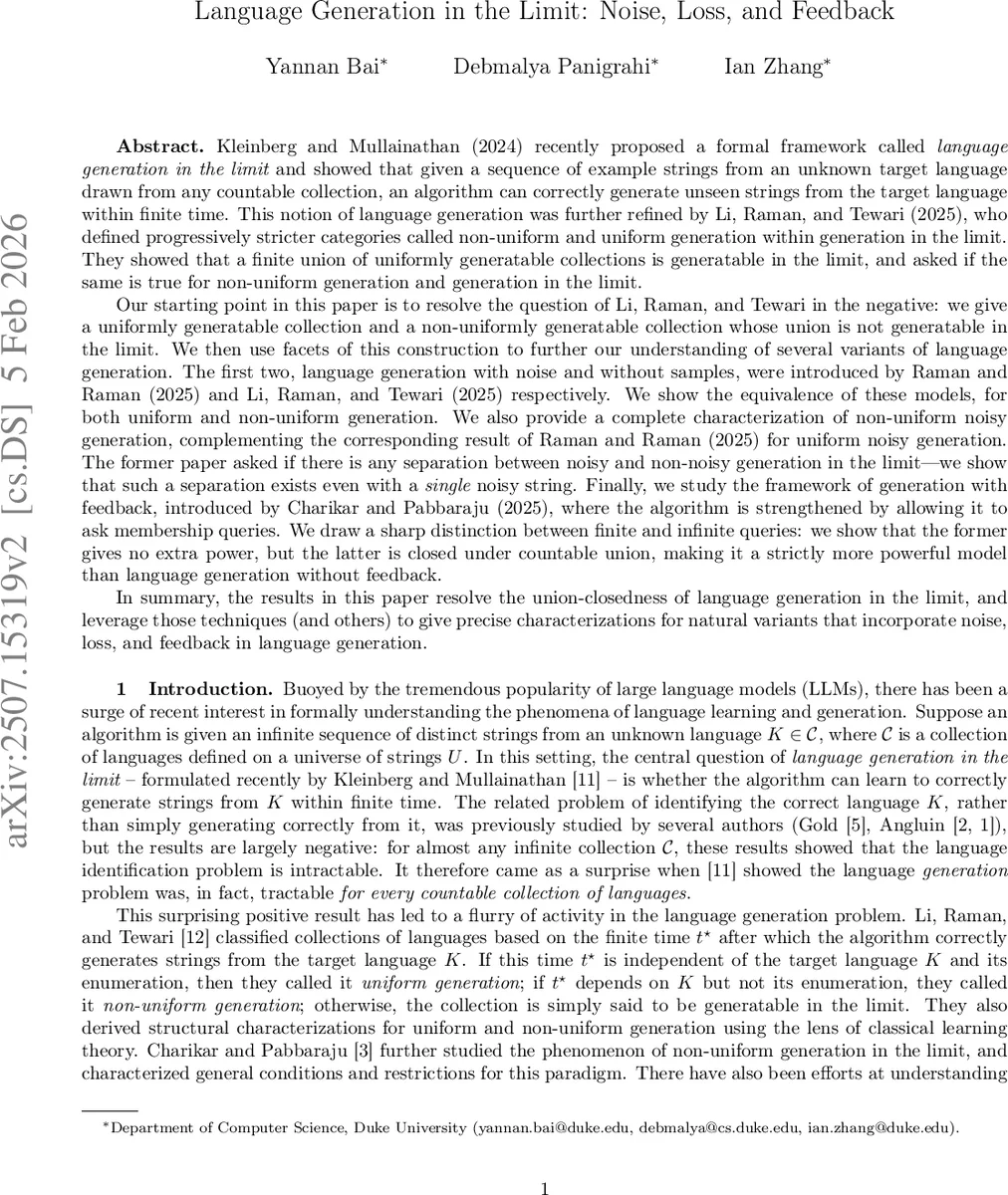
Kleinberg and Mullainathan (2024) recently proposed a formal framework called language generation in the limit and showed that given a sequence of example strings from an unknown target language drawn from any countable collection, an algorithm can correctly generate unseen strings from the target language within finite time. This notion was further refined by Li, Raman, and Tewari (2024), who defined stricter categories of non-uniform and uniform generation. They showed that a finite union of uniformly generatable collections is generatable in the limit, and asked if the same is true for non-uniform generation. We begin by resolving the question in the negative: we give a uniformly generatable collection and a non-uniformly generatable collection whose union is not generatable in the limit. We then use facets of this construction to further our understanding of several variants of language generation. The first two, generation with noise and without samples, were introduced by Raman and Raman (2025) and Li, Raman, and Tewari (2024) respectively. We show the equivalence of these models for uniform and non-uniform generation, and provide a characterization of non-uniform noisy generation. The former paper asked if there is any separation between noisy and non-noisy generation in the limit – we show that such a separation exists even with a single noisy string. Finally, we study the framework of generation with feedback, introduced by Charikar and Pabbaraju (2025), where the algorithm is strengthened by allowing it to ask membership queries. We show finite queries add no power, but infinite queries yield a strictly more powerful model. In summary, the results in this paper resolve the union-closedness of language generation in the limit, and leverage those techniques (and others) to give precise characterizations for natural variants that incorporate noise, loss, and feedback.
💡 Research Summary
The paper investigates the theoretical limits and extensions of language generation in the limit, a framework introduced by Kleinberg and Mullainathan (2024) in which an algorithm receives an infinite, distinct enumeration of strings from an unknown target language K and must eventually generate only new strings from K after some finite time t*. Li, Raman, and Tewari (2025) refined this notion by distinguishing uniform generation (where t* is independent of both K and its enumeration) from non‑uniform generation (where t* may depend on K but not on the enumeration). The authors first resolve an open question of Li et al. by showing that the class of non‑uniformly generatable collections is not closed under finite union. They construct two collections C₁ and C₂ such that C₁ is non‑uniformly generatable (even without any sample strings) and C₂ is uniformly generatable (also without samples), yet C₁ ∪ C₂ cannot be generated in the limit by any algorithm. This demonstrates a stark contrast with traditional learning models, where ensembles or boosting can combine learners; such a combination fails for language generators.
The paper then turns to two weakened variants: noisy generation and generation without samples (auto‑regressive generation). In the noisy model (Raman & Raman, 2025) the adversary may insert a finite number of arbitrary strings into the enumeration. The authors prove an equivalence (Theorem 1.2) between noisy generation and generation without samples for both uniform and non‑uniform settings. Consequently, a complete characterization of non‑uniform noisy generation follows from their new characterization of generation without samples (Theorem 1.3). The latter states that a collection is generatable without samples iff it can be expressed as a countable increasing union of sub‑collections each containing infinitely many languages with infinite “target size” (i.e., each sub‑collection has languages of unbounded size).
Next, the authors introduce a lossy variant where the adversary may omit strings from K. They distinguish between infinite omissions (the adversary may leave out infinitely many strings) and finite omissions (only finitely many are omitted). They show that infinite omissions do not increase the power of generation: any algorithm that works in the standard model also works when infinite omissions are allowed (Theorem 1.4). However, they prove a strong separation for finite omissions: there exist collections that are generatable in the standard model but become non‑generatable if even a single string is omitted (Theorem 1.5). The same separation holds for noise: a collection may be generatable with i noisy strings but not with i + 1. Moreover, knowing the exact noise level is crucial; a collection can be generatable for any fixed noise level i, yet not generatable when the noise level is unknown (Theorem 1.6).
Finally, the paper studies feedback (membership queries) as introduced by Charikar and Pabbaraju (2025). They prove that allowing only a finite number of queries adds no power over the basic model, but permitting an infinite sequence of queries yields a strictly stronger model (Theorem 1.7). With infinite feedback, the class of generatable collections becomes closed under countable unions, and any countable collection can be identified (i.e., the exact index of the target language can be recovered) non‑uniformly (Theorem 1.8).
Overall, the work provides a comprehensive taxonomy of language generation models, clarifies the relationships among uniform, non‑uniform, noisy, lossy, and feedback‑augmented variants, and establishes precise boundaries of what can be learned or generated under each scenario. These theoretical insights have practical implications for designing and evaluating large language models, especially concerning data quality (noise and loss) and interactive mechanisms (queries or feedback).
Comments & Academic Discussion
Loading comments...
Leave a Comment