Salem numbers and commensurability classes of arithmetic hyperbolic manifolds
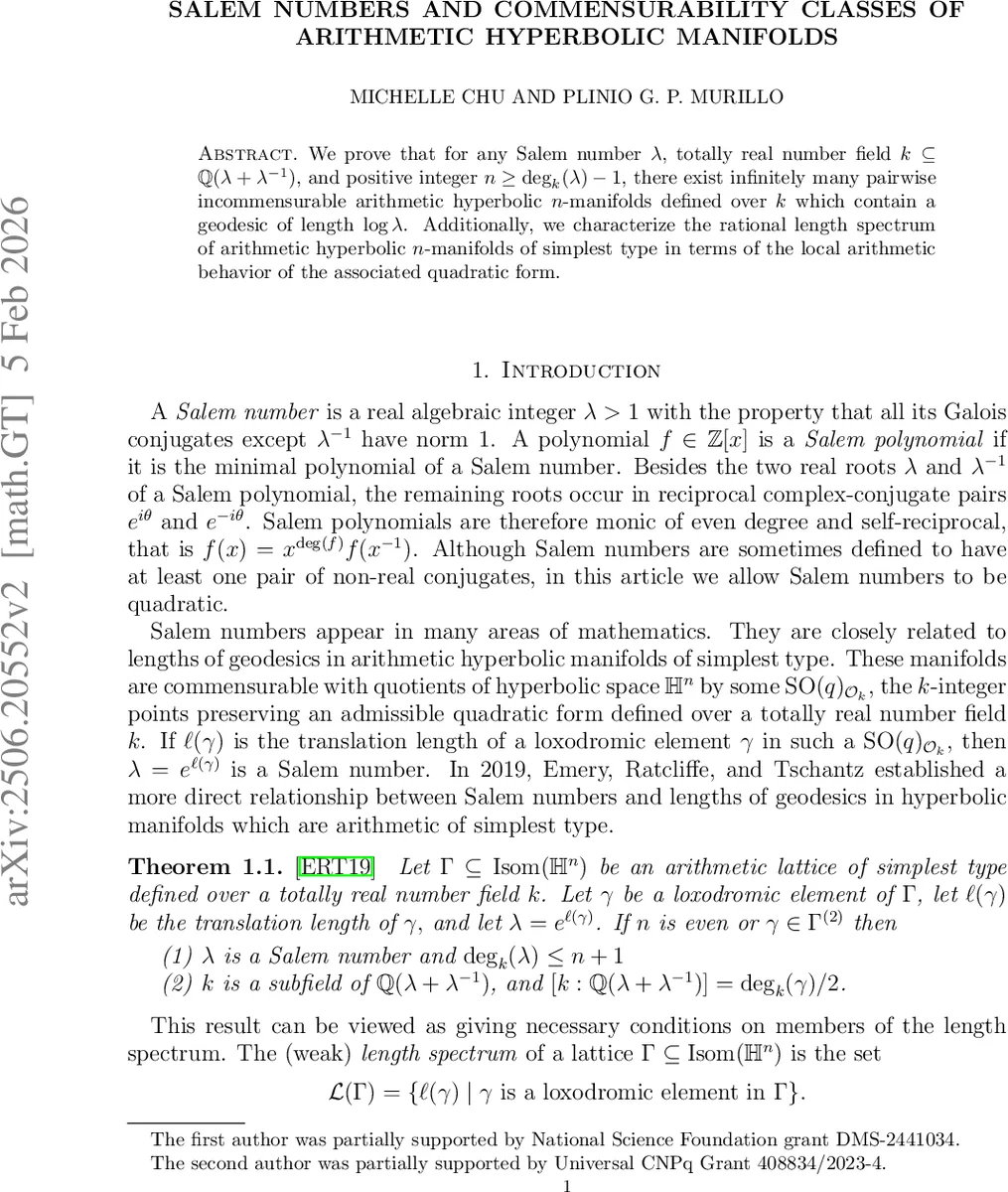
In this article we show that given a Salem number $λ$, a totally real number field $k\subseteq\mathbb{Q}(λ+λ^{-1})$, and a positive integer $n\geq\mathrm{deg}_k(λ)-1$, there exist infinitely many commensurability classes of arithmetic hyperbolic $n$-manifolds defined over $k$ which contain a geodesic of length $\logλ$.
💡 Research Summary
The paper investigates the deep connection between Salem numbers and arithmetic hyperbolic manifolds of simplest type, establishing that for any Salem number λ, any totally real subfield k of ℚ(λ+λ⁻¹), and any integer n ≥ deg_k(λ) – 1, there exist infinitely many pairwise incommensurable arithmetic hyperbolic n‑manifolds defined over k that contain a closed geodesic of length log λ.
The authors begin by recalling that a Salem number λ > 1 is a real algebraic integer whose conjugates all lie on the unit circle except for λ and λ⁻¹. In the setting of arithmetic lattices of simplest type, a loxodromic element γ has eigenvalues λ = e^{ℓ(γ)} and λ⁻¹, so the translation length ℓ(γ) equals log λ. Earlier work of Emery, Ratcliffe, and Tschantz (2019) proved that given λ and k with k ⊂ ℚ(λ+λ⁻¹) and n ≥ deg_k(λ) – 1, one can construct a single arithmetic lattice Γ ⊂ Isom(Hⁿ) defined over k that realizes λ. However, that result does not address the multiplicity of commensurability classes.
The central contribution of this article is Theorem A, which upgrades the existence result to an infinite family of distinct commensurability classes. The proof hinges on two sophisticated tools:
-
A Hasse principle for isometries due to Bayer‑Fluckiger (2015). They show that a quadratic space (V,q) over a global field k admits an isometry with prescribed characteristic polynomial F if and only if such an isometry exists locally at every completion k_ν. For a Salem number λ, the minimal polynomial of λ is ε‑symmetric (ε = λ·λ⁻¹ = 1) and can be decomposed into factors of three types (0, 1, 2) as defined in the paper. The authors verify that the polynomial associated to λ is “hyperbolic” in the sense of Bayer‑Fluckiger, which guarantees the existence of a loxodromic isometry with eigenvalues λ, λ⁻¹ in a suitable quadratic space.
-
Maclachlan’s parametrisation of commensurability classes of arithmetic lattices of simplest type. Two such lattices are commensurable precisely when their Witt invariants c(q) (and discriminants when n is odd) agree after appropriate base change. The authors exploit this criterion to distinguish lattices by engineering the local invariants of the defining quadratic forms.
To produce infinitely many non‑commensurable lattices, the authors use class‑field theory to construct an infinite set of prime ideals of k with prescribed splitting behaviour in certain field extensions (including ℚ(λ+λ⁻¹) and quadratic extensions determined by discriminants). By selecting arbitrary finite subsets of this infinite set, they define quaternion algebras B_I whose ramification sets encode the chosen subset I. Each B_I determines a quadratic form q_I (via the standard correspondence between quaternion algebras and ternary forms) that satisfies the Bayer‑Fluckiger local conditions for λ. Because the ramification sets differ for distinct I, the associated Witt invariants differ, and thus the resulting arithmetic lattices Γ_I = SO(q_I)(𝔬_k) lie in distinct commensurability classes.
Theorem B provides an explicit finite list of necessary and sufficient conditions for a commensurability class to realize a given Salem number λ. These conditions involve:
- the degree bound deg_k(λ) ≤ n + 1,
- the inclusion k ⊂ ℚ(λ+λ⁻¹),
- the discriminant and Witt invariant of the quadratic form,
- the existence of a set of primes with prescribed splitting in the relevant extensions.
As a corollary, the authors obtain a complete description of the rational length spectrum Q L(Γ) of an arithmetic lattice of simplest type: a real number s belongs to Q L(Γ) if and only if e^s is a Salem number satisfying the finite conditions of Theorem B.
The paper is organized as follows. Section 2 reviews quadratic forms, quaternion algebras, loxodromic isometries, and the classification of arithmetic lattices of simplest type, including Maclachlan’s parametrisation. Section 3 summarizes the Bayer‑Fluckiger Hasse principle and translates it into concrete criteria for the existence of a loxodromic isometry with a given Salem eigenvalue. Section 4 states Theorem B, giving the finite list of conditions for λ‑realization. Section 5 combines the local‑global criteria with class‑field constructions to prove Theorem A, thereby producing infinitely many pairwise incommensurable arithmetic hyperbolic manifolds containing a geodesic of length log λ.
In summary, the authors bridge the gap between necessary conditions (previously known) and sufficient conditions for Salem numbers to appear as lengths of closed geodesics in arithmetic hyperbolic manifolds. By leveraging deep results from the arithmetic of quadratic forms, the Hasse principle, and class‑field theory, they demonstrate that for any admissible λ and field k, the landscape of arithmetic hyperbolic manifolds realizing λ is vast: infinitely many distinct commensurability classes exist, and the rational length spectrum can be completely characterized in terms of Salem numbers and explicit local invariants. This work significantly enriches our understanding of the interplay between algebraic number theory and the geometry of hyperbolic manifolds.
Comments & Academic Discussion
Loading comments...
Leave a Comment