Dissipative phase transition of interacting non-reciprocal fermions
While non-reciprocal couplings are ubiquitous in classical systems, their impact on quantum many-body criticality and entanglement remains largely unexplored. Using exact numerical simulations, we study an interacting fermionic chain subject to non-reciprocal gain and loss. We show that the interplay between dissipation and interactions drives a dissipative phase transition, marked by the opening of a many-body gap and a crossover from power-law to exponential relaxation. The weakly-interacting regime displays non-reciprocal signatures, including nonzero currents and directional charge accumulation reminiscent of the skin effect. Notably, despite this localization, quantum trajectories exhibit volume-law entanglement. Finally, reciprocity is dynamically restored above a critical interaction strength.
💡 Research Summary
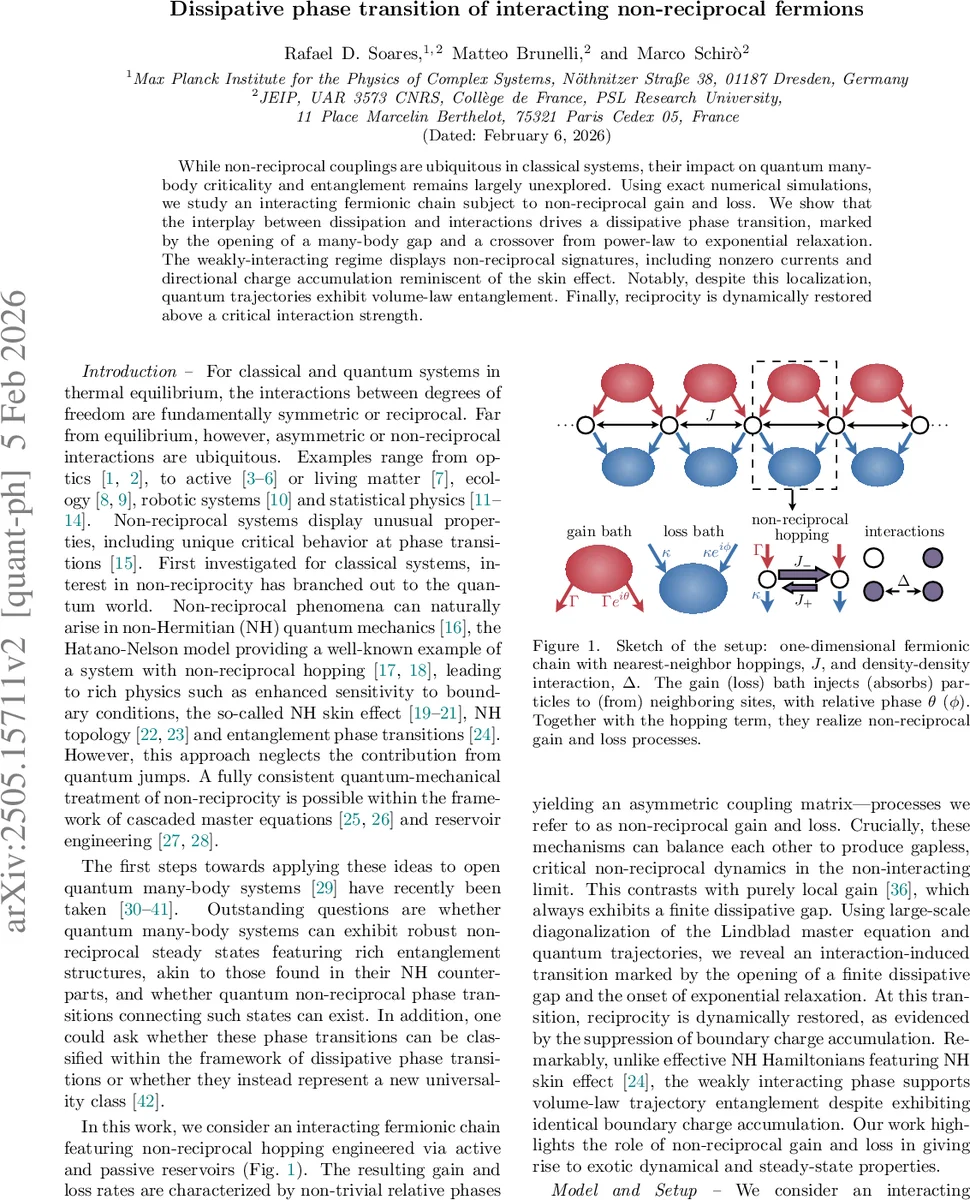
The paper investigates a one‑dimensional interacting fermionic chain subject to non‑reciprocal gain and loss, described by a Lindblad master equation. The coherent part of the Hamiltonian consists of nearest‑neighbor hopping J and a density‑density interaction Δ. Dissipation is introduced via two families of jump operators: L_{j,g}=√Γ (c†j+e^{iθ}c†{j+1}) (gain) and L_{j,ℓ}=√κ (c_j+e^{iϕ}c_{j+1}) (loss). The phases θ and ϕ encode synthetic gauge fields and generate an asymmetric coupling matrix, i.e., non‑reciprocal hopping.
In the non‑interacting limit (Δ=0) the unconditional dynamics reduces to an effective non‑Hermitian Hatano‑Nelson Hamiltonian with asymmetric hopping amplitudes J_± = J + i(Γ cosθ+κ cosϕ) ± (Γ sinθ−κ sinϕ). The spectrum of decay rates λ_k = 2(Γ+κ) + Im(J_+ + J_-) cosk + (J_+−J_−) sink determines the approach to the steady state. For generic parameters the system relaxes exponentially, but along the line ϕ = −θ the dissipative gap δ closes at a specific momentum k* = arctan
Comments & Academic Discussion
Loading comments...
Leave a Comment