Magneto-optical-trap loading in a large optical-access experiment
We present an experimental, numerical, and analytical study of strontium magneto-optical trap (MOT) loading from a cold atomic beam in a configuration optimized for high numerical aperture optical tweezers. Our approach orients the beam flow along the MOT symmetry axis to reduce the experimental complexity and maximize the overall optical access into the scientific region of study. We use a moving molasses technique to enable this configuration and show that its performance depends critically on metastable-state shelving (to 5s5p 3P2) during the atom transfer to the three-dimensional (3D) MOT. Furthermore, we find that the parameters for optimal transfer efficiency are bounded by dark-state loss (to 5s5p 3P0) in the trap region where repumping is present. These observations are verified to great degree of accuracy using both our developed analytical and numerical models. The corresponding 3D simulation tool is used to perform a comprehensive study of the trap loading dynamics, beginning at the oven exit and ending at the 3D MOT, demonstrating its effectiveness in optimizing an effusive oven experiment.
💡 Research Summary
**
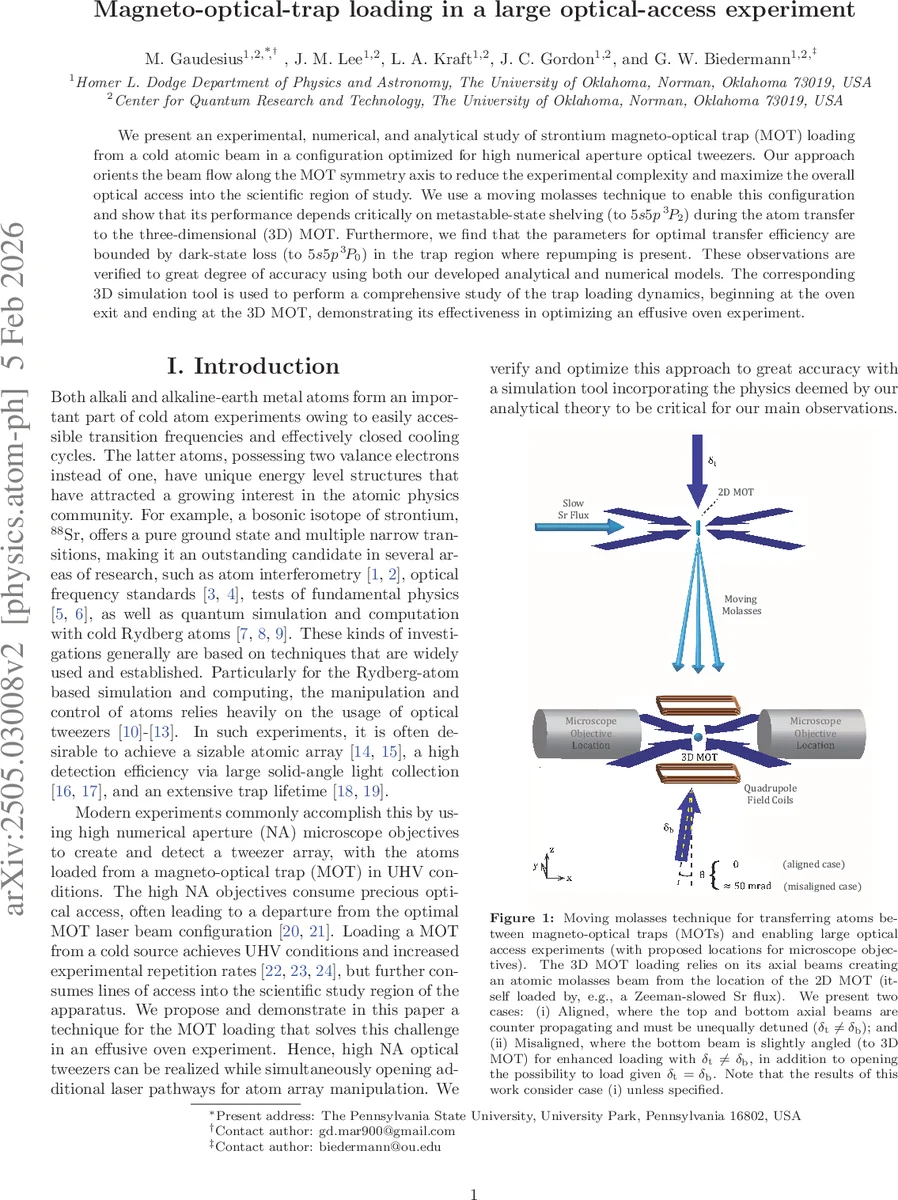
The paper presents a comprehensive experimental, numerical, and analytical investigation of loading a strontium magneto‑optical trap (MOT) from a cold atomic beam in a configuration that maximizes optical access for high‑numerical‑aperture (NA) optical tweezers. Traditional two‑stage MOT loading schemes (e.g., 2D + MOT, L‑VIS) often require in‑vacuum components such as mirrors with apertures, which limit the available solid angle for high‑NA objectives. To overcome this, the authors develop a “moving molasses” technique that uses only the axial beams of the three‑dimensional MOT (3D‑MOT) to pull atoms from a two‑dimensional MOT (2D‑MOT) directly into the science region. The axial beams are deliberately detuned asymmetrically (δₜ ≠ δ_b), creating a net radiation‑pressure force along the MOT symmetry axis that transports the atoms while preserving a clear optical path for the tweezers.
A central finding is that the transfer efficiency is strongly governed by the population dynamics of two metastable states of strontium. During the blue‑transition (5s² ¹S₀ → 5s5p ¹P₁) cooling, a fraction of atoms decays into the long‑lived 5s5p ³P₂ state. Atoms shelved in this state are essentially immune to further radiation pressure, allowing them to drift into the 3D‑MOT region without excessive heating. Once inside, a repumping laser at 481 nm (³P₂ → ³P₂) revives these atoms, extending their effective lifetime in the trap by a factor E ≈ 27. However, the same repumping light can also drive atoms into the dark state 5s5p ³P₀, which is a loss channel that limits the ultimate loading efficiency. By carefully optimizing the repump power, detuning, and polarization, the authors minimize dark‑state loss while maximizing the benefit of the ³P₂ shelving.
To quantitatively describe the entire loading process—from the oven exit, through a dual‑stage collimation (micro‑capillaries and a differential tube), a 2D optical molasses (2D‑OM), a Zeeman slower, the 2D‑MOT, and finally the 3D‑MOT—the authors construct a three‑dimensional Monte‑Carlo simulation. The simulation employs “superparticles” that each represent many real atoms, and it integrates the equations of motion using a Leapfrog algorithm. Forces include laser radiation pressure (with full treatment of polarization and arbitrary beam geometry), magnetic field gradients, gravity, and state‑dependent lifetimes. The model also incorporates the stochastic nature of the metastable shelving and dark‑state loss: when a superparticle enters the repumping region it receives a new lifetime scaled by E; if it later decays to the dark state it is removed from the simulation. Up to 10⁷ superparticles are used, providing converged results that match experimental measurements within 5 % across all stages.
Experimentally, the oven is operated at 440 °C, producing a flux of 2 × 10¹¹ atoms s⁻¹. The dual‑stage collimation yields a divergence of ~23 mrad, verified by MolFlow+ simulations. The 2D‑OM consists of two retro‑reflected beams (6 mW each, 1/e² radius 3.2 mm, detuned –30 MHz). The Zeeman slower brings the longitudinal velocity into the capture range of the 2D‑MOT. The moving‑molasses configuration that gives optimal transfer uses a top beam detuned –30 MHz and a bottom beam detuned –45 MHz, both with ~6 mW power. Under these conditions the 3D‑MOT loads at a rate of ~1 × 10⁹ atoms s⁻¹, corresponding to a transfer efficiency of ~30 %—significantly higher than the ~10 % typical for conventional 2D + MOT schemes.
The authors also discuss practical considerations such as background pressure (∼10⁻⁹ Torr achieved with a 240 l s⁻¹ ion getter pump), atom lifetime limited by background collisions (~1 s), and the impact of beam misalignment (the “misaligned case” in Fig. 1) which can further enhance loading but was not the focus of the present study. The analytical model presented in the appendices provides closed‑form expressions for the capture velocity, radiation‑pressure force, and steady‑state atom number, offering intuitive insight into the role of the asymmetric detuning and the metastable dynamics.
In conclusion, the paper demonstrates that a carefully engineered moving‑molasses transfer, combined with strategic use of metastable shelving and repumping, enables high‑efficiency MOT loading while preserving maximal optical access for high‑NA tweezers. The integrated 3D simulation tool serves as a valuable design aid for future effusive‑oven experiments, and the methodology is readily extendable to other alkaline‑earth species such as ytterbium or calcium. Future work may incorporate multiple‑scattering effects at higher densities, real‑time feedback control of laser parameters, and exploration of alternative repumping schemes to further suppress dark‑state loss.
Comments & Academic Discussion
Loading comments...
Leave a Comment