Asymptotics for resolutions and smoothings of Calabi-Yau conifolds
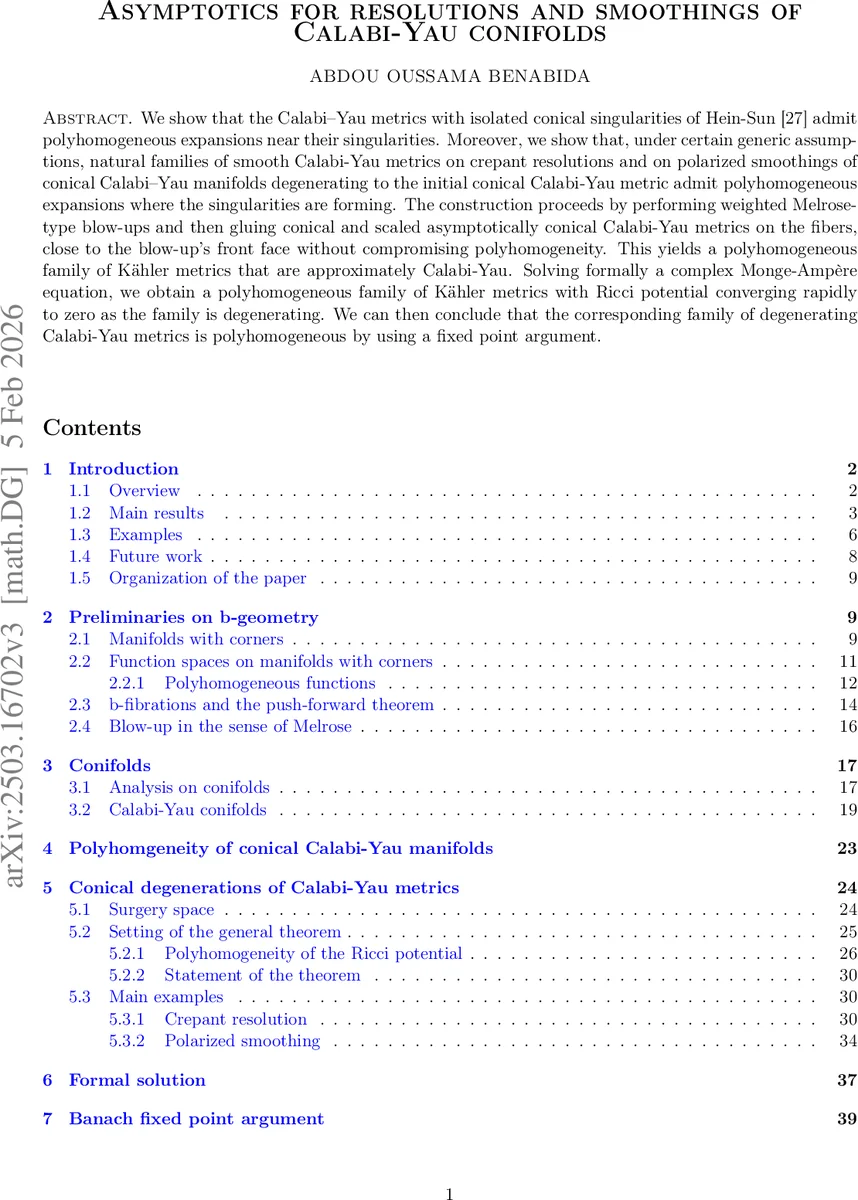
We show that the Calabi-Yau metrics with isolated conical singularities of Hein-Sun admit polyhomogeneous expansions near their singularities. Moreover, we show that, under certain generic assumptions, natural families of smooth Calabi-Yau metrics on crepant resolutions and on polarized smoothings of conical Calabi-Yau manifolds degenerating to the initial conical Calabi-Yau metric admit polyhomogeneous expansions where the singularities are forming. The construction proceeds by performing weighted Melrose-type blow-ups and then gluing conical and scaled asymptotically conical Calabi-Yau metrics on the fibers, close to the blow-up’s front face without compromising polyhomogeneity. This yields a polyhomogeneous family of Kähler metrics that are approximately Calabi-Yau. Solving formally a complex Monge-Ampère equation, we obtain a polyhomogeneous family of Kähler metrics with Ricci potential converging rapidly to zero as the family is degenerating. We can then conclude that the corresponding family of degenerating Calabi-Yau metrics is polyhomogeneous by using a fixed point argument.
💡 Research Summary
The paper establishes that Calabi‑Yau metrics with isolated conical singularities, as constructed by Hein‑Sun, possess poly‑homogeneous asymptotic expansions near each singular point. Using the framework of b‑geometry and weighted Melrose‑type blow‑ups, the authors first prove poly‑homogeneity of the conical Calabi‑Yau metric itself by analyzing the linearized complex Monge‑Ampère equation (the Laplacian on a cone) via b‑calculus. The spectrum of this Laplacian, determined by the link of the cone, dictates the admissible exponents in the expansion.
The main contributions concern two desingularisation scenarios. In the crepant resolution case, each cone C_i admits a crepant resolution ˆC_i with an asymptotically conical (AC) Calabi‑Yau metric ω_AC,i. Under a cohomological condition (Assumption R) allowing non‑compactly supported Kähler classes, the authors construct a manifold with corners M_b whose two boundary hypersurfaces correspond respectively to the resolved space and the original singular space, meeting along the common link. By gluing the scaled AC metrics (ε²ω_AC,i) to the original conical metric ω_CY in a poly‑homogeneous fashion, they obtain an approximate Kähler form ω_ε. The Ricci potential v_ε of ω_ε is shown to be poly‑homogeneous on M_b and to vanish at both boundaries. Solving the complex Monge‑Ampère equation (ω_ε+i∂∂u_ε)^n=e^{v_ε} formally yields a correction term u_{0,ε} whose error g_ε decays rapidly as ε→0. A Banach fixed‑point argument then produces a genuine solution u_ε, giving a family of smooth Calabi‑Yau metrics ω_CY,ε on the resolution that are poly‑homogeneous on M_b; this is Theorem B.
In the polarized smoothing scenario, the authors assume a smoothing π:X→D that locally models the cone C via a weighted ℝ⁺‑action (Assumption S.1) and that the general fiber of the associated affine smoothing carries an i∂∂‑exact AC Calabi‑Yau metric (Assumption S.2). They build a similar corner manifold X_b with boundary faces representing the smoothing fiber and the original singular space. By the same gluing, Ricci‑potential analysis, formal Monge‑Ampère solution, and fixed‑point correction, they obtain a family of Calabi‑Yau metrics ω_CY,s on the fibers X_s (s→0) that are poly‑homogeneous on X_b (Theorem C).
The methodology hinges on three technical pillars: (1) the use of weighted Melrose blow‑ups to encode the degeneration geometry as a smooth manifold with corners; (2) the systematic treatment of the complex Monge‑Ampère equation within the poly‑homogeneous function space A_phg, ensuring that all intermediate quantities (metrics, potentials, error terms) retain poly‑homogeneity; (3) a fixed‑point scheme that upgrades the formal asymptotic solution to an exact one while preserving the poly‑homogeneous structure.
Consequently, the paper provides a refined convergence notion—poly‑homogeneous convergence—stronger than the usual Gromov‑Hausdorff limit, and it yields detailed asymptotics describing how singularities form in families of Calabi‑Yau manifolds. These results deepen the analytic understanding of Calabi‑Yau desingularisation, with potential implications for mirror symmetry, string‑theoretic compactifications, and the study of moduli spaces of Calabi‑Yau metrics.
Comments & Academic Discussion
Loading comments...
Leave a Comment