Simultaneous Decoding of Classical Coset Codes over $3-$User Quantum Broadcast Channel: New Achievable Rate Regions
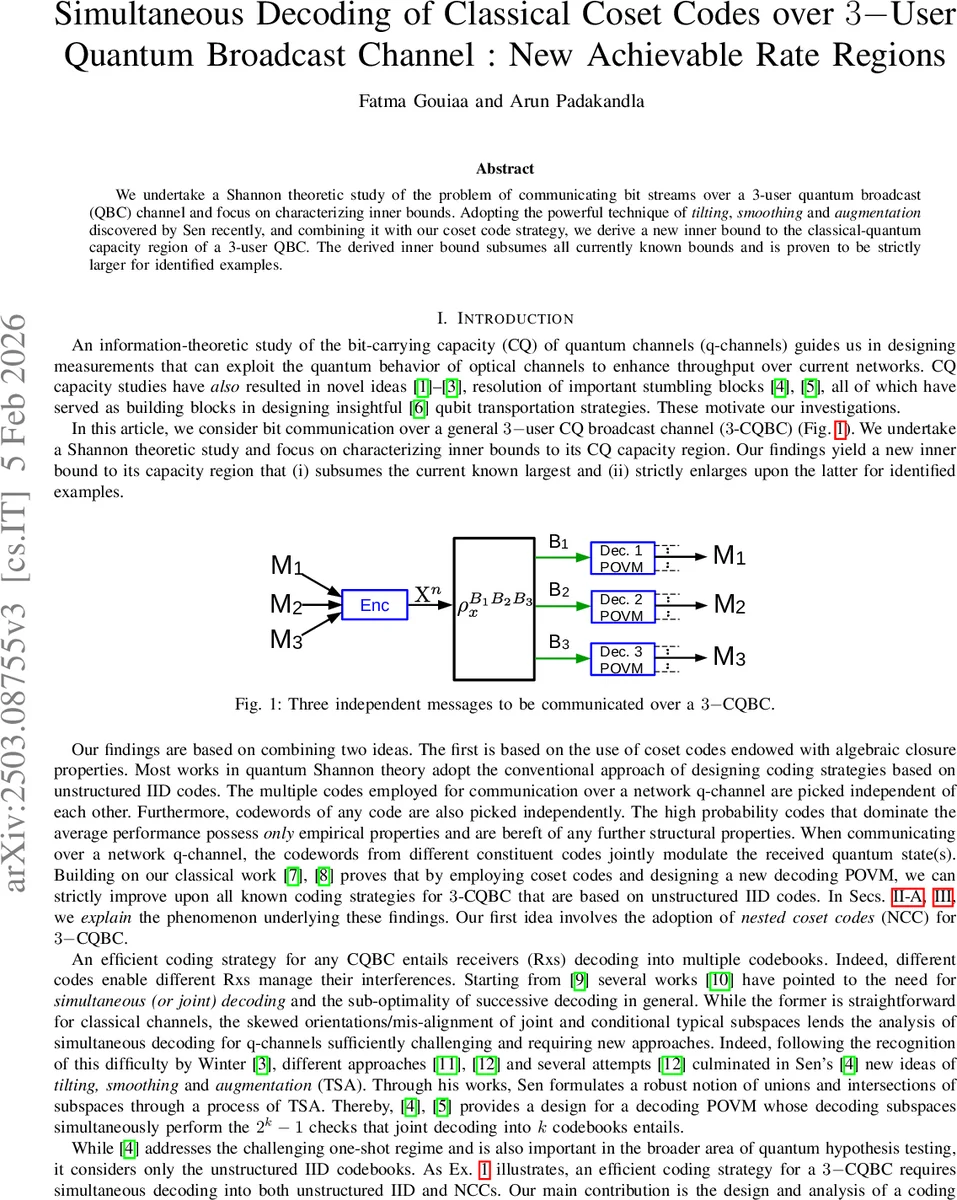
Combining the technique of employing coset codes for communicating over a quantum broadcast channel and the recent discovery of tilting, smoothing and augmentation by Sen to perform simultaneous decoding over network quantum channels, we derive new inner bounds to the capacity region of a $3-$user classical quantum broadcast channel that subsumes all known.
💡 Research Summary
The paper investigates the classical‑to‑quantum (CQ) capacity region of a three‑user quantum broadcast channel (3‑CQBC). While previous works on two‑user broadcast channels have employed superposition coding, Marton’s binning, and other unstructured i.i.d. codebooks, extending these techniques to three users encounters a fundamental obstacle: each receiver experiences interference that is a bivariate function of the other two users’ signals. Simply treating the interference as independent noise or attempting to decode both interfering codewords leads to a severe rate loss.
To overcome this, the authors combine two powerful ideas. The first is the use of nested coset codes (NCC). A coset code is a linear code over a finite field with an added bias vector; the sum of two coset codewords is again a coset of the same underlying linear code. By sharing a common linear code among the two “interfering” users, the transmitter can ensure that the sum of their codewords lies in a known coset. This algebraic closure allows a receiver to decode only the sum (a bivariate function) rather than the individual codewords, thereby reducing the amount of information it must extract while still eliminating the interference.
The second ingredient is the recent “tilting, smoothing, and augmentation” (TSA) framework introduced by Sen. TSA provides a systematic way to define quantum typical projectors that are tilted (rotated) and smoothed so that unions and intersections of subspaces can be handled cleanly. In the context of simultaneous decoding, TSA enables a single POVM to perform all the 2^k – 1 checks required when decoding k codebooks jointly. Prior applications of TSA were limited to unstructured i.i.d. codebooks; the present work extends it to the algebraically structured NCCs.
The paper’s technical contributions can be summarized as follows:
-
Coset‑Based Encoding Scheme – Each user’s message is split into parts; for users 2 and 3 a portion is encoded using coset codewords drawn from a common linear code, while the remaining parts use conventional i.i.d. codebooks. This creates three layers of codebooks: (i) a public layer, (ii) private i.i.d. layers, and (iii) a structured NCC layer.
-
Likelihood Encoder – To handle the statistical dependence introduced by the coset structure (codewords are only pairwise independent), the authors employ a likelihood encoder. This technique selects codewords according to the conditional distribution induced by the message, ensuring that the joint distribution of all codewords matches the desired product form needed for typicality arguments.
-
Tilted Simultaneous Decoder – Building on TSA, a tilted POVM is constructed that simultaneously decodes the i.i.d. layers and the NCC layer. The decoder checks the joint typicality of the received quantum state with respect to all three layers, effectively performing the required 2^3 – 1 = 7 subspace checks in a single measurement.
-
Inner Bound Theorems – Theorem 1 establishes an achievable rate region for the simplified setting where only receiver 1 decodes the bivariate interference. Theorem 2 extends this to the full three‑receiver scenario, yielding an inner bound that contains all previously known inner bounds (including Marton’s region for CQ broadcast channels) and is strictly larger for concrete parameter choices.
-
Illustrative Examples – Two examples are worked out in detail. In the commuting case the channel reduces to three binary symmetric channels; using linear coset codes the sum interference can be decoded perfectly, achieving the triple (C₁, C₂, C₃) that is unattainable with unstructured codes. In the non‑commuting case the output states are non‑orthogonal quantum states; nevertheless, by choosing appropriate sub‑cosets the same rate triple is achieved, demonstrating the power of the method beyond classical analogues.
-
Technical Lemmas – The analysis overcomes three major hurdles: (a) identifying the appropriate tilted projectors for functions of codebooks, (b) dealing with the dependence among coset codewords, and (c) avoiding the overcounting problem in binning by using the likelihood encoder. The paper provides rigorous proofs for each step, including concentration bounds for the tilted typical projectors and error‑exponent calculations.
Overall, the work shows that structured coding (coset codes) combined with advanced quantum decoding (TSA) can fundamentally enlarge the achievable CQ capacity region of multi‑user quantum broadcast channels. The results suggest that future quantum network designs should incorporate algebraic code structures rather than relying solely on random i.i.d. ensembles, especially when dealing with higher‑order interference patterns. The paper also opens several avenues for further research, such as extending the approach to more than three users, exploring other algebraic codes (e.g., LDPC or polar codes) within the TSA framework, and investigating practical implementations of the tilted simultaneous decoder in optical or superconducting quantum communication platforms.
Comments & Academic Discussion
Loading comments...
Leave a Comment