On a conjecture with implications for multicriteria decision making
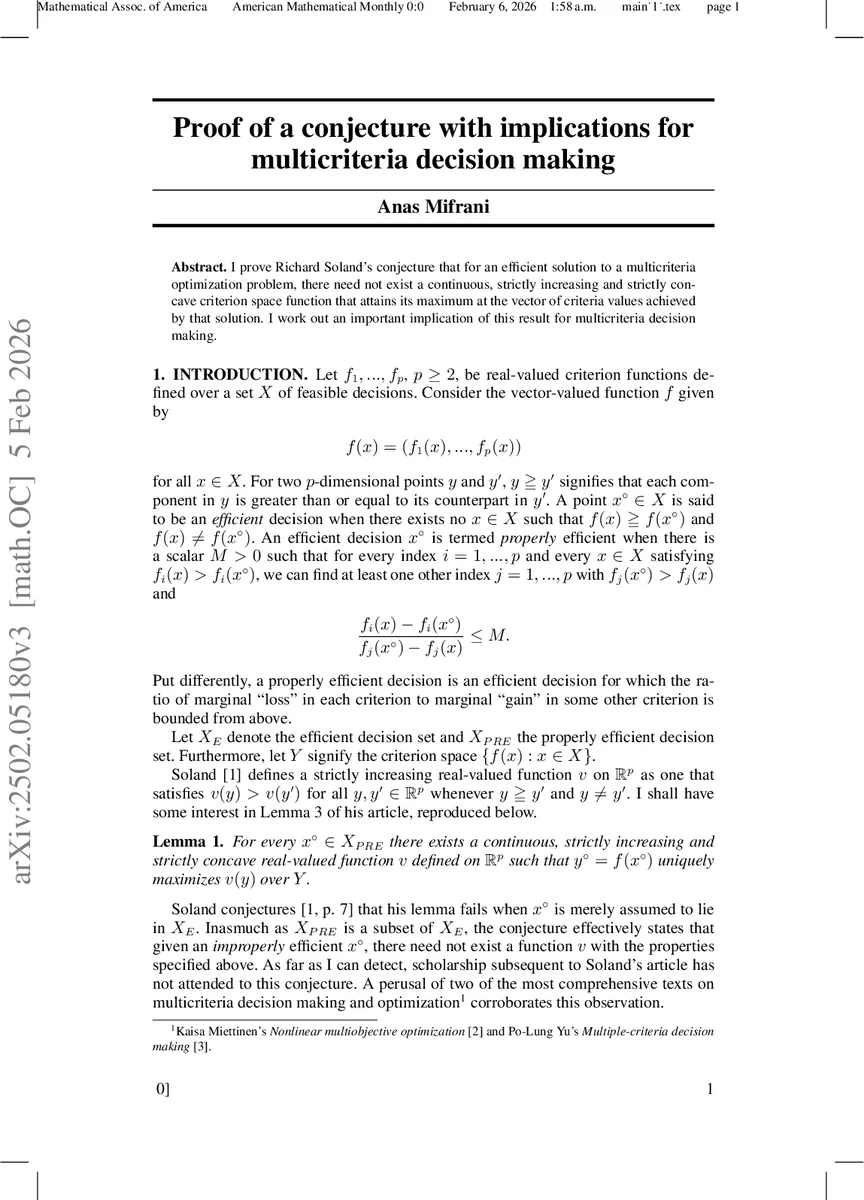
I prove Richard Soland’s conjecture that for an efficient solution to a multicriteria optimization problem, there need not exist a continuous, strictly increasing and strictly concave criterion space function that attains its maximum at the vector of criteria values achieved by that solution. I work out an important implication of this result for multicriteria decision making.
💡 Research Summary
The paper addresses a long‑standing conjecture posed by Richard Soland concerning the existence of a value‑function that simultaneously satisfies three properties—continuity, strict monotonicity, and strict concavity—and that uniquely maximizes at the criterion vector of an efficient solution in a multicriteria optimization problem. Soland had proved that for properly efficient solutions such a function always exists (Lemma 3 in his original work) and conjectured that the result fails for merely efficient solutions. The author, Anas Mifrani, provides a concise yet rigorous proof of this conjecture by constructing a counter‑example in the simplest possible setting (two criteria, a one‑dimensional decision space).
The model is defined on X =
Comments & Academic Discussion
Loading comments...
Leave a Comment