When and How to Integrate Multimodal Large Language Models in College Psychotherapy: Perspectives from Multi-stakeholders
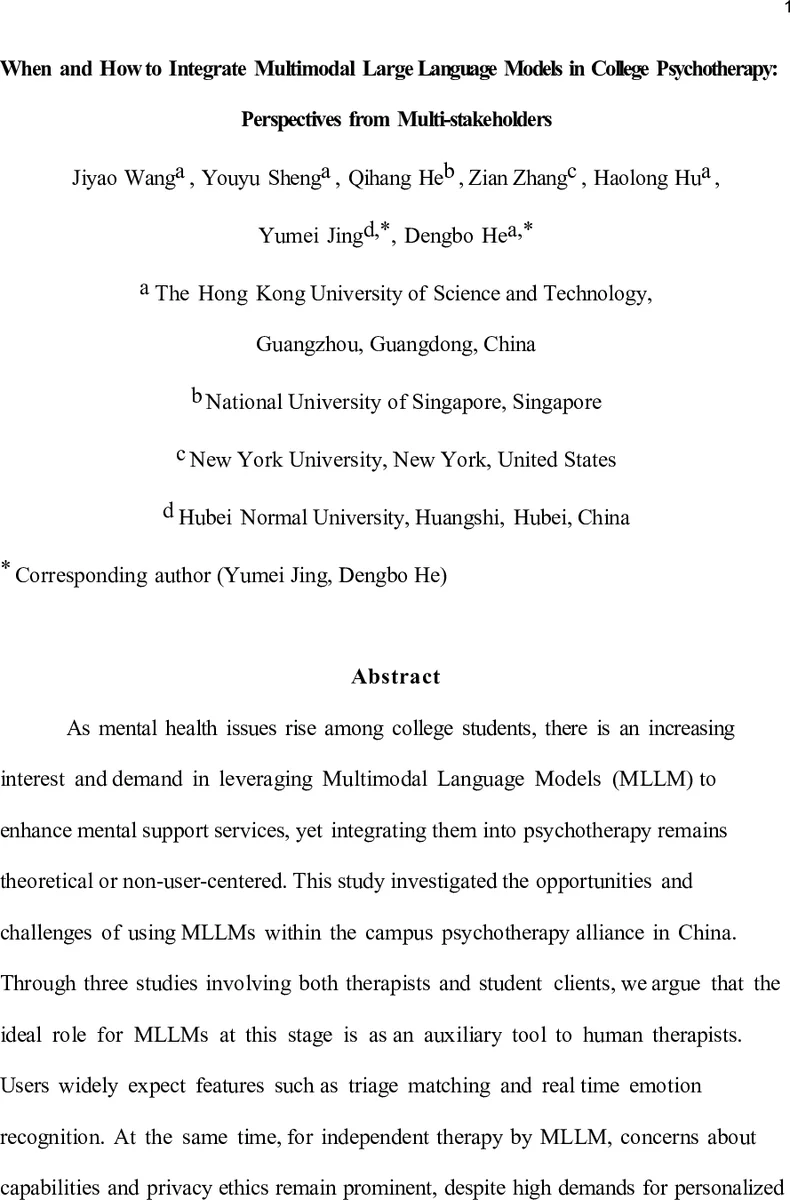
As mental health issues rise among college students, there is an increasing interest and demand in leveraging Multimodal Language Models (MLLM) to enhance mental support services, yet integrating them into psychotherapy remains theoretical or non-user-centered. This study investigated the opportunities and challenges of using MLLMs within the campus psychotherapy alliance in China. Through three studies involving both therapists and student clients, we argue that the ideal role for MLLMs at this stage is as an auxiliary tool to human therapists. Users widely expect features such as triage matching and real-time emotion recognition. At the same time, for independent therapy by MLLM, concerns about capabilities and privacy ethics remain prominent, despite high demands for personalized avatars and non-verbal communication. Our findings further indicate that users’ sense of social identity and perceived relative status of MLLMs significantly influence their acceptance. This study provides insights for future intelligent campus mental healthcare.
💡 Research Summary
This paper investigates how multimodal large language models (MLLMs) can be integrated into college psychotherapy in China, drawing on the perspectives of three key stakeholder groups: campus therapists, student clients, and a broader student population. The authors note the rising prevalence of mental health problems among university students and the limitations of traditional face‑to‑face counseling, such as stigma, financial barriers, and reduced access during crises like the COVID‑19 pandemic. While AI‑driven chatbots have shown promise for providing round‑the‑clock support, most existing systems rely on text‑only natural language processing and lack the ability to interpret non‑verbal cues, limiting their therapeutic efficacy. Recent advances in multimodal LLMs (e.g., GPT‑4/5) that can process text, audio, and visual data open new possibilities for mental‑health applications, yet their clinical integration remains largely theoretical.
To address this gap, the authors conducted a mixed‑methods study comprising three sequential components. Study I involved a focus‑group interview with 15 campus psychotherapists, stratified by experience (junior, mid‑career, senior). Study II consisted of semi‑structured interviews with 20 college students who reported mental‑health difficulties. Study III deployed an online survey to over 300 students from diverse universities to capture broader attitudes. All procedures received ethics approval.
Key findings across the three studies converge on a consistent view: MLLMs are best positioned as auxiliary tools rather than autonomous therapists. Therapists highlighted the value of real‑time emotion detection, multimodal triage matching, session summarization, and rapid information retrieval to augment their clinical workflow, but warned that over‑reliance on AI could undermine clinical judgment and therapeutic alliance. Students expressed enthusiasm for features such as personalized avatars, non‑verbal communication support, and 24/7 accessibility, yet voiced strong concerns about data privacy, potential misuse of personal disclosures, and the ethical responsibility for erroneous advice. Notably, both groups’ acceptance was moderated by perceived social identity and relative status of the AI; users were more comfortable when the system was framed as a “supportive colleague” rather than a “replacement therapist.”
The authors synthesize these insights into concrete design recommendations. First, they advocate a “support‑only” deployment model that limits MLLM functions to emotion flagging, triage, and knowledge‑base querying, leaving diagnosis and treatment planning to human clinicians. Second, they propose adjustable autonomy controls so users can select the degree of AI involvement. Third, they stress transparent data‑governance policies, including explicit consent, on‑demand data deletion, and clear attribution of responsibility. Fourth, they recommend embedding the principles of the Digital Therapeutic Alliance—empathy, engagement, and goal alignment—through high‑fidelity multimodal perception and real‑time feedback loops. Finally, they suggest customizable avatars and voice personas that enhance user rapport while maintaining an explicit “AI” label to avoid deception.
In conclusion, the study provides the first multi‑stakeholder, user‑centered evaluation of MLLM integration in campus psychotherapy. It demonstrates that, given current technical maturity and ethical considerations, MLLMs should function as augmentative assistants that enhance therapist efficiency and student engagement, rather than as standalone therapeutic agents. Future work should involve longitudinal clinical pilots to assess the impact of such AI‑augmented interventions on therapeutic outcomes and to refine the balance between technological capability and human‑centered care.
Comments & Academic Discussion
Loading comments...
Leave a Comment