Impact of light-matter coupling strength on the efficiency of microcavity OLEDs: A unified quantum master equation approach
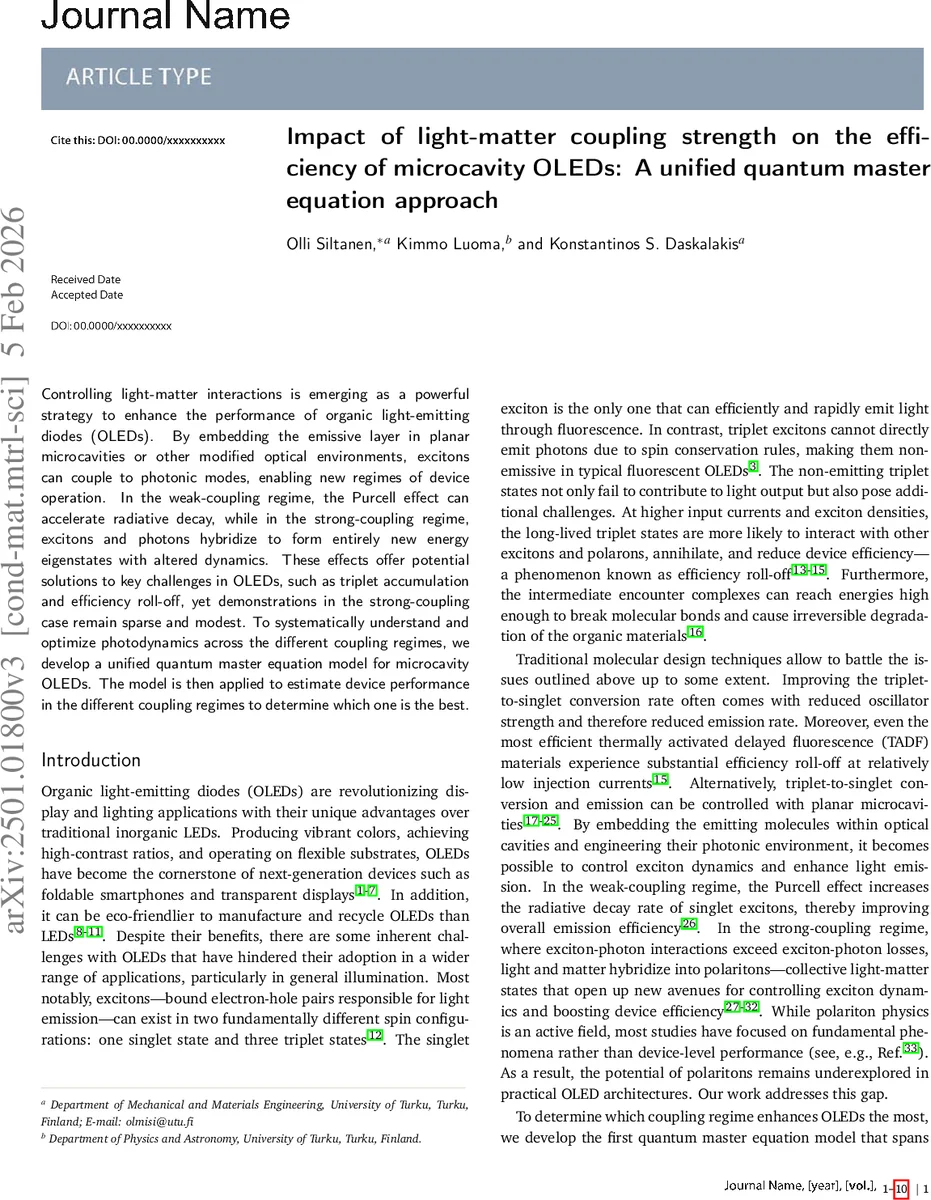
Controlling light-matter interactions is emerging as a powerful strategy to enhance the performance of organic light-emitting diodes (OLEDs). By embedding the emissive layer in planar microcavities or other modified optical environments, excitons can couple to photonic modes, enabling new regimes of device operation. In the weak-coupling regime, the Purcell effect can accelerate radiative decay, while in the strong-coupling regime, excitons and photons hybridize to form entirely new energy eigenstates with altered dynamics. These effects offer potential solutions to key challenges in OLEDs, such as triplet accumulation and efficiency roll-off, yet demonstrations in the strong-coupling case remain sparse and modest. To systematically understand and optimize photodynamics across the different coupling regimes, we develop a unified quantum master equation model for microcavity OLEDs. The model is then applied to estimate device performance in the different coupling regimes to determine which one is the best.
💡 Research Summary
This paper presents a comprehensive theoretical framework for evaluating how the strength of light‑matter coupling influences the performance of organic light‑emitting diodes (OLEDs) when the emissive layer is placed inside a planar microcavity. The authors first motivate the study by highlighting two major challenges in conventional OLEDs: (i) the large population of long‑lived triplet excitons that do not emit light directly and cause efficiency roll‑off at high current densities, and (ii) the degradation of organic materials due to exciton‑polaron annihilation. While molecular design strategies such as thermally activated delayed fluorescence (TADF) partially address these issues, they often trade off oscillator strength and radiative rates. An alternative route is to engineer the photonic environment so that excitons couple to cavity modes, thereby modifying their radiative dynamics.
To treat both the weak‑coupling (Purcell‑enhanced) and strong‑coupling (polariton) regimes within a single formalism, the authors construct a Holstein‑Tavis‑Cummings (HTC) Hamiltonian for N identical organic molecules interacting with a set of in‑plane cavity photon modes. The Hamiltonian includes singlet (S) and triplet (T) exciton energies, a singlet‑triplet mixing term Vst, and light‑matter coupling g(k‖) that depends on the transition dipole moment, cavity mode volume, and dielectric environment. By moving to the interaction picture and performing a coarse‑graining over a time Δt, they derive a detuning‑corrected coupling (\tilde g(k‖) = g(k‖) \exp
Comments & Academic Discussion
Loading comments...
Leave a Comment