Energy Guided smoothness to improve Robustness in Graph Classification
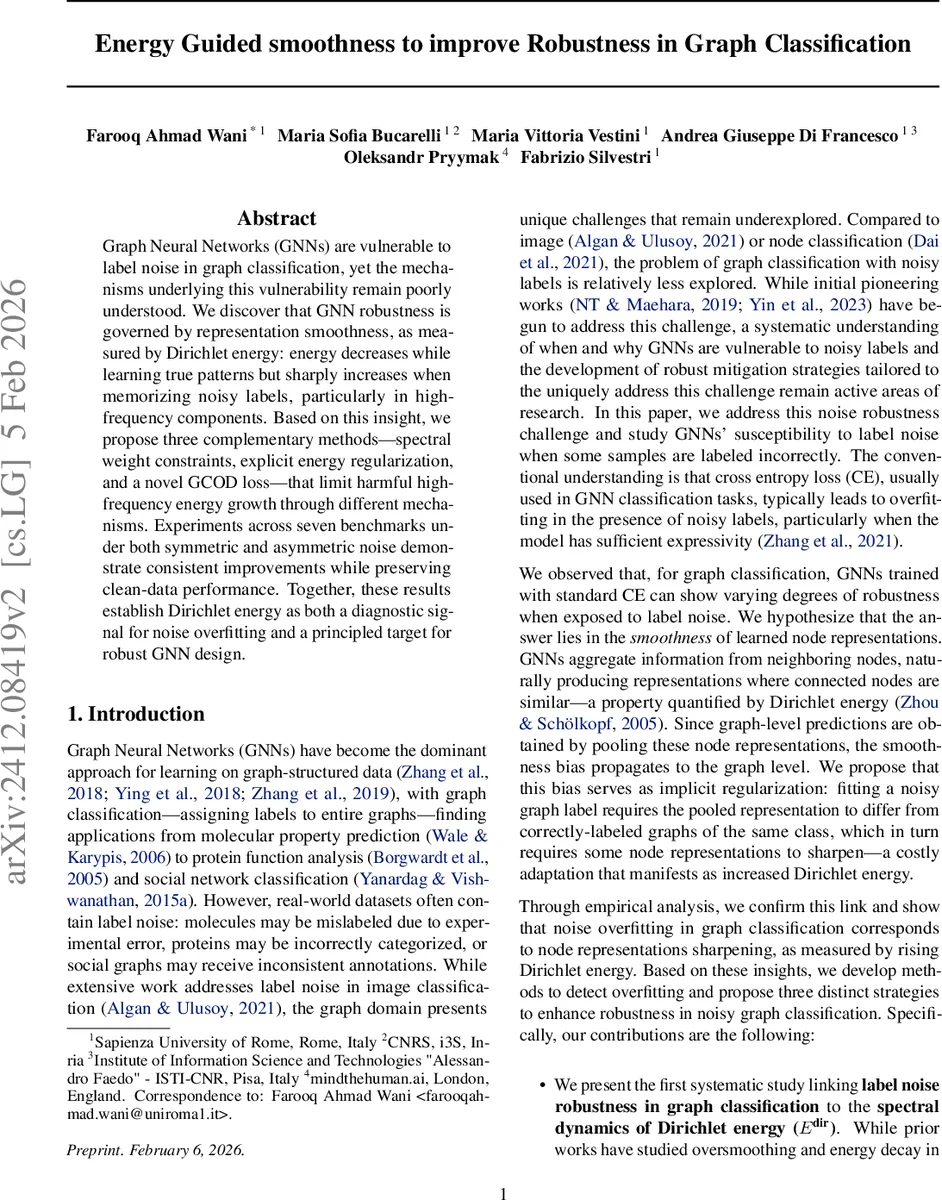
Graph Neural Networks (GNNs) are powerful at solving graph classification tasks, yet applied problems often contain noisy labels. In this work, we study GNN robustness to label noise, demonstrate GNN failure modes when models struggle to generalise on low-order graphs, low label coverage, or when a model is over-parameterized. We establish both empirical and theoretical links between GNN robustness and the reduction of the total Dirichlet Energy of learned node representations, which encapsulates the hypothesized GNN smoothness inductive bias. Finally, we introduce two training strategies to enhance GNN robustness: (1) by incorporating a novel inductive bias in the weight matrices through the removal of negative eigenvalues, connected to Dirichlet Energy minimization; (2) by extending to GNNs a loss penalty that promotes learned smoothness. Importantly, neither approach negatively impacts performance in noise-free settings, supporting our hypothesis that the source of GNNs robustness is their smoothness inductive bias.
💡 Research Summary
**
This paper investigates why graph neural networks (GNNs) for graph‑level classification are vulnerable to noisy labels and proposes three energy‑based strategies to improve robustness without sacrificing performance on clean data.
The authors first conduct a systematic empirical study, varying the number of classes, graph size, and training set proportion. They show that over‑parameterized models, small graphs, and limited training data cause GNNs to memorize noisy labels, as evidenced by a rapid rise in training accuracy on corrupted samples.
A key insight is that the Dirichlet energy (E_{\text{dir}}) of node embeddings—measuring the smoothness of representations across edges—behaves as a diagnostic signal. During early training, when the model captures true patterns, (E_{\text{dir}}) stays low (low‑frequency, smooth signals). Once the model starts fitting noise, high‑frequency components emerge and (E_{\text{dir}}) sharply increases. This phenomenon holds across multiple datasets and noise regimes (both symmetric and asymmetric).
Based on this observation, the paper proposes three complementary interventions that all aim to suppress harmful high‑frequency energy growth:
-
Spectral Weight Constraints – For each GNN layer, the weight matrix is eigendecomposed and any negative eigenvalues are clipped to zero. This forces the layer to act as a low‑pass filter, mathematically equivalent to minimizing Dirichlet energy.
-
Explicit Dirichlet Energy Regularization – The training loss is augmented with (\lambda E_{\text{dir}}(Z)), where (Z) denotes the final node embeddings. The regularizer directly penalizes high‑frequency representations, encouraging smoothness throughout learning.
-
GCOD Loss (Graph‑Centroid‑Oriented Discrepancy) – Class‑specific graph‑level centroids (\mu_c) are maintained. For a sample (i) with (possibly noisy) label (y_i), the loss combines a pull term toward its own centroid and a push term away from all other centroids. This re‑weights samples based on how well their embeddings align with the true class center, effectively down‑weighting noisy examples.
The authors evaluate the three methods on seven benchmark graph‑classification datasets (e.g., PROTEINS, MUTAG, PPA) under label‑noise rates from 10 % to 40 % and both symmetric and asymmetric noise. All three strategies consistently improve test accuracy compared with a standard cross‑entropy baseline, achieving an average gain of +6.3 % and up to +9.1 % in the hardest asymmetric setting. Importantly, when no noise is present, performance remains on par with the baseline, confirming that the added constraints do not hurt clean‑data generalization.
Ablation studies reveal that spectral constraints most directly curb high‑frequency growth, while the GCOD loss provides the strongest overall robustness when combined with the other two techniques. The paper also discusses computational trade‑offs: spectral clipping requires eigen‑decomposition (costly for very large graphs), energy regularization needs careful tuning of (\lambda), and GCOD introduces extra memory for class centroids.
In conclusion, the work establishes Dirichlet energy as both a diagnostic tool for detecting label‑noise overfitting and a principled target for designing robust GNNs. By integrating spectral weight clipping, energy regularization, and centroid‑based loss, the authors deliver a unified framework that markedly enhances GNN robustness to noisy graph labels while preserving clean‑data performance, opening avenues for future research on energy‑guided learning in other graph tasks and adversarial settings.
Comments & Academic Discussion
Loading comments...
Leave a Comment