On Lenstra's criterion for norm-Euclideanity of number fields and properties of Dedekind zeta-functions
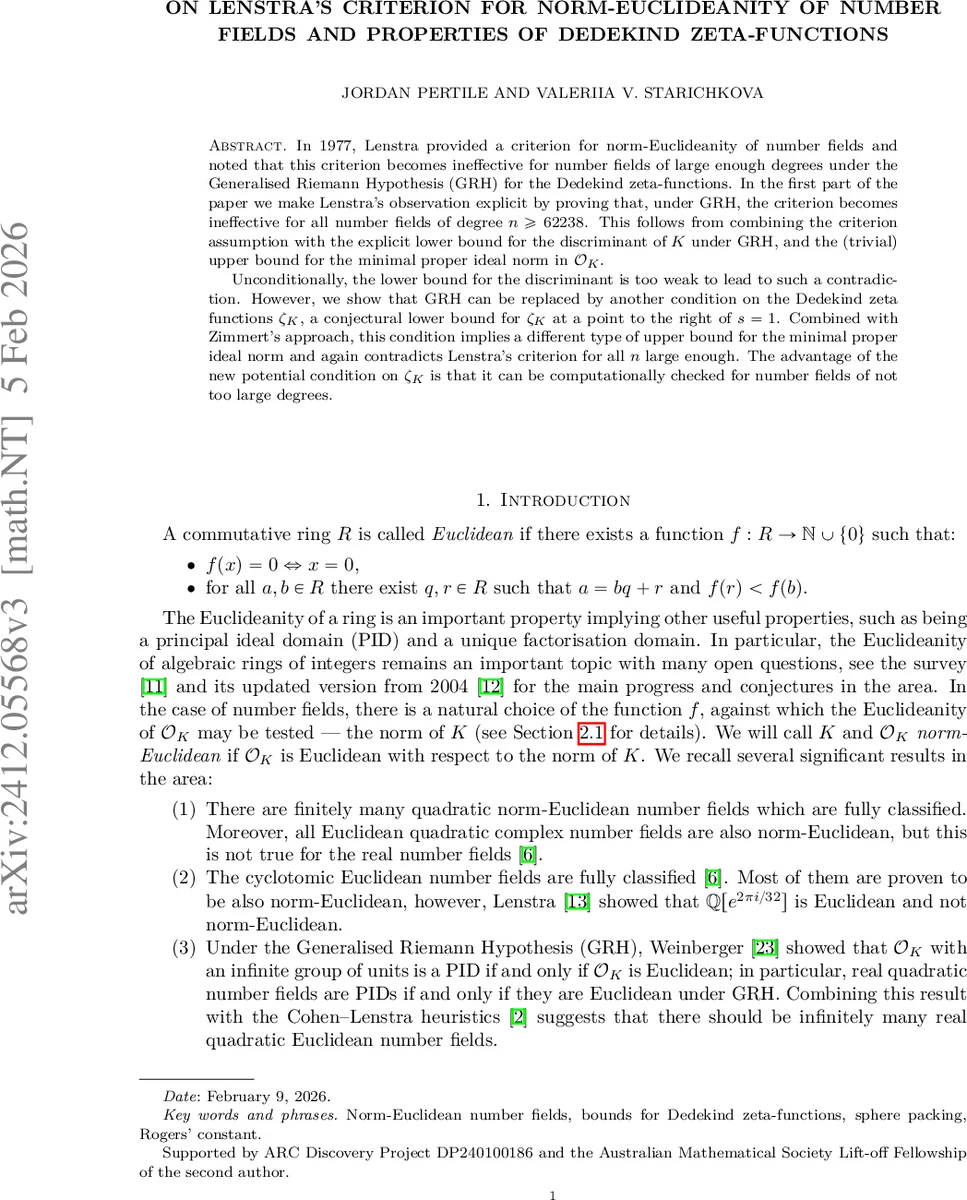
In 1977, Lenstra provided a criterion for norm-Euclideanity of number fields and noted that this criterion becomes ineffective for number fields of large enough degrees under the Generalised Riemann Hypothesis (GRH) for the Dedekind zeta-functions. In the first part of the paper we make Lenstra’s observation explicit by proving that, under GRH, the criterion becomes ineffective for all number fields of degree $n \geq 62238$. This follows from combining the criterion assumption with the explicit lower bound for the discriminant of $K$ under GRH, and the (trivial) upper bound for the minimal proper ideal norm in $\mathcal{O}_K$. Unconditionally, the lower bound for the discriminant is too weak to lead to such a contradiction. However, we show that GRH can be replaced by another condition on the Dedekind zeta functions $ζ_K$, a conjectural lower bound for $ζ_K$ at a point to the right of $s = 1$. Combined with Zimmert’s approach, this condition implies a different type of upper bound for the minimal proper ideal norm and again contradicts Lenstra’s criterion for all $n$ large enough. The advantage of the new potential condition on $ζ_K$ is that it can be computationally checked for number fields of not too large degrees.
💡 Research Summary
The paper revisits the 1977 Lenstra criterion for norm‑Euclidean number fields, which asserts that a number field $K$ of degree $n$ is norm‑Euclidean if its minimal non‑trivial ideal norm $M$ exceeds a certain multiple of the discriminant $|\Delta|$, the multiplier being the centre‑packing constant $\delta^\circ(U)$ of a bounded set $U\subset\mathbb R^n$. Lenstra gave two concrete choices for $U$: a unit cube $U_1$ and a sphere $U_2$. For $U_2$ the constant can be written as $\sigma_n\frac{4\pi n}{\Gamma(1+n/2)}$, where $\sigma_n$ is Rogers’ sphere‑packing constant. The paper first shows that, under the Generalised Riemann Hypothesis (GRH), the discriminant satisfies an explicit lower bound \
Comments & Academic Discussion
Loading comments...
Leave a Comment