Efficient Scene Modeling via Structure-Aware and Region-Prioritized 3D Gaussians
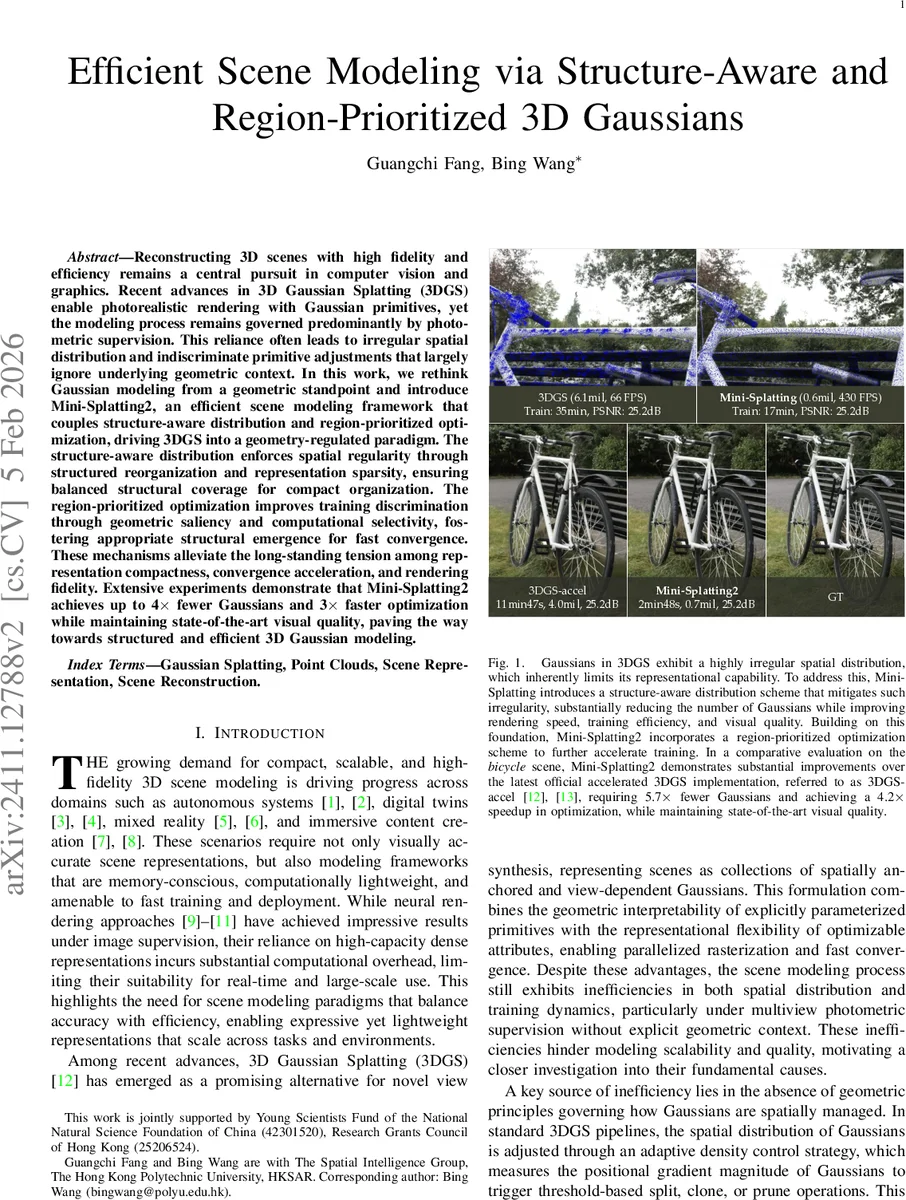
Reconstructing 3D scenes with high fidelity and efficiency remains a central pursuit in computer vision and graphics. Recent advances in 3D Gaussian Splatting (3DGS) enable photorealistic rendering with Gaussian primitives, yet the modeling process remains governed predominantly by photometric supervision. This reliance often leads to irregular spatial distribution and indiscriminate primitive adjustments that largely ignore underlying geometric context. In this work, we rethink Gaussian modeling from a geometric standpoint and introduce Mini-Splatting2, an efficient scene modeling framework that couples structure-aware distribution and region-prioritized optimization, driving 3DGS into a geometry-regulated paradigm. The structure-aware distribution enforces spatial regularity through structured reorganization and representation sparsity, ensuring balanced structural coverage for compact organization. The region-prioritized optimization improves training discrimination through geometric saliency and computational selectivity, fostering appropriate structural emergence for fast convergence. These mechanisms alleviate the long-standing tension among representation compactness, convergence acceleration, and rendering fidelity. Extensive experiments demonstrate that Mini-Splatting2 achieves up to 4$\times$ fewer Gaussians and 3$\times$ faster optimization while maintaining state-of-the-art visual quality, paving the way towards structured and efficient 3D Gaussian modeling.
💡 Research Summary
The paper addresses two fundamental inefficiencies in the prevailing 3D Gaussian Splatting (3DGS) pipelines: (1) irregular spatial distribution of Gaussians and (2) indiscriminate training dynamics that treat all primitives equally regardless of their geometric relevance. Existing 3DGS methods rely almost exclusively on photometric supervision; they adaptively split, clone, or prune Gaussians based on image‑space gradients. This leads to an over‑concentration of Gaussians on high‑contrast edges while leaving low‑contrast, structurally important regions under‑represented. Consequently, memory consumption, rasterization cost, and convergence speed suffer.
Mini‑Splatting2 proposes a unified framework that introduces (i) a structure‑aware distribution scheme and (ii) a region‑prioritized optimization scheme, both grounded in explicit geometric reasoning. The structure‑aware distribution comprises three components: (a) Blur‑Split, which detects blurry, low‑gradient regions by combining image blur metrics with gradient magnitude and injects additional Gaussians to improve coverage; (b) Depth Reinitialization, which aggregates multi‑view depth estimates to reposition Gaussians in depth‑error hotspots, thereby balancing the 3‑D layout; and (c) Redundant Gaussian Simplification, which includes (1) Intersection‑Preserving modeling that keeps Gaussians essential for ray‑mesh intersections while discarding redundant ones, and (2) Primitive Sampling, a stochastic sampling step that maintains a sparse yet informative set of primitives. Together these modules enforce spatial regularity, reduce the total number of Gaussians, and lower rasterization overhead without sacrificing reconstruction fidelity.
The region‑prioritized optimization introduces two complementary mechanisms: (a) Aggressive Model Growth, which first identifies Critical Gaussians—those contributing most to reconstruction error—and then performs Aggressive Gaussian Cloning to rapidly expand scene coverage in early training stages; and (b) Occluded Gaussian Culling, which estimates per‑view visibility from blended rendering weights, treating low‑visibility Gaussians as candidates for exclusion from both forward rasterization and backward gradient updates. This selective focus accelerates convergence by concentrating computation on geometrically salient regions and discarding updates for occluded or irrelevant primitives.
Extensive experiments on standard multi‑view benchmarks (including synthetic NeRF scenes and real‑world datasets such as Tanks‑and‑Temples) demonstrate that Mini‑Splatting2 achieves up to a 4× reduction in the number of Gaussians and a 3× speed‑up in optimization time compared to the accelerated 3DGS baseline (3DGS‑accel), while maintaining comparable or slightly better PSNR, SSIM, and LPIPS scores. Qualitative visualizations show that the proposed structure‑aware distribution eliminates the “over‑lapping” and “under‑reconstruction” artifacts typical of vanilla 3DGS, and the region‑prioritized optimization yields faster emergence of coherent geometry, especially in low‑texture areas.
The contributions are threefold: (1) a geometric analysis that pinpoints the root causes of inefficiency in existing 3DGS pipelines; (2) a novel distribution scheme that enforces spatial regularity and removes redundancy; (3) an optimization scheme that prioritizes geometrically informative regions, thereby reducing unnecessary computation. The authors also release code for reproducibility.
Limitations include the current focus on static scenes; extending the approach to dynamic environments would require additional mechanisms for handling temporal consistency. Moreover, the depth reinitialization step depends on reliable multi‑view depth estimation, which may be challenging in highly ambiguous or texture‑poor scenarios.
In summary, Mini‑Splatting2 re‑architects 3D Gaussian Splatting by embedding geometric priors into both the placement and training of Gaussians. This results in a more compact representation, faster convergence, and retained visual quality, making it a practical baseline for real‑world applications such as robotics, digital twins, and mixed‑reality content creation.
Comments & Academic Discussion
Loading comments...
Leave a Comment