Escape of quantum information across an analogue black hole horizon
The complete evaporation of black holes, as a natural endpoint of Hawking radiation, gives rise to the black hole information paradox, which fundamentally challenges the principles of unitarity and information conservation in quantum mechanics. Although the AdS/CFT correspondence indicates that information is preserved during black hole evaporation, the precise mechanism by which it is recovered from the Hawking radiation remains an open question. To explore a potential resolution, we investigate information transfer in an analog black hole spacetime realized through position-dependent coupling in an XY spin chain. We derive and demonstrate Page curve-like behavior, and analyze the transmission of quantum resources, such as entanglement and coherence, across the effective horizon. Our results show that quantum resources initially localized within an interior subsystem can be transferred to the exterior via particle radiation through the horizon. This study provides a novel perspective from quantum simulation on how information may escape from black holes, thereby contributing to the further understanding of the black hole information paradox.
💡 Research Summary
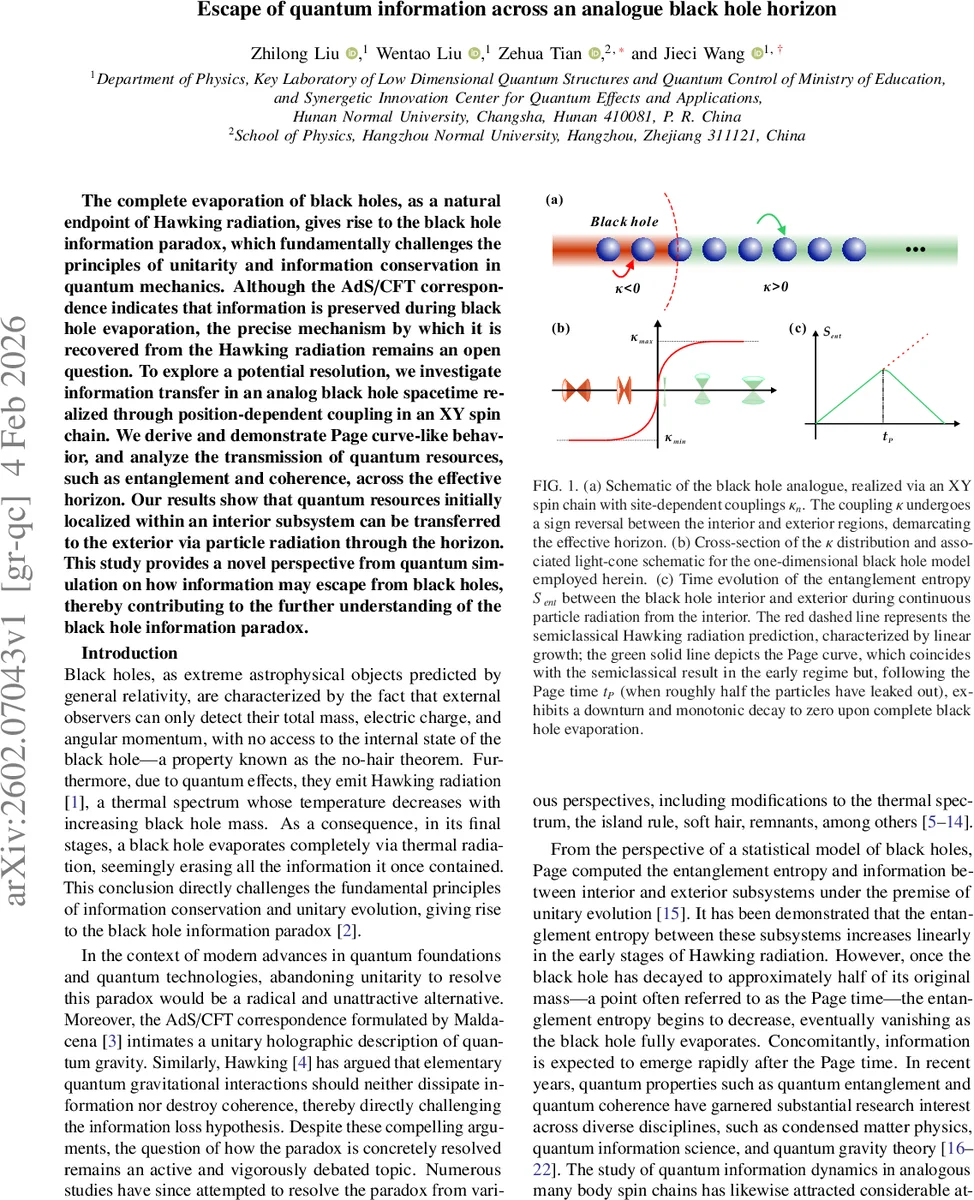
The authors address the black‑hole information paradox by constructing a quantum‑simulation platform that mimics a (1+1)‑dimensional black‑hole spacetime using a one‑dimensional XY spin chain with site‑dependent couplings. The coupling profile κₙ is engineered to follow the discretized metric function f(x) of a black‑hole geometry, such that κₙ changes sign at the horizon: negative inside the “black‑hole” region and positive outside. This sign reversal creates an effective event horizon separating a system (the interior spins) from a bath (the exterior spins). Near the horizon the coupling κ_c is strongly suppressed, reproducing the weakening of the light‑cone in a real black‑hole horizon and placing the system‑bath interaction in the weak‑coupling regime.
The initial state is prepared with two interior spins in a partially entangled Bell‑type state |ψ⟩ = α|↑↓⟩ + √(1−α²)|↓↑⟩, while all exterior spins are in their ground (|↓⟩) state, mimicking a vacuum bath. The full chain evolves unitarily under H = H_S + H_B + H_I, preserving global purity. However, reduced density matrices of the subsystem (interior) or bath become mixed, allowing the von Neumann entropy S_ent = −Tr ρ_S ln ρ_S to serve as a diagnostic of information flow.
Numerical simulations reveal a Page‑curve‑like behavior: at early times, excitations leak from the interior to the bath, causing S_ent to increase linearly, exactly as predicted by Hawking’s semiclassical picture. When roughly half of the initial excitations have escaped—a moment identified as the analogue Page time t_P—the entropy reaches a maximum and subsequently declines, eventually approaching zero in the limit of an infinite bath. For the finite bath used in the calculations a small residual entropy remains, which the authors attribute to finite‑size effects.
Beyond entropy, the paper quantifies the transfer of genuine quantum correlations. Concurrence C_AB is computed for two specific exterior qubits (the two outermost spins). When the interior is initially unentangled (α = 0), C_AB exhibits brief peaks followed by rapid decay, indicating only transient entanglement generated by particle emission. As α increases, the peaks become smaller but the baseline of C_AB rises, showing that a portion of the interior entanglement survives the radiation process and is continuously redistributed into the bath. A similar analysis for the interior nearest‑neighbor pair (sites 1 and 2) shows that their concurrence decays while simultaneously feeding entanglement into the exterior pair, confirming a bidirectional flow of quantum correlations.
Coherence is examined using an l₁‑norm based measure. Initially localized coherence in the interior diminishes as particles radiate, but a non‑zero coherence reappears in the bath, demonstrating that the radiation channel does not merely carry energy but also preserves phase information. The authors argue that the weak system‑bath coupling and the vacuum nature of the bath are essential for the emergence of the Page‑curve dynamics, in line with recent theoretical work on open quantum systems.
The model parameters (chain length L = 10, lattice spacing d = 2, κ_c ≈ 0.01 max|κₙ|) are chosen to be compatible with existing superconducting‑circuit or trapped‑ion platforms, suggesting that the predicted entropy turnover and entanglement transfer could be observed experimentally in the near term.
In summary, the paper makes three key contributions: (i) it demonstrates that a Page‑curve‑like entropy evolution naturally arises in a simple, experimentally realizable spin‑chain model of an analogue black hole; (ii) it provides a quantitative picture of how interior entanglement and coherence are transmitted to the exterior via Hawking‑like radiation; and (iii) it identifies the weak, horizon‑suppressed system‑bath coupling as a crucial ingredient for unitary information recovery. These results offer a concrete quantum‑simulation route to explore how information might escape from an evaporating black hole, thereby enriching the dialogue between quantum information theory and quantum gravity.
Comments & Academic Discussion
Loading comments...
Leave a Comment