Almost all primes are partially regular
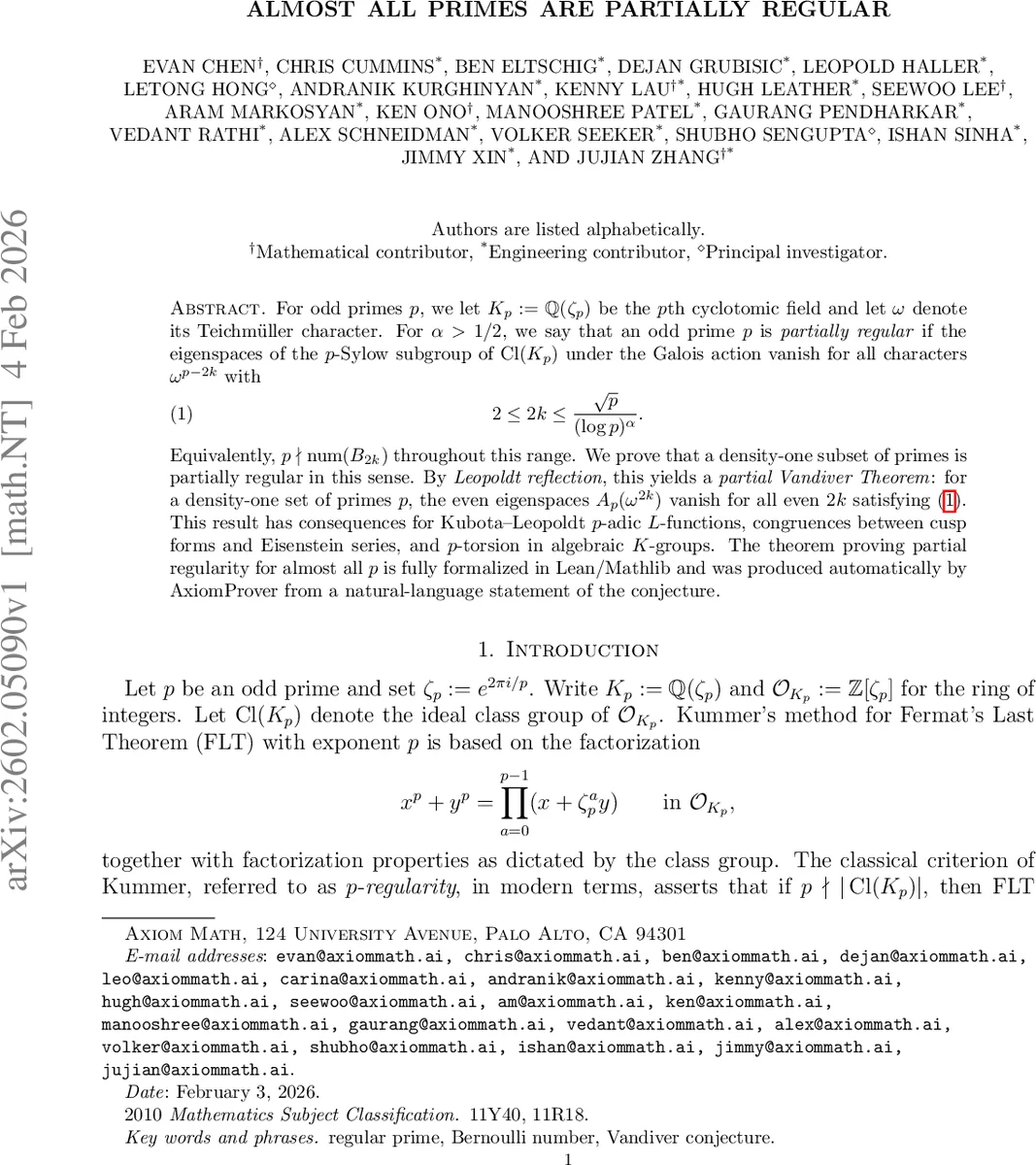
For odd primes $p$, we let $K_p:=\mathbb{Q}(ζ_p)$ be the $p$th cyclotomic field and let $ω$ denote its Teichmuller character. For $α>1/2$, we say that an odd prime $p$ is partially regular if the eigenspaces of the $p$-Sylow subgroup of $\operatorname{Cl}(K_p)$ under the Galois action vanish for all characters $ω^{p-2k}$ with [ 2\le 2k \le \frac{\sqrt{p}}{(\log p)^α}. ] Equivalently, $p\nmid \operatorname{num}(B_{2k})$ throughout this range. We prove that a density-one subset of primes is partially regular in this sense. By Leopoldt reflection, this yields a partial Vandiver Theorem: for a density-one set of primes $p$, the even eigenspaces $A_p(ω^{2k})$ vanish for all even $2k$ satisfying the inequality above. This result has consequences for Kubota-Leopoldt $p$-adic $L$-functions, congruences between cusp forms and Eisenstein series, and $p$-torsion in algebraic $K$-groups. The theorem proving partial regularity for almost all $p$ is fully formalized in Lean/Mathlib and was produced automatically by AxiomProver from a natural-language statement of the conjecture.
💡 Research Summary
The paper introduces the notion of “partial regularity” for odd primes p, weakening the classical notion of p‑regularity (which requires p∤B₂ₖ for every even 2k < p‑1) to a condition that only the Bernoulli numerators in a short initial range need to be prime‑free. Fix a real parameter α > ½ and define
Mₐ(p) = ⌊√p / (log p)ᵅ⌋.
A prime p is called Mₐ(p)‑regular if p does not divide the numerator of any Bernoulli number B₂ₖ with 2 ≤ 2k ≤ Mₐ(p). The main theorem (Theorem 1.1) asserts that the set of primes that fail to be Mₐ(p)‑regular has size
≤ Cₐ X / (log X)^{2α}
for X → ∞, where Cₐ is an absolute constant (in fact Cₐ = 10 works for all α > ½). Consequently, a density‑one subset of the primes is partially regular.
The proof proceeds by bounding the product
Pₘ = ∏_{k≤m} num(B₂ₖ).
Using Euler’s formula for ζ(2k) and the von Staudt–Clausen theorem, the authors obtain a logarithmic upper bound
log num(B₂ₖ) ≤ C₁ k log (2k)
and consequently
log Pₘ ≤ C₂ m² log m.
A standard estimate for the number of distinct prime divisors, ω(n) ≤ C₃ log n log log n, then yields
# {p ≤ X : p ∤ Mₐ(p)‑regular} ≤ ω(P_{Mₐ(p)}) ≤ Cₐ X / (log X)^{2α}.
Thus almost all primes satisfy the partial regularity condition.
Through Leopoldt’s reflection principle, the vanishing of the “odd” eigenspaces Aₚ(ω^{p−2k}) forces the vanishing of the corresponding “even” eigenspaces Aₚ(ω^{2k}). Hence Corollary 1.4 gives a partial Vandiver theorem: for a density‑one set of primes, Aₚ(ω^{2k}) = 0 for every even 2k ≤ Mₐ(p).
The authors then translate this algebraic vanishing into analytic statements via the Mazur–Wiles main conjecture in cyclotomic Iwasawa theory. If Aₚ(ω^{p−2k}) = 0, the associated Kubota–Leopoldt p‑adic L‑function Lₚ(s, ω^{2k}) becomes a unit in the Iwasawa algebra Λ = ℤₚ
Comments & Academic Discussion
Loading comments...
Leave a Comment