QuantumGS: Quantum Encoding Framework for Gaussian Splatting
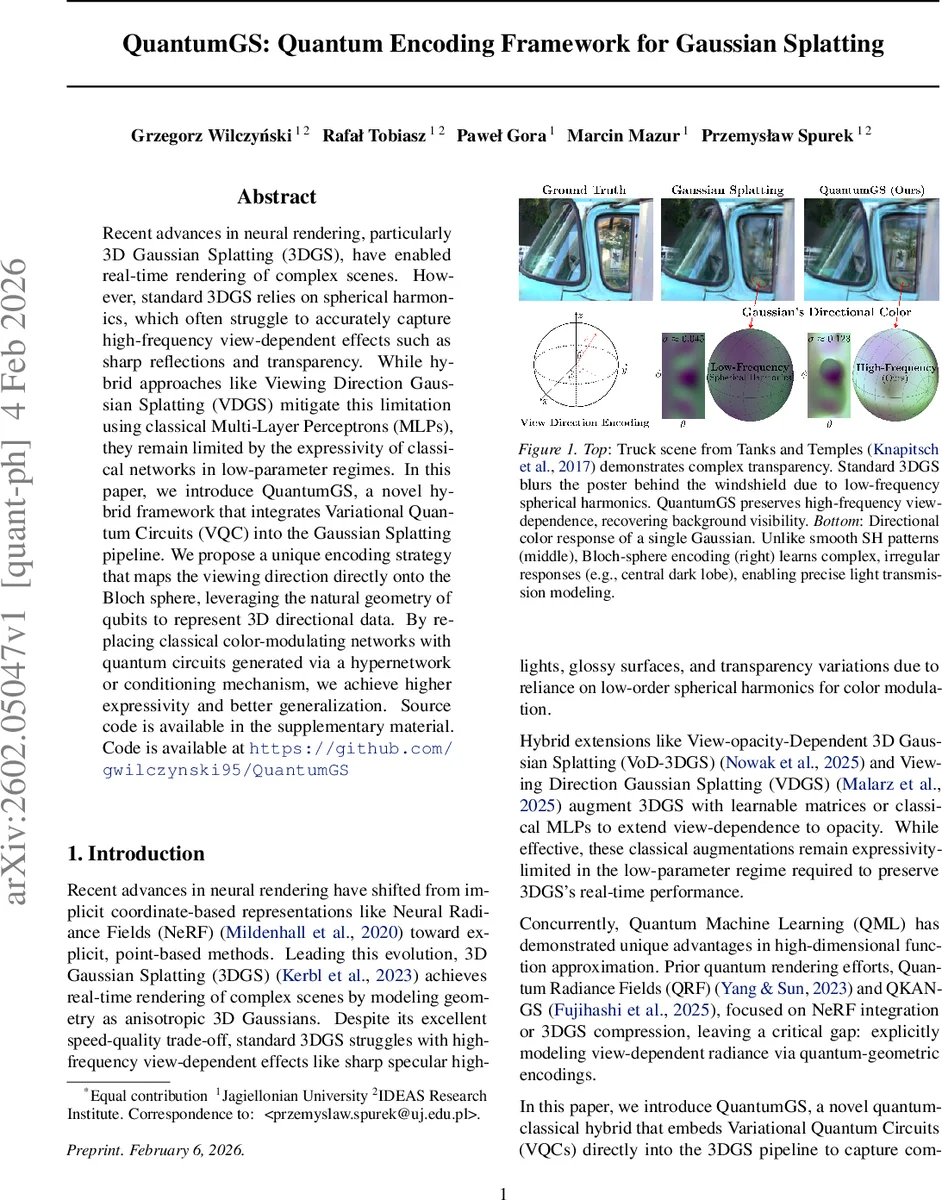
Recent advances in neural rendering, particularly 3D Gaussian Splatting (3DGS), have enabled real-time rendering of complex scenes. However, standard 3DGS relies on spherical harmonics, which often struggle to accurately capture high-frequency view-dependent effects such as sharp reflections and transparency. While hybrid approaches like Viewing Direction Gaussian Splatting (VDGS) mitigate this limitation using classical Multi-Layer Perceptrons (MLPs), they remain limited by the expressivity of classical networks in low-parameter regimes. In this paper, we introduce QuantumGS, a novel hybrid framework that integrates Variational Quantum Circuits (VQC) into the Gaussian Splatting pipeline. We propose a unique encoding strategy that maps the viewing direction directly onto the Bloch sphere, leveraging the natural geometry of qubits to represent 3D directional data. By replacing classical color-modulating networks with quantum circuits generated via a hypernetwork or conditioning mechanism, we achieve higher expressivity and better generalization. Source code is available in the supplementary material. Code is available at https://github.com/gwilczynski95/QuantumGS
💡 Research Summary
The paper introduces QuantumGS, a hybrid quantum‑classical framework that augments 3D Gaussian Splatting (3DGS) with variational quantum circuits (VQCs) to improve view‑dependent color and opacity modeling. Standard 3DGS represents scene geometry as a collection of anisotropic Gaussians and modulates their appearance using low‑order spherical harmonics (SH). While SH are efficient, they act as a low‑pass filter and cannot capture high‑frequency effects such as sharp specular highlights, thin transparent layers, or complex view‑dependent opacity variations. Existing extensions like Viewing‑Direction Gaussian Splatting (VDGS) or View‑Opacity‑Dependent 3DGS (VoD‑3DGS) replace SH with small multilayer perceptrons (MLPs), but the limited parameter budget required for real‑time performance still restricts expressivity.
QuantumGS tackles this limitation by encoding the viewing direction directly onto the Bloch sphere, the geometric representation of a pure qubit state. A normalized direction vector d = (dx, dy, dz) is transformed into polar and azimuthal angles (θ = arccos(dz), φ = atan2(dy, dx)). These angles drive single‑qubit rotation gates R_y(θ) and R_z(φ) applied to each of three qubits, producing an initial quantum state |ψ_enc⟩ that faithfully preserves the SO(3) symmetry of the direction space. This “Bloch‑sphere directional encoding” replaces the Euclidean coordinate input used by classical pipelines and provides a continuous, rotation‑aware representation.
The encoded state is processed by a variational quantum circuit consisting of L = 4 layers. Each layer applies (1) parameterized single‑qubit rotations R_j(θ_j,ℓ, φ_j,ℓ) = R_z(φ_j,ℓ) R_y(θ_j,ℓ) on every qubit j, followed by (2) a cyclic entanglement pattern realized with three CNOT gates (0→1, 1→2, 2→0). This ring topology creates correlations among the three qubits, which the authors interpret as a joint representation of the RGB channels and opacity. After the final layer, the circuit’s output |ψ_out⟩ is measured in the computational (Z) basis, yielding expectation values ⟨Z_j⟩ ∈
Comments & Academic Discussion
Loading comments...
Leave a Comment