Instability of G/M/c queues under stochastic resetting in the interval
Proper management of resources whose arrival and consumption are subject to environmental randomness is an intrinsic process in both natural and artificial systems. This phenomenon can be modeled as a queuing process whose arrival distribution is determined by a search process with stochastic resetting. When the queuing system has a limited number of servers and the search process occurs within a bounded domain, the dynamics of expediting or delaying the search through stochastic resetting interact with the long-term dynamics of the number of resources in the queue. We combine results from queuing theory with those from search processes with stochastic resetting in a bounded domain to obtain regions of the parameter space of the search process that ensure convergence of the number of resources in the queue to a steady state. Furthermore, we find a threshold resetting rate at which the effects of stochastic resetting shift from reducing convergence regions to expanding them. Finally, we demonstrate that this threshold value grows exponentially with the number of servers, making it harder for stochastic resetting to improve the convergence of the queueing system.
💡 Research Summary
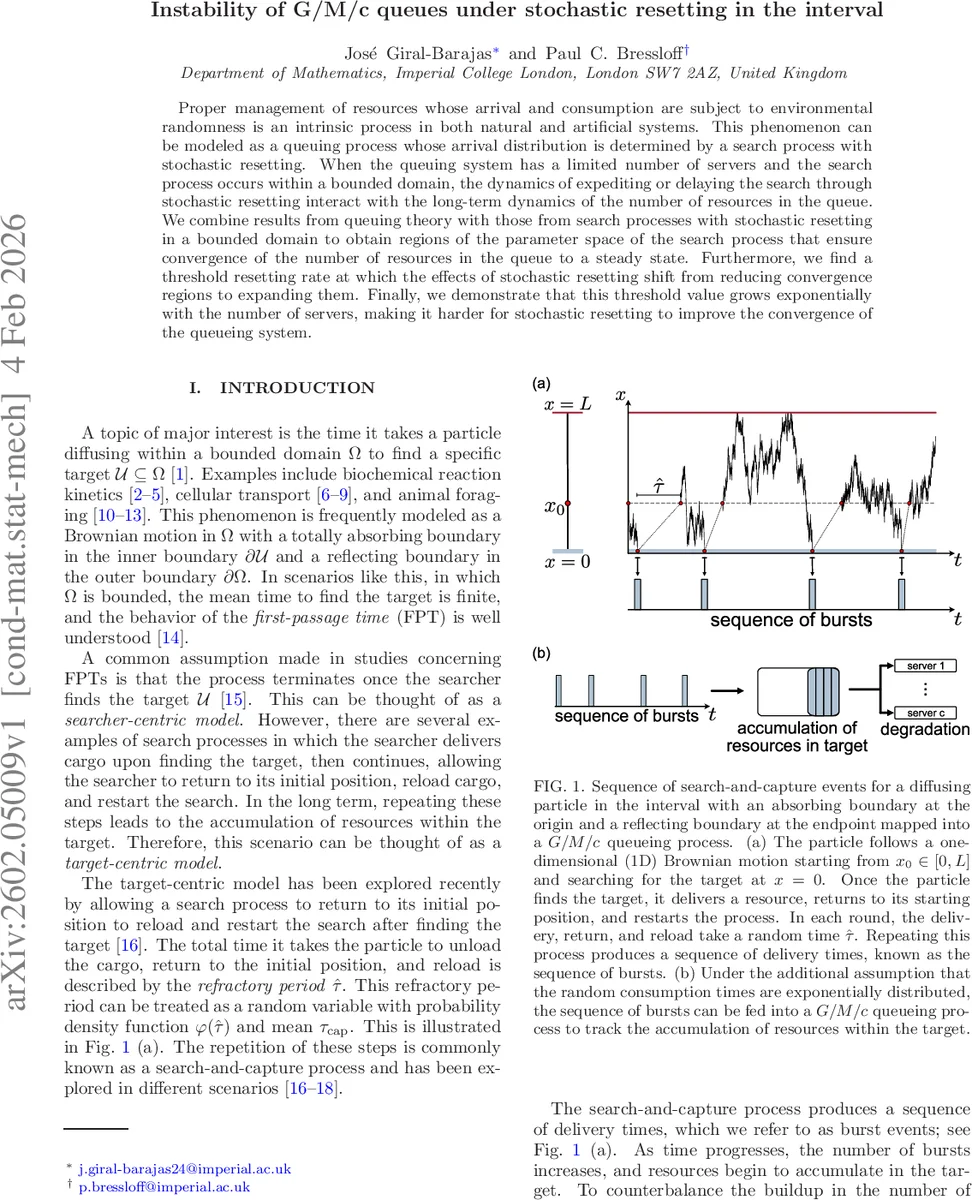
The paper investigates how stochastic resetting influences the stability of a G/M/c queue that arises from a “search‑and‑capture” process in a bounded one‑dimensional domain. A diffusing particle searches for an absorbing target at one end of the interval
Comments & Academic Discussion
Loading comments...
Leave a Comment