ASPIRE: The Environments and Dark Matter Halos of Luminous Quasars in the Epoch of Reionization
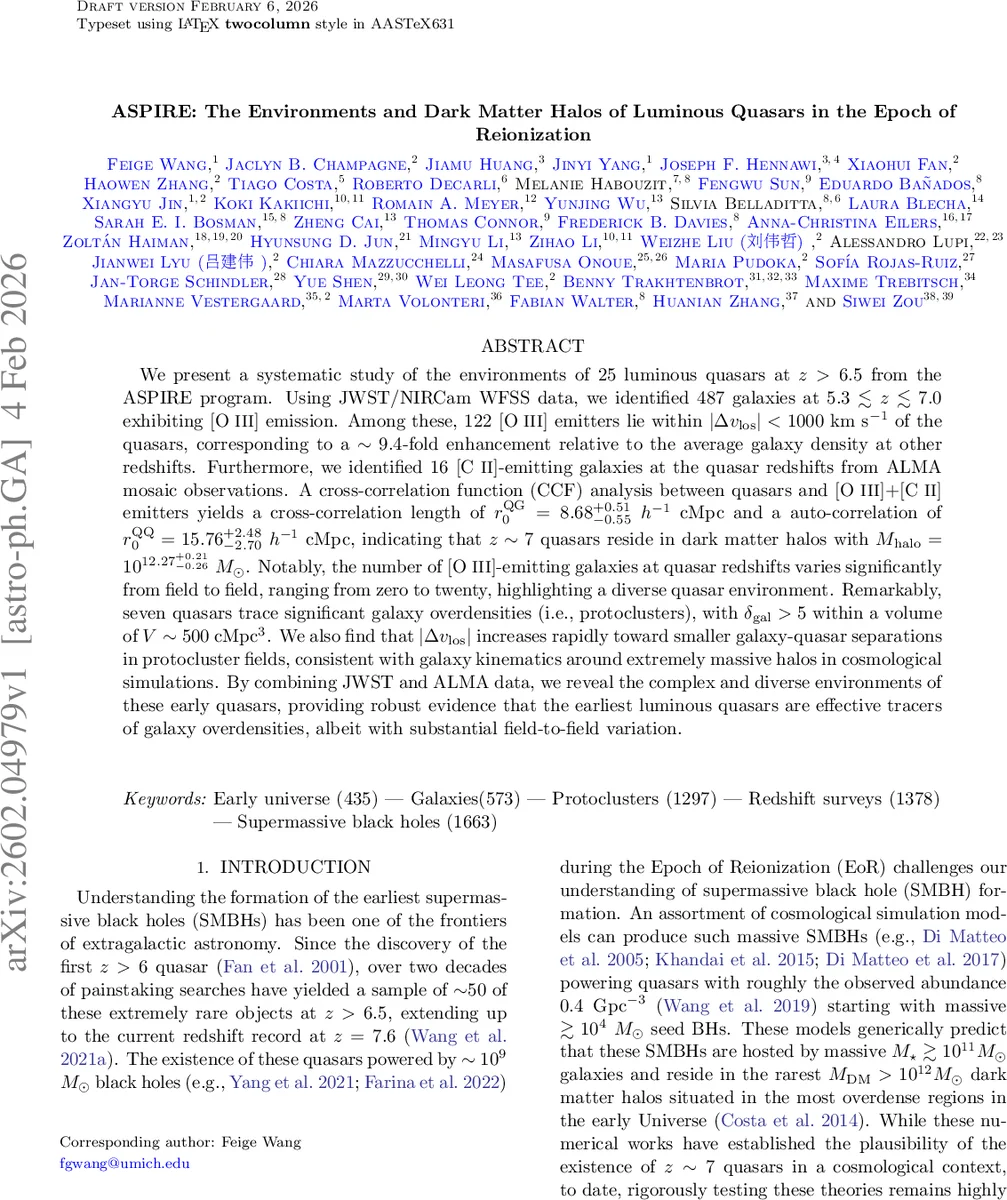
We present a systematic study of the environments of 25 luminous quasars at $z > 6.5$ from the ASPIRE program. Using JWST/NIRCam WFSS data, we identified 487 galaxies at $5.3 \lesssim z \lesssim 7.0$ exhibiting [OIII] emission. Among these, 122 [OIII] emitters lie within $|Δv_{\rm los}| < 1000~{\rm kms^{-1}}$ of the quasars, corresponding to a $\sim9.4$-fold enhancement relative to the average galaxy density at other redshifts. Furthermore, we identified 16 [CII]-emitting galaxies at the quasar redshifts from ALMA mosaic observations. A cross-correlation function (CCF) analysis between quasars and [OIII]+[CII] emitters yields a cross-correlation length of $r_0^{\rm QG} = 8.68^{+0.51}{-0.55}{\rm cMpc^3}$. We also find that $|Δv_{\rm los}|$ increases rapidly toward smaller galaxy-quasar separations in protocluster fields, consistent with galaxy kinematics around extremely massive halos in cosmological simulations. By combining JWST and ALMA data, we reveal the complex and diverse environments of these early quasars, providing robust evidence that the earliest luminous quasars are effective tracers of galaxy overdensities, albeit with substantial field-to-field variation.h^{-1}\mathrm{cMpc}$ and a auto-correlation of $r_0^{\rm{QQ}}=15.76^{+2.48}{-2.70}h^{-1}{\rm cMpc}$, indicating that $z \sim 7$ quasars reside in dark matter halos with $M_{\rm halo} = 10^{12.27^{+0.21}{-0.26}}~M\odot$. Notably, the number of [OIII]-emitting galaxies at quasar redshifts varies significantly from field to field, ranging from zero to twenty, highlighting a diverse quasar environment. Remarkably, seven quasars trace significant galaxy overdensities (i.e., protoclusters), with $δ_{\rm gal} > 5$ within a volume of $V \sim 500
💡 Research Summary
The ASPIRE (A Spectroscopic Survey of Biased Halos in the Reionization Era) program targets a flux‑limited sample of 25 luminous quasars at redshifts 6.5 < z ≲ 6.8 (absolute magnitude M₁₄₅₀ < –25). Using JWST/NIRCam wide‑field slitless spectroscopy (WFSS) in the F356W filter (3–4 µm) and simultaneous imaging in F200W/F115W, the team obtained a spectroscopic redshift survey of galaxies in the immediate vicinity of each quasar. The WFSS data reach a line‑flux limit of ≈2 × 10⁻¹⁸ erg s⁻¹ cm⁻², enabling the detection of strong Hβ +
Comments & Academic Discussion
Loading comments...
Leave a Comment