Information, Dissipation, and Planckian Optimality
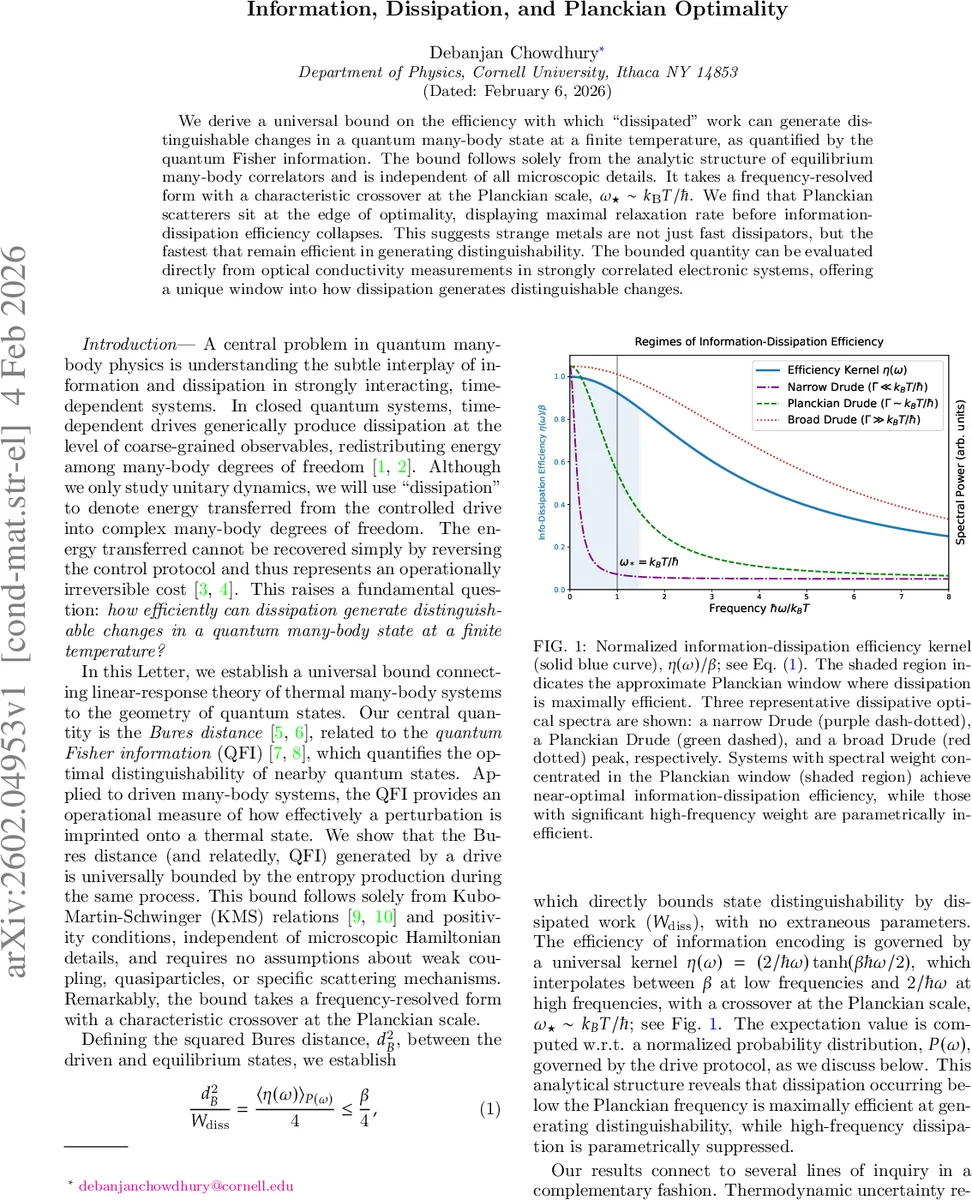
We derive a universal bound on the efficiency with which “dissipated” work can generate distinguishable changes in a quantum many-body state at a finite temperature, as quantified by the quantum Fisher information. The bound follows solely from the analytic structure of equilibrium many-body correlators and is independent of all microscopic details. It takes a frequency-resolved form with a characteristic crossover at the Planckian scale, $ω_\star\sim k_B T/\hbar$. We find that Planckian scatterers sit at the edge of optimality, displaying maximal relaxation rate before information-dissipation efficiency collapses. This suggests strange metals are not just fast dissipators, but the fastest that remain efficient in generating distinguishability. The bounded quantity can be evaluated directly from optical conductivity measurements in strongly correlated electronic systems, offering a unique window into how dissipation generates distinguishable changes.
💡 Research Summary
The paper establishes a universal, temperature‑dependent bound that links the amount of “dissipated” work performed by an external drive on a quantum many‑body system in thermal equilibrium to the distinguishability of the resulting state, quantified by the quantum Fisher information (QFI). Starting from a Gibbs state ρβ = e⁻ᵝᴴ⁰/Z, the authors consider a spatially uniform, time‑dependent vector potential A(t)=θ λ(t) minimally coupled to the total current operator J. The parameter θ controls the drive strength while λ(t) is a dimensionless pulse shape that vanishes at long times.
In the interaction picture the unitary evolution to leading order in θ is Uθ(t)=e⁻ⁱᴴ⁰ᵗ/ℏ
Comments & Academic Discussion
Loading comments...
Leave a Comment