Beyond the Control Equations: An Artifact Study of Implementation Quality in Robot Control Software
A controller – a software module managing hardware behavior – is a key component of a typical robot system. While control theory gives safety guarantees for standard controller designs, the practical implementation of controllers in software introduces complexities that are often overlooked. Controllers are often designed in continuous space, while the software is executed in discrete space, undermining some of the theoretical guarantees. Despite extensive research on control theory and control modeling, little attention has been paid to the implementations of controllers and how their theoretical guarantees are ensured in real-world software systems. We investigate 184 real-world controller implementations in open-source robot software. We examine their application context, the implementation characteristics, and the testing methods employed to ensure correctness. We find that the implementations often handle discretization in an ad hoc manner, leading to potential issues with real-time reliability. Challenges such as timing inconsistencies, lack of proper error handling, and inadequate consideration of real-time constraints further complicate matters. Testing practices are superficial, no systematic verification of theoretical guarantees is used, leaving possible inconsistencies between expected and actual behavior. Our findings highlight the need for improved implementation guidelines and rigorous verification techniques to ensure the reliability and safety of robotic controllers in practice.
💡 Research Summary
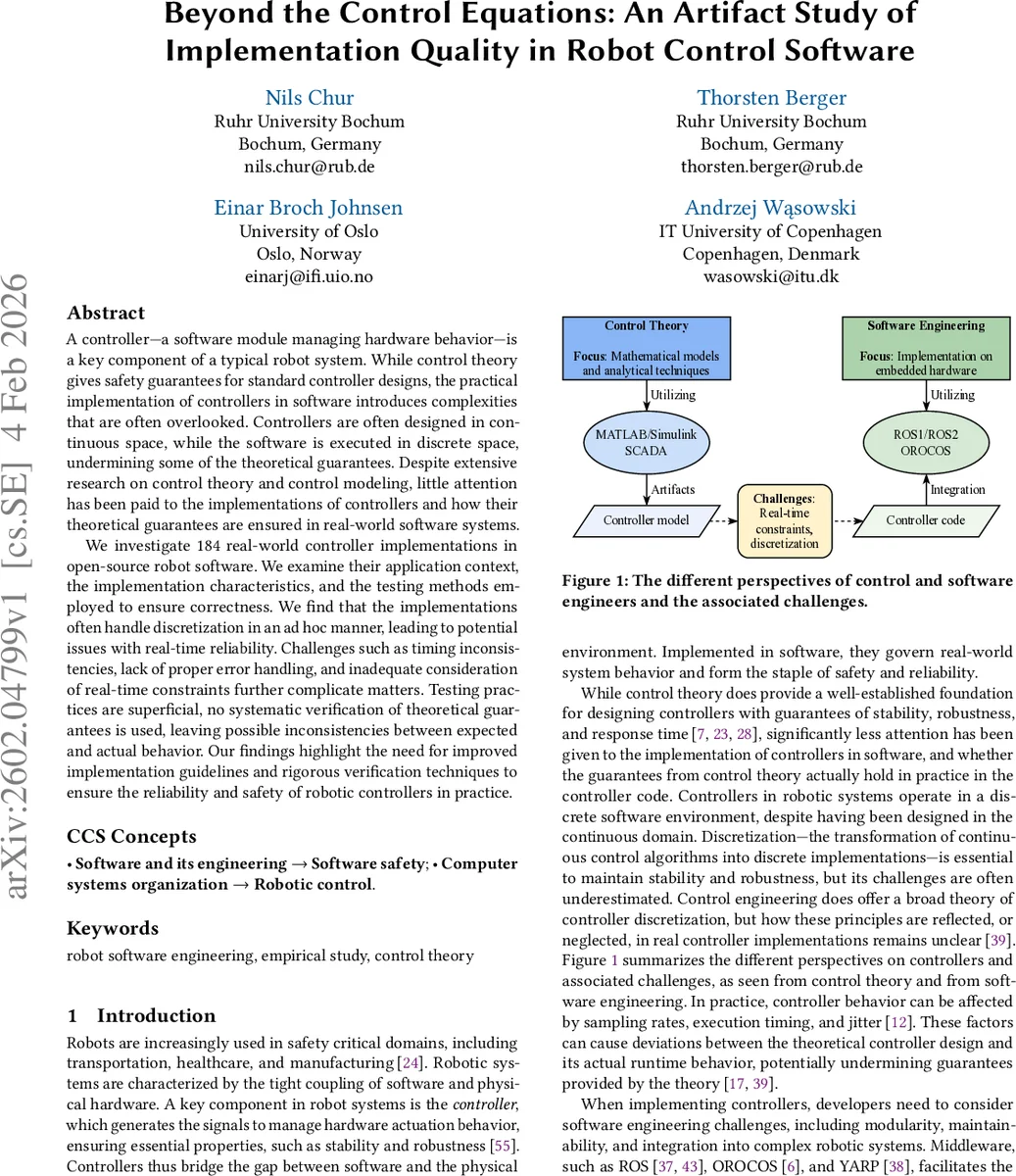
The paper “Beyond the Control Equations: An Artifact Study of Implementation Quality in Robot Control Software” presents a large‑scale empirical investigation of how robot controllers—software modules that translate control‑theoretic designs into executable code—are actually implemented in open‑source ROS/ROS2 projects and what quality‑assurance practices surround them. The authors start from the observation that control theory provides strong guarantees (stability, robustness, bounded response time) under continuous‑time assumptions, yet real robot software runs in a discrete, often non‑real‑time environment. This mismatch can erode the theoretical guarantees, but the literature has paid little attention to the implementation side.
To fill this gap, the authors collected 450 candidate repositories from GitHub using the keywords “ROS” (or “ROS2”) and “Controller”, applied a star‑count filter for ROS1 (≥5 stars), and then manually screened them against inclusion criteria (ROS usage, robotics domain, presence of controller code in C++/Python) and exclusion criteria (driver‑only projects, joystick‑controlled systems, lack of documentation). After this rigorous filtering, 141 repositories (78 ROS1, 63 ROS2) remained, containing a total of 184 distinct controller implementations.
The analysis proceeds in three parts. First, the authors categorize the application contexts (mobile platforms, manipulators, drones, etc.) and identify the most common control laws (PID, LQR, MPC, etc.). Second, they examine the source code to understand how continuous‑time designs are discretized, how the control loop is structured, whether real‑time constraints are respected, and how safety‑critical aspects (e.g., handling of stale sensor data, error handling) are addressed. Third, they investigate verification and validation (V&V) practices, looking for unit tests, simulation‑based tests, hardware‑in‑the‑loop (HIL) setups, and any formal verification tools.
Key findings include:
-
Implicit Discretization – The majority of controllers rely on “ad‑hoc” discretization, often delegating the sampling logic to ROS middleware without explicitly defining a fixed sampling period or accounting for jitter. This implicit approach contradicts the fixed‑interval assumption required by many control‑theoretic guarantees, potentially leading to instability or degraded performance under load.
-
Real‑Time Violations – Many implementations run on standard Linux kernels using ROS timers, which do not guarantee hard real‑time behavior. Consequently, loop periods vary, and outdated sensor readings are sometimes used because there is no explicit freshness check.
-
Sparse Error Handling – Safety‑critical error handling (e.g., fallback to safe mode, detection of communication loss) is largely absent. Controllers often assume that all inputs are valid and that the hardware will always respond within the expected time window.
-
Superficial Testing – Only a small fraction of projects contain unit tests, and those that do usually test trivial functions (e.g., getters/setters). Simulation tests are occasionally present, but they rarely compare the simulated controller’s behavior against the mathematical model’s guarantees. No project employed formal verification tools (e.g., model checking, theorem proving) to validate stability or convergence properties.
-
Tool Support Gaps – While MATLAB/Simulink can generate code with built‑in discretization, many projects either modify the generated code manually or write controllers from scratch, losing the guarantees that the code‑generation pipeline provides.
The authors argue that these issues stem from a cultural and educational divide: control engineers often lack software quality‑assurance expertise, while software engineers are unfamiliar with the nuances of control‑theoretic discretization and stability analysis. Middleware such as ros_control focuses on integration rather than on guiding developers through safe discretization and real‑time design.
Based on the empirical evidence, the paper calls for:
-
Explicit Discretization Guidelines – Standardized patterns for converting continuous‑time designs (e.g., Z‑transform, Tustin approximation) into discrete implementations, with clear documentation of sampling periods and jitter tolerances.
-
Real‑Time‑Aware Middleware Extensions – Enhancements to ROS/ROS2 that allow developers to declare hard real‑time requirements and automatically enforce them (e.g., by binding controllers to real‑time threads or using PREEMPT_RT kernels).
-
Robust Safety Mechanisms – Built‑in checks for stale data, timeout handling, and safe‑mode fallbacks that can be reused across projects.
-
Systematic V&V Pipelines – Integration of unit testing, simulation‑based regression testing, and hardware‑in‑the‑loop testing, complemented by formal methods (model checking, static analysis) that can verify that the implemented controller respects the stability and robustness properties proved on paper.
The study’s contribution lies in providing the first large‑scale, artifact‑based snapshot of how robot controllers are actually built in the wild, exposing a systematic gap between theory and practice, and offering concrete research directions to bridge that gap. The authors make their dataset publicly available, inviting the community to extend the analysis and to develop tooling that can raise the overall reliability and safety of robotic control software.
Comments & Academic Discussion
Loading comments...
Leave a Comment