Exact Volumes of Semi-Algebraic Convex Bodies
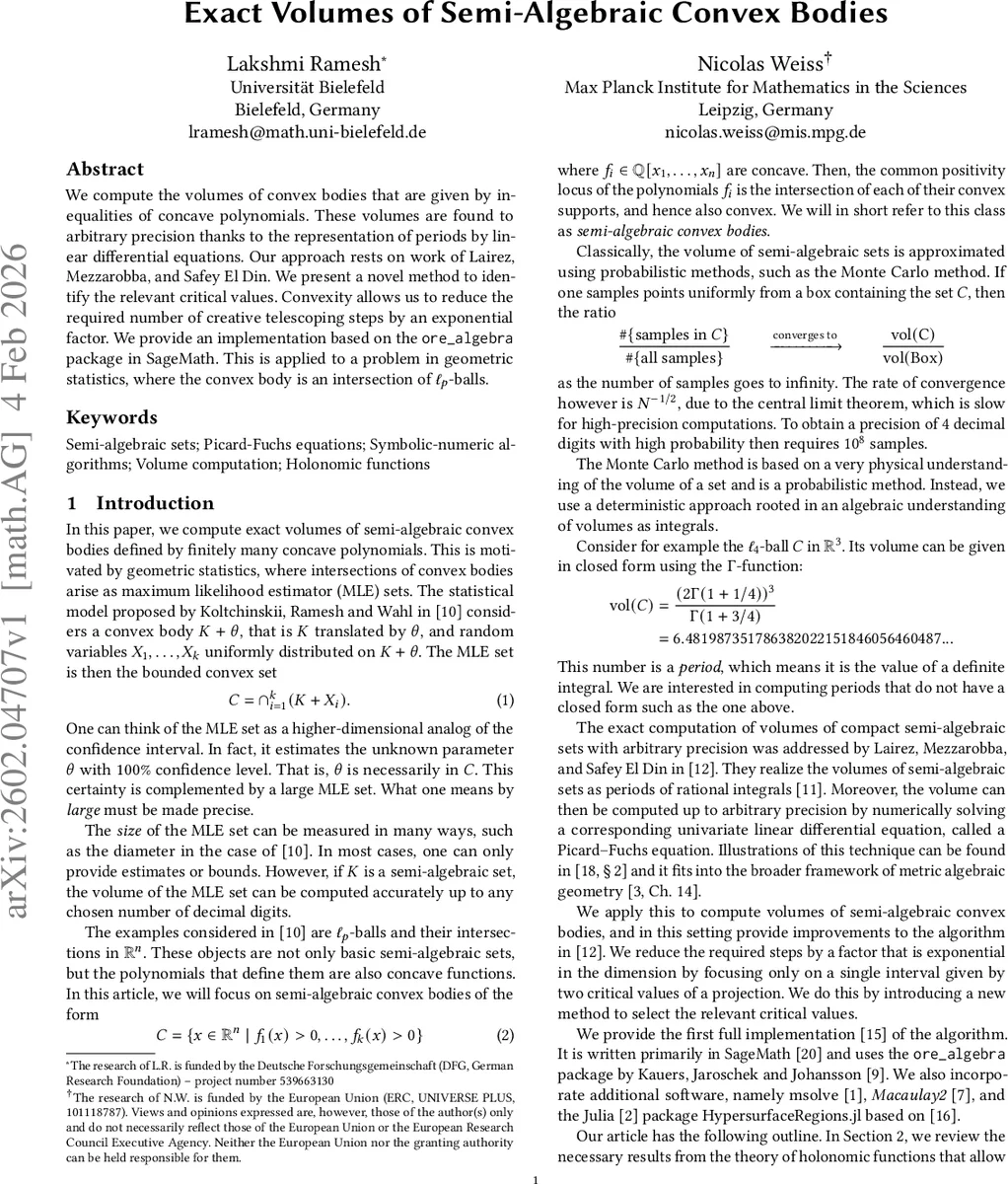
We compute the volumes of convex bodies that are given by inequalities of concave polynomials. These volumes are found to arbitrary precision thanks to the representation of periods by linear differential equations. Our approach rests on work of Lairez, Mezzarobba, and Safey El Din. We present a novel method to identify the relevant critical values. Convexity allows us to reduce the required number of creative telescoping steps by an exponential factor. We provide an implementation based on the ore_algebra package in SageMath. This is applied to a problem in geometric statistics, where the convex body is an intersection of $\ell_p$-balls.
💡 Research Summary
The paper presents a deterministic, high‑precision algorithm for computing the exact volume of convex semi‑algebraic bodies defined by a finite collection of concave polynomials. The authors reinterpret the volume as a period of a rational integral that depends on a single deformation parameter t. By introducing the family Cₜ = { x ∈ ℝⁿ | ∏{i=1}^k f_i(x) − t > 0 }, they show that the volume function φ(t)=vol(Cₜ) is a period of the rational function A(t,x) = (∂{x₁}F_t)·x₁/F_t, where F_t = ∏ f_i − t. Classical results on holonomic functions guarantee that φ(t) satisfies a linear differential equation with polynomial coefficients—a Picard–Fuchs operator Pₜ∈Dₜ.
The core computational task is to obtain Pₜ via creative telescoping, i.e., to eliminate the integration variables from the annihilating D‑ideal of A(t,x). In the general semi‑algebraic setting, each elimination step may generate many critical values of the projection maps, leading to an exponential blow‑up in the number of integration intervals and certificates. The authors exploit the convexity of the underlying set to prove that, for any coordinate projection, only two adjacent critical values bound the region where the volume varies. Consequently, the recursive algorithm needs to consider a single interval (c₁,c₂) rather than a combinatorial collection of intervals, reducing the number of creative‑telescoping steps by an exponential factor in the dimension.
Algorithmically, the procedure works as follows:
- Construction of the deformation: Define F_t and the associated rational form A(t,x). Build the holonomic left ideal I_t generated by the relations A∂_α − ∂_α·A for all variables α∈{x₁,…,x_n,t}.
- Creative telescoping: Use the ore_algebra package (SageMath) to compute the integration ideal with respect to t, yielding the Picard–Fuchs operator Pₜ.
- Selection of suitable evaluation points: Determine ord(Pₜ) distinct values of t inside the interval (0,ε), where ε is the smallest positive singular value of Pₜ. The subroutine
SuitableValuesautomates this choice. - Recursive evaluation of initial conditions: For each chosen t‑value, compute vol(Cₜ) by recursively applying the same algorithm to lower‑dimensional slices of Cₜ. The slice volumes are themselves periods and satisfy lower‑dimensional Picard–Fuchs equations.
- Solving the differential equation: Assemble the list of initial conditions and solve Pₜ·φ=0 numerically with arbitrary precision (using Arb via ore_algebra). Analytic continuation to t=0 yields vol(C).
The implementation integrates several computer‑algebra tools: ore_algebra for D‑module operations and high‑precision ODE solving, msolve for Gröbner basis computations, Macaulay2 for ideal manipulations, and the Julia package HypersurfaceRegions.jl for critical‑value analysis. The authors provide a fully functional SageMath library that, given the defining polynomials and a target precision N, returns vol(C) to N binary digits.
Experimental results focus on intersections of ℓₚ‑balls (p = 2, 4, 6) in dimensions up to ten. The algorithm computes 100–200 decimal digits of volume within seconds, whereas a Monte‑Carlo estimator would require on the order of 10⁸–10⁹ samples for comparable accuracy. Moreover, the observed runtime scales roughly as 2ⁿ, confirming the theoretical reduction from the naïve exponential (≈eⁿ) cost of generic creative telescoping.
Key contributions of the paper are:
- Convexity‑driven critical‑value reduction – a novel proof that only two critical values are relevant for each projection, leading to an exponential speed‑up.
- Fully automated high‑precision pipeline – a SageMath‑based implementation that hides the intricate D‑module machinery from the end‑user.
- Application to geometric statistics – exact volumes of MLE sets (convex intersections) become tractable, opening new avenues for rigorous statistical inference.
- Open‑source software – the code is released publicly, encouraging reproducibility and further development.
The authors suggest several future directions: extending the critical‑value selection to non‑convex semi‑algebraic sets, handling families with multiple deformation parameters (multivariate Picard–Fuchs systems), and exploiting parallelism in the recursive volume evaluations. Overall, the work bridges symbolic‑numeric computation, algebraic geometry, and statistical applications, providing a powerful tool for exact volume computation in high dimensions.
Comments & Academic Discussion
Loading comments...
Leave a Comment