Discussing Your Needs in VR: A Novel Approach through Persona-based Stakeholder Role-Playing
In this study, we propose a novel approach that supports requirements discussions in virtual environments by automatically generating personas from real-time speech-to-text data. In our pilot experiment, 18 participants (14 from universities and 4 from IT companies) used the generated personas to discuss accessibility requirements within the virtual environment. Participants reported a relatively high level of satisfaction with the social presence and usability of the VR system. We also found that requirements discussions based on personas have a lower workload. Finally, we outline the main directions for future work.
💡 Research Summary
The paper introduces a novel virtual‑reality (VR) system that automatically generates stakeholder personas from real‑time speech‑to‑text data and uses these personas to facilitate requirements discussions, with a focus on accessibility concerns. The authors note that while VR has been explored for requirements engineering (RE), existing platforms typically only provide basic audio/video communication and lack dedicated support for persona‑driven elicitation. Personas are a well‑established RE artefact for capturing stakeholder perspectives, but manual creation is time‑consuming and may not scale to distributed, multinational teams.
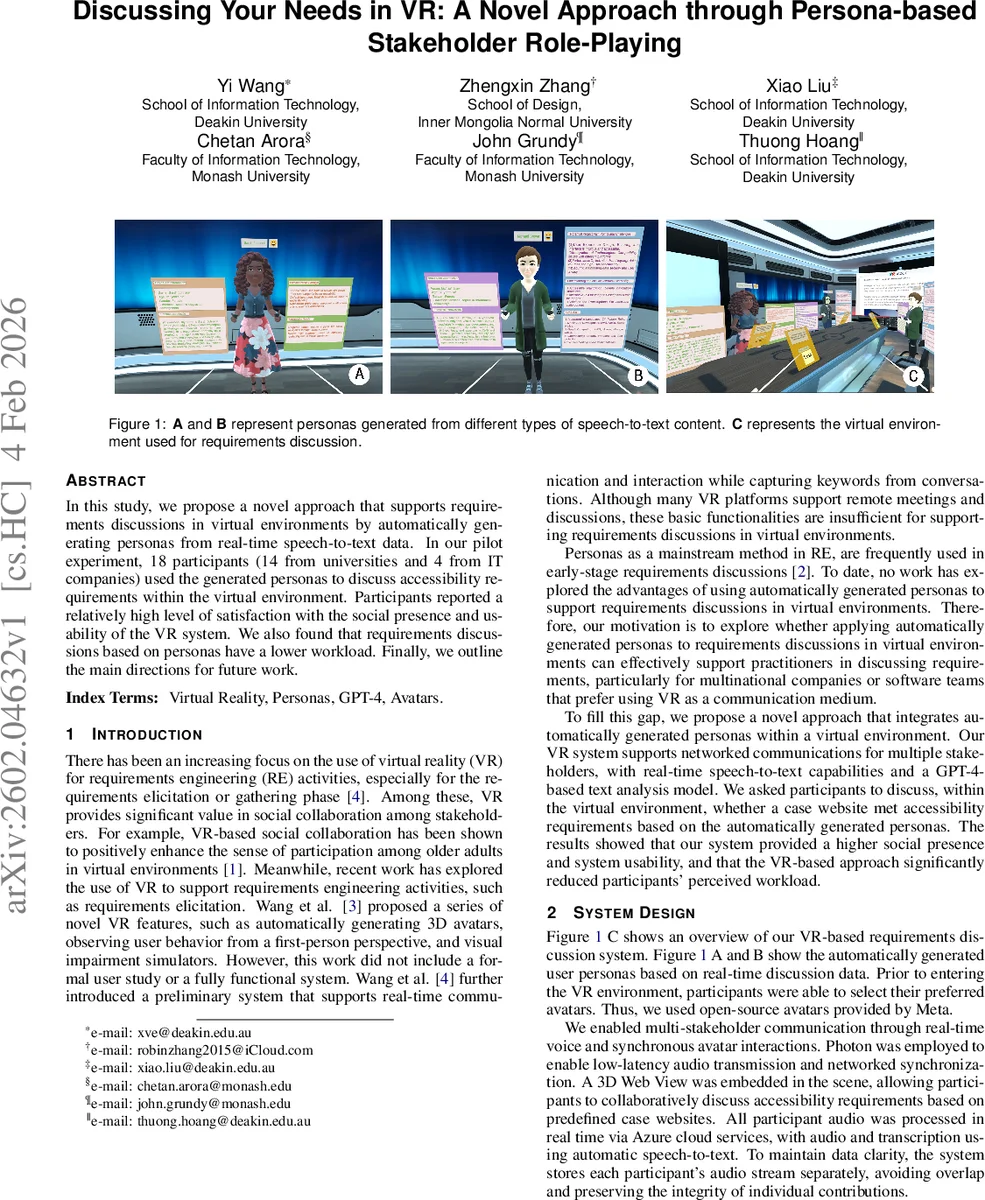
The proposed system integrates three main technologies: (1) Meta Quest 3 head‑mounted displays for immersive interaction, (2) Azure Speech‑to‑Text for low‑latency transcription of each participant’s audio stream, and (3) a GPT‑4‑based analysis pipeline that processes the transcriptions. The pipeline runs four prompts: (i) generate a basic persona with demographic attributes (fabricating missing details when necessary), (ii) enrich the persona with accessibility requirements, personalized settings, and a short biography, (iii) extract participants’ attitudes, expertise, pain points, and challenges, and (iv) identify user needs and preferences. An additional sentiment‑analysis step converts textual emotions into emoji visualisations. Avatars are rendered using open‑source Meta assets, and Photon networking ensures synchronized low‑latency audio and avatar movement. A 3‑D web view embedded in the scene allows participants to collaboratively inspect a case website and annotate accessibility issues.
A within‑subjects user study was conducted with 18 participants (10 M/8 F, ages 21‑29, M = 25.9). Ten participants were university students from interaction design and computer science; four were industry practitioners involved in web development. Each pair performed two conditions: (a) a traditional face‑to‑face meeting where they manually created personas, and (b) a VR meeting using the automated persona system. After each condition participants completed three 7‑point Likert questionnaires measuring social presence, system usability (VR only), and NASA‑TLX workload.
Results show that the VR condition achieved relatively high scores for social presence (Mean = 5.21, SD = 0.81) and system usability (Mean = 5.19, SD = 0.78), indicating that participants felt a strong sense of co‑presence and found the interface intuitive. More importantly, workload was significantly lower in the VR condition (Mean = 3.57, SD = 0.85) compared with the traditional method (p < .001). The authors interpret this reduction as evidence that automatically generated personas streamline the discussion, reduce cognitive overhead, and help participants focus on substantive accessibility requirements rather than on persona construction.
The paper acknowledges several limitations: (1) no direct comparison with existing VR collaboration platforms (e.g., AltspaceVR, Mozilla Hubs), (2) lack of an independent validation of the fidelity of automatically generated personas, and (3) the small, convenience sample limits generalisability. Future work is outlined to address these gaps, including benchmarking against other VR tools, extending the system to other domains (e.g., healthcare, education), evaluating long‑term collaboration outcomes, and investigating ethical considerations around inferred demographic data.
In summary, this study demonstrates that integrating real‑time speech transcription with large‑language‑model‑driven persona generation inside an immersive VR environment can improve the efficiency and user experience of RE discussions. The approach holds promise for distributed, multinational software teams that seek richer stakeholder empathy without the overhead of manual persona creation, and it opens a research avenue at the intersection of VR, natural‑language processing, and requirements engineering.
Comments & Academic Discussion
Loading comments...
Leave a Comment