Targeted Synthetic Control Method
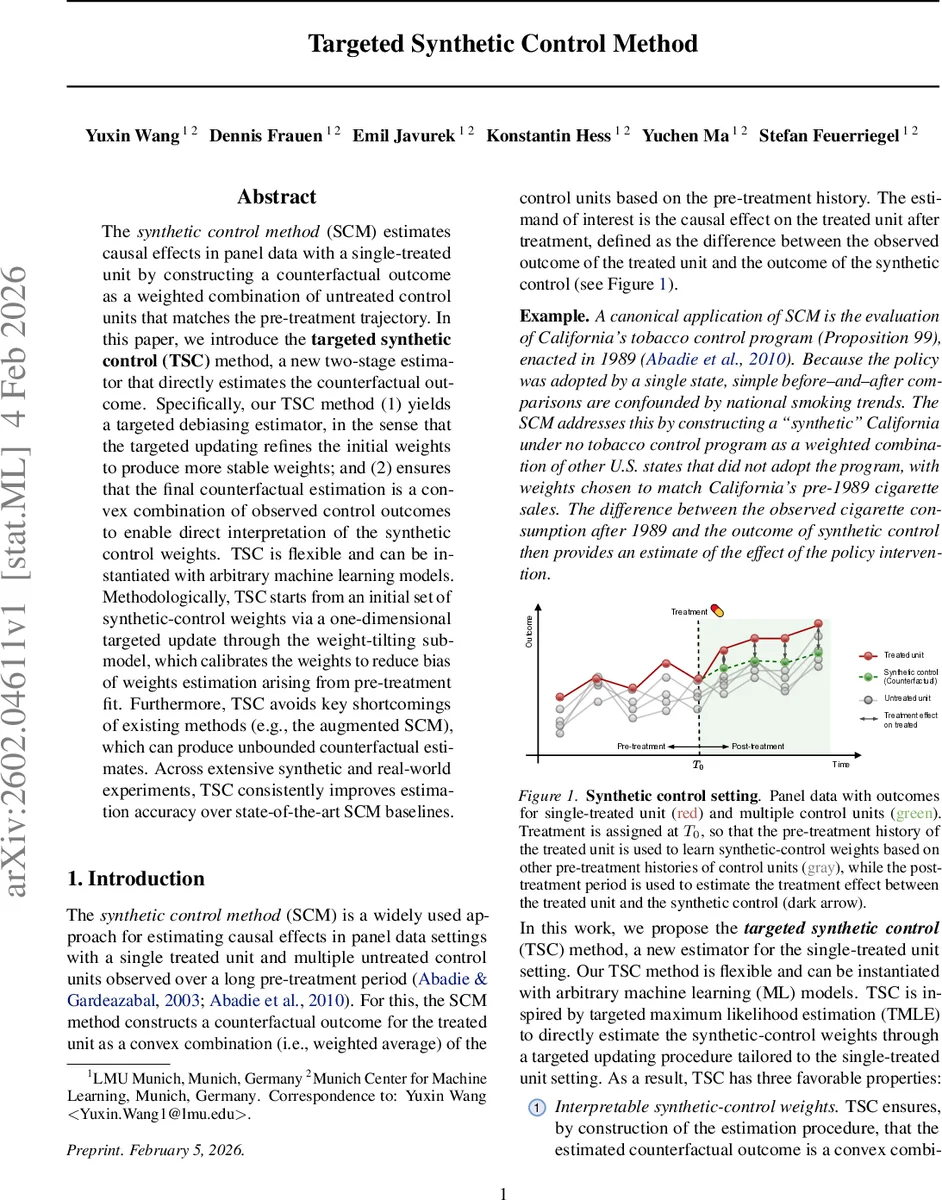
The synthetic control method (SCM) estimates causal effects in panel data with a single-treated unit by constructing a counterfactual outcome as a weighted combination of untreated control units that matches the pre-treatment trajectory. In this paper, we introduce the targeted synthetic control (TSC) method, a new two-stage estimator that directly estimates the counterfactual outcome. Specifically, our TSC method (1) yields a targeted debiasing estimator, in the sense that the targeted updating refines the initial weights to produce more stable weights; and (2) ensures that the final counterfactual estimation is a convex combination of observed control outcomes to enable direct interpretation of the synthetic control weights. TSC is flexible and can be instantiated with arbitrary machine learning models. Methodologically, TSC starts from an initial set of synthetic-control weights via a one-dimensional targeted update through the weight-tilting submodel, which calibrates the weights to reduce bias of weights estimation arising from pre-treatment fit. Furthermore, TSC avoids key shortcomings of existing methods (e.g., the augmented SCM), which can produce unbounded counterfactual estimates. Across extensive synthetic and real-world experiments, TSC consistently improves estimation accuracy over state-of-the-art SCM baselines.
💡 Research Summary
The paper introduces the Targeted Synthetic Control (TSC) method, a novel two‑stage estimator designed for the classic single‑treated‑unit synthetic control setting. Traditional Synthetic Control (SCM) constructs a counterfactual by finding non‑negative weights that balance the pre‑treatment trajectory of the treated unit against a convex combination of control units. While SCM is interpretable, its reliance on a perfect pre‑treatment fit makes it vulnerable to finite‑sample bias: any mismatch in the pre‑treatment period propagates to the post‑treatment counterfactual. Augmented SCM (a recent extension) adds a flexible outcome‑model correction to reduce this bias, but the correction term can push the estimated counterfactual outside the convex hull of the control outcomes, destroying interpretability and potentially producing unbounded predictions.
TSC addresses both issues by borrowing ideas from Targeted Maximum Likelihood Estimation (TMLE). In the first stage, TSC obtains an initial set of synthetic‑control weights using any standard SCM variant (classical, regularized, etc.) and simultaneously fits a flexible machine‑learning outcome model ( \hat m_t(\cdot) ) on the control units’ pre‑treatment data to predict post‑treatment outcomes. In the second stage, TSC performs a one‑dimensional “weight‑tilting” update: it computes residuals ( r_{jt}=Y_{jt}-\hat m_t(X_j) ) for each control unit and adjusts the initial weights by a scalar factor ( \epsilon ) chosen to solve the TMLE estimating equation (i.e., to set the empirical efficient influence function to zero). The updated weights ( \tilde w_j = \hat w^{SC}j \exp(\epsilon r{jt}) ) remain non‑negative and sum to one, guaranteeing that the final counterfactual ( \tilde\psi_t = \sum_{j=2}^N \tilde w_j Y_{jt} ) is always a convex combination of observed control outcomes. Consequently, TSC preserves the interpretability of SCM weights while achieving a bias‑reduced, bounded estimate.
Key methodological contributions are: (1) framing SCM within a TMLE‑style targeted updating paradigm, thereby creating a new meta‑learner that directly targets the counterfactual; (2) allowing arbitrary machine‑learning models for the outcome regression, which enhances flexibility for high‑dimensional or nonlinear data; (3) reducing the second‑stage optimization to a single scalar problem, keeping computational cost low and preserving the convex‑hull property absent in augmented SCM.
The authors evaluate TSC on extensive synthetic simulations and a real‑world policy case (California’s Proposition 99 tobacco control). Across varying pre‑treatment lengths, noise levels, and degrees of initial weight misspecification, TSC consistently yields lower Mean Squared Error (MSE) and Mean Absolute Error (MAE) than both classical SCM and augmented SCM. In the California example, TSC produces a more stable weight distribution (avoiding extreme concentration on a few donor states) and delivers treatment‑effect estimates comparable to prior literature but with tighter confidence intervals, reflecting improved precision.
Limitations are acknowledged. TSC’s performance depends on the quality of the initial SCM weights; if these are severely misspecified, the one‑dimensional tilt may not fully correct the bias. Moreover, when the pre‑treatment period is extremely short, the balancing problem itself may be ill‑posed, making the TMLE update unstable. Future work is suggested to extend TSC to multiple treated units, to handle irregularly spaced or missing time points, and to incorporate Bayesian priors for weight uncertainty.
In summary, Targeted Synthetic Control unifies the interpretability of classic SCM with the bias‑reduction benefits of TMLE‑style updates, all while retaining the flexibility of modern machine‑learning outcome models. This makes TSC a compelling addition to the causal inference toolbox for panel data with a single treated unit.
Comments & Academic Discussion
Loading comments...
Leave a Comment