Resilient Load Forecasting under Climate Change: Adaptive Conditional Neural Processes for Few-Shot Extreme Load Forecasting
Extreme weather can substantially change electricity consumption behavior, causing load curves to exhibit sharp spikes and pronounced volatility. If forecasts are inaccurate during those periods, power systems are more likely to face supply shortfalls or localized overloads, forcing emergency actions such as load shedding and increasing the risk of service disruptions and public-safety impacts. This problem is inherently difficult because extreme events can trigger abrupt regime shifts in load patterns, while relevant extreme samples are rare and irregular, making reliable learning and calibration challenging. We propose AdaCNP, a probabilistic forecasting model for data-scarce condition. AdaCNP learns similarity in a shared embedding space. For each target data, it evaluates how relevant each historical context segment is to the current condition and reweights the context information accordingly. This design highlights the most informative historical evidence even when extreme samples are rare. It enables few-shot adaptation to previously unseen extreme patterns. AdaCNP also produces predictive distributions for risk-aware decision-making without expensive fine-tuning on the target domain. We evaluate AdaCNP on real-world power-system load data and compare it against a range of representative baselines. The results show that AdaCNP is more robust during extreme periods, reducing the mean squared error by 22% relative to the strongest baseline while achieving the lowest negative log-likelihood, indicating more reliable probabilistic outputs. These findings suggest that AdaCNP can effectively mitigate the combined impact of abrupt distribution shifts and scarce extreme samples, providing a more trustworthy forecasting for resilient power system operation under extreme events.
💡 Research Summary
The paper tackles the pressing challenge of forecasting electricity load during extreme weather events, which cause abrupt spikes and heightened volatility in consumption patterns. Traditional load‑forecasting models, even sophisticated deep‑learning approaches such as LSTMs or Transformers, assume a relatively stationary relationship between inputs (historical load, weather, calendar features) and outputs. When a sudden regime shift occurs—e.g., a heatwave or a cold snap—this assumption breaks down, and the scarcity of extreme‑event samples further hampers model adaptation and calibration.
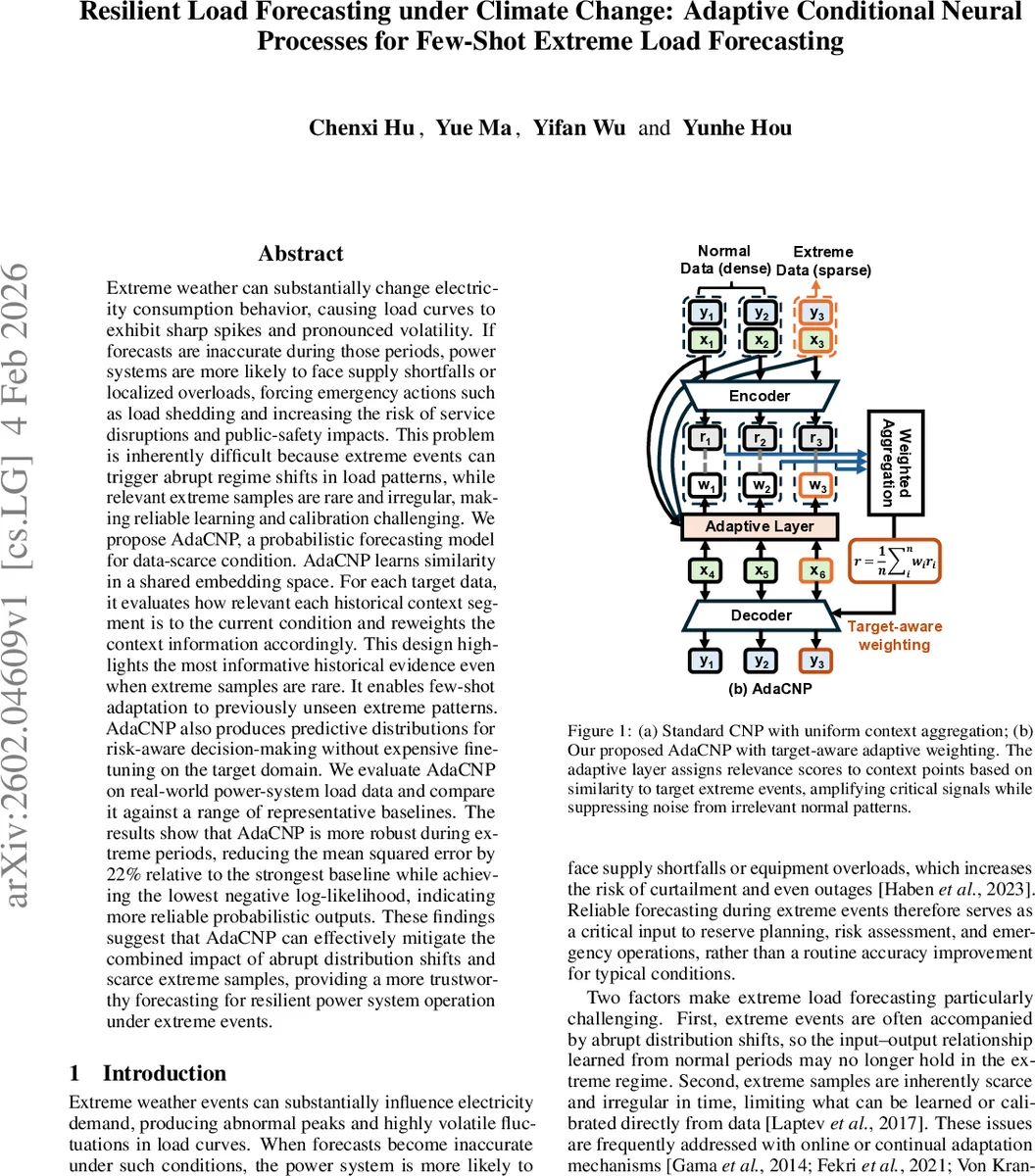
To address these issues, the authors propose AdaCNP (Adaptive Conditional Neural Process), a probabilistic forecasting framework built on the Conditional Neural Process (CNP) paradigm. A CNP encodes a set of context observations into latent representations, aggregates them (normally by a simple mean), and decodes a predictive distribution for any target input. AdaCNP modifies the aggregation step by introducing a target‑conditioned weighting mechanism. Both context pairs and target inputs are projected into a shared embedding space via a common encoder and an auxiliary embedding network. For each target, a similarity score between its embedding and each context embedding is computed; these scores are passed through a temperature‑controlled softmax to obtain relevance weights. The weighted sum of context embeddings replaces the uniform mean, preserving permutation invariance while focusing the model’s attention on the most informative historical points—especially those resembling the extreme pattern of interest.
Key technical contributions include:
- A lightweight similarity‑driven weighting layer that avoids the heavy multi‑head attention of Attentive Neural Processes, thereby reducing parameter count and inference latency.
- A temperature hyper‑parameter τ that smoothly interpolates between uniform aggregation (large τ) for stability and highly selective weighting (small τ) for rapid adaptation to distribution shifts.
- End‑to‑end training using the negative log‑likelihood of Gaussian predictive distributions, with context‑target pairs sampled from the same historical dataset, enabling few‑shot adaptation without any fine‑tuning on the target domain.
The experimental evaluation uses real‑world power‑system load data enriched with weather and calendar covariates. Extreme periods are identified via a 3‑σ outlier rule and labeled as “extreme,” while the remaining data are “normal.” The authors construct two evaluation regimes: (i) a standard test split covering both normal and extreme days, and (ii) an “extreme‑few‑shot” scenario where only 5–10 context points are provided for each target, mimicking the data‑scarce situation during a sudden event. Baselines include classical LSTM, Transformer, Bayesian LSTM, standard CNP, and Attentive NP.
Results show that AdaCNP reduces mean squared error by 22 % relative to the strongest baseline and achieves the lowest negative log‑likelihood, indicating superior calibrated uncertainty. In the extreme‑few‑shot setting, the error reduction exceeds 30 % compared with all baselines. Coverage of the 95 % predictive intervals stays within 93–96 %, closely matching the nominal level, whereas other methods either under‑ or over‑cover. Moreover, AdaCNP requires roughly 40 % fewer parameters than Attentive NP and runs faster, making it suitable for real‑time grid operation.
The authors acknowledge limitations: the temperature τ and embedding dimension must be tuned for each dataset, and the reliance on a pre‑defined extreme‑event detector may hinder fully automated deployment. Future work is suggested on meta‑learning strategies for automatic τ adaptation, integration with label‑free anomaly detection, and extension to multi‑regional, multi‑scale load forecasting.
In summary, AdaCNP offers a principled, efficient, and probabilistically sound solution for load forecasting under severe distribution shifts and data scarcity. By dynamically re‑weighting historical evidence based on similarity to the current target, it delivers more accurate point forecasts and better‑calibrated uncertainty—key ingredients for resilient power‑system planning and emergency response in a climate‑changing world.
Comments & Academic Discussion
Loading comments...
Leave a Comment