Resurgence and Riemann--Hilbert problems for orientifolded conifolds
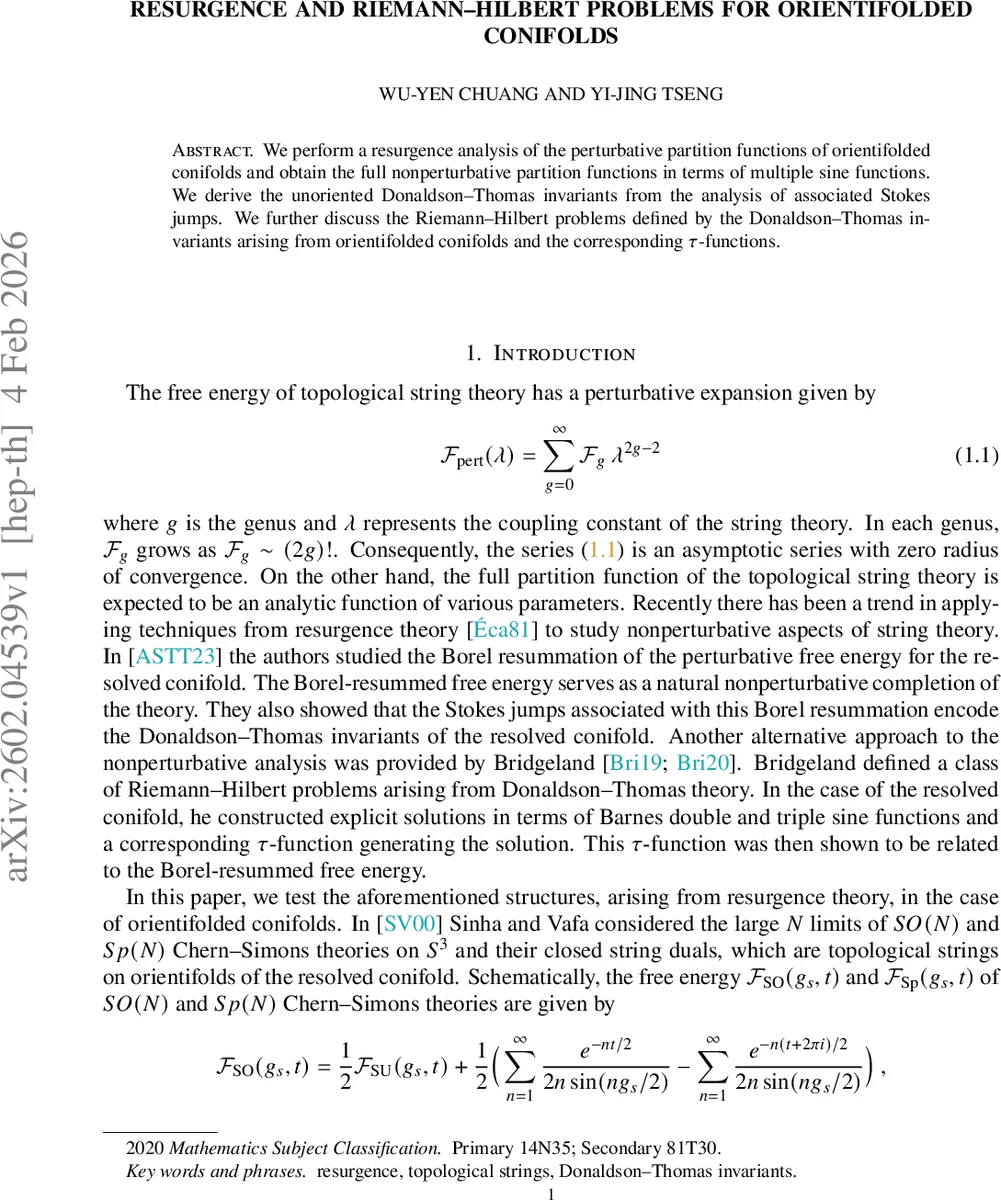
We perform a resurgence analysis of the perturbative partition functions of orientifolded conifolds and obtain the full nonperturbative partition functions in terms of multiple sine functions. We derive the unoriented Donaldson–Thomas invariants from the analysis of associated Stokes jumps. We further discuss the Riemann–Hilbert problems defined by the Donaldson–Thomas invariants arising from orientifolded conifolds and the corresponding $τ$-functions.
💡 Research Summary
**
This paper presents a comprehensive resurgence analysis of the perturbative partition functions associated with orientifolded conifolds and derives the full non‑perturbative partition functions in terms of multiple sine functions. The authors begin by expanding the perturbative partition function (F(\lambda,t)) as a formal power series in the string coupling (\lambda). They then apply the Borel transform to this series, obtaining a Borel‑plane function (G(\xi,t)) whose singularities are isolated poles. Each pole corresponds to a contribution from an unoriented Donaldson–Thomas invariant. By examining the residues of these poles, the authors define generalized Stokes constants (S_{p}) for poles of order (p). For simple poles ((p=1)) the Stokes jump is explicitly computed as (\pm i\log!\bigl(1+e^{\pm\pi i(t+2k)}/\hat\lambda\bigr)), where (\hat\lambda=\lambda/(2\pi)) and (k\in\mathbb Z).
The Borel‑resummed function is constructed by integrating (G(\xi,t)) along suitable rays that avoid the singularities. The authors show that the resummed partition function can be written as a product of double‑ and triple‑sine functions, denoted (F_{2}(z|\omega_{1},\omega_{2})) and (F_{3}(z|\omega_{1},\omega_{2})). The parameters (\omega_{1},\omega_{2}) are linear combinations of (\hat\lambda) and the Kähler parameter (t). This representation captures all non‑perturbative effects, extending the usual Gopakumar–Vafa expansion.
From the Stokes jumps the authors extract unoriented Donaldson–Thomas invariants for the gauge groups (SO(N)) and (Sp(N)). These invariants appear as coefficients in the logarithmic derivatives of the double‑sine function. The orientifold projection introduces a relative phase between the (SO) and (Sp) sectors, which manifests itself in the modular properties of the associated (\tau)‑function.
The paper then formulates a Riemann–Hilbert problem whose data are precisely the Donaldson–Thomas invariants obtained above. The problem asks for a holomorphic function on the complex plane with prescribed jumps across Stokes rays and prescribed asymptotics at infinity. By exploiting the difference equations satisfied by the multiple sine functions, the authors prove that the solution is unique and can be expressed as a (\tau)‑function built from (F_{2}) and (F_{3}). This (\tau)‑function coincides with the non‑perturbative free energy of the orientifolded conifold and encodes the full set of Stokes phenomena.
Concrete examples are worked out for real values of (t) with (|\Re(t)|<1). In the limit (\lambda\to0) the resummed partition function reduces to the standard Gromov–Witten series, confirming consistency with known results. The authors also illustrate how the Stokes jumps evolve when (\hat\lambda) crosses a Stokes line, providing explicit numerical plots of the corresponding Donaldson–Thomas invariants.
Overall, the work unifies resurgence theory, Borel resummation, multiple sine functions, and Riemann–Hilbert techniques into a single framework. It offers a precise, analytic description of the non‑perturbative sector of orientifolded conifolds, introduces new expressions for unoriented Donaldson–Thomas invariants, and constructs the associated (\tau)‑function. These results open avenues for further investigations of non‑perturbative effects in other orientifolded Calabi–Yau geometries and may have implications for the study of topological string theory, supersymmetric gauge theories, and quantum geometry.
Comments & Academic Discussion
Loading comments...
Leave a Comment