Stellar Interpretation of Meteoritic Data and PLotting for Everyone (SIMPLE): Isotope Mixing Lines for Six Sets of Core-Collapse Supernova Models
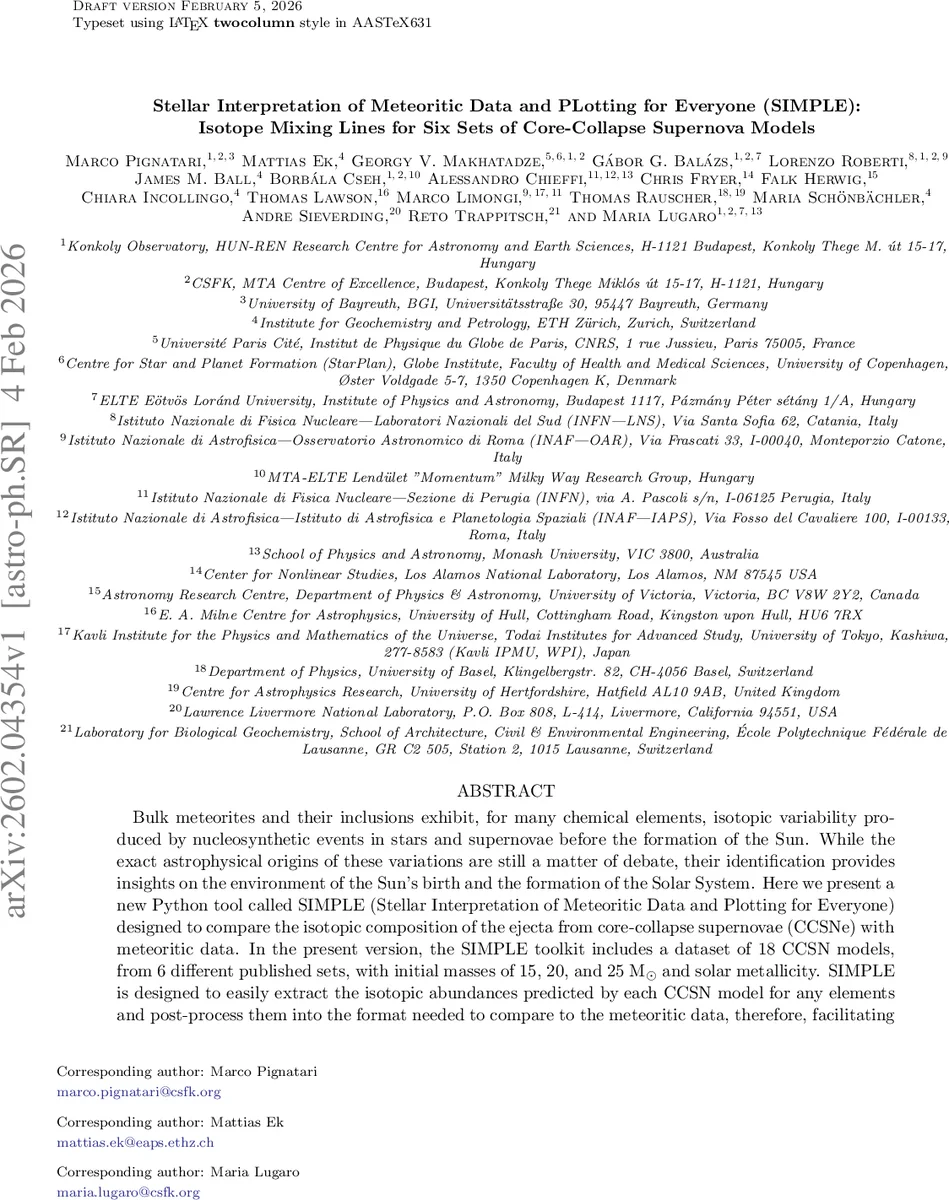
Bulk meteorites and their inclusions exhibit, for many chemical elements, isotopic variability produced by nucleosynthetic events in stars and supernovae before the formation of the Sun. While the exact astrophysical origins of these variations are still a matter of debate, their identification provides insights on the environment of the Sun’s birth and the formation of the Solar System. Here we present a new Python tool called SIMPLE (Stellar Interpretation of Meteoritic Data and Plotting for Everyone) designed to compare the isotopic composition of the ejecta from core-collapse supernovae (CCSNe) with meteoritic data. In the present version, the SIMPLE toolkit includes a dataset of 18 CCSN models, from 6 different published sets, with initial masses of 15, 20, and 25 M$_{\odot}$ and solar metallicity. SIMPLE is designed to easily extract the isotopic abundances predicted by each CCSN model for any elements and post-process them into the format needed to compare to the meteoritic data, therefore, facilitating their interpretation. As an example of how to use SIMPLE, we analyze the composition of the Ni isotopes in the 18 models and confirm that bulk meteorite Ni anomalies are compatible with material from the innermost Si-rich region of CCSN ejecta. Designed as a collaborative platform, SIMPLE is open-source and welcomes community contributions to enhance its development and dissemination for stellar nucleosynthesis and meteoritic studies. Future enhancements include addition of more model predictions and inclusion of mixing between different layers of supernova ejecta.
💡 Research Summary
The paper introduces SIMPLE (Stellar Interpretation of Meteoritic Data and Plotting for Everyone), an open‑source Python toolkit designed to bridge the gap between core‑collapse supernova (CCSN) nucleosynthesis predictions and isotopic measurements from bulk meteorites, calcium‑aluminium‑rich inclusions (CAIs), and other early Solar System materials. The authors compile a database of 18 CCSN models drawn from six independent research groups, covering progenitor masses of 15, 20, and 25 M⊙ at solar metallicity. Each model provides isotopic mass fractions as a function of ejected mass coordinate, enabling layer‑by‑layer comparison rather than relying on integrated yields alone.
SIMPLE reads these tabulated abundances, automatically converts mass fractions (Xi) to molar fractions (Yi = Xi/Ai) using integer atomic masses, and allows the user to work consistently in either representation. Crucially, the toolkit adopts the initial stellar composition of each model as its own “standard” for normalization, preventing artificial anomalies that would arise from mixing model‑specific initial abundances with terrestrial standards. Users can select any element or isotope, extract its profile across the ejecta, and generate mixing‑line plots that combine a chosen supernova layer with a bulk Solar System composition (typically terrestrial) over a range of dilution factors. The x‑axis represents the mass coordinate, while the y‑axis shows isotopic ratios (e.g., 60Ni/58Ni). Optional labeling of burning zones (Si‑rich, O‑Ne/Mg‑Si, etc.) helps visualize which stellar shells dominate a given isotopic signature.
Radioactive isotopes are currently handled in a simplified way: the user may either omit them entirely or add their full abundance to that of the stable daughter isotope. No decay network is implemented yet, but the framework is prepared for future integration of decay and chemical fractionation modules.
The authors demonstrate SIMPLE’s capabilities by analysing nickel isotopes across all 18 models. Nickel, an Fe‑peak element, exhibits strong isotopic variations in the innermost Si‑burning region. By constructing mixing lines between bulk meteorite Ni compositions and individual supernova shells, they find that the observed Ni anomalies (e.g., δ60Ni ≈ +0.2 ‰) are best reproduced by material originating from the deepest Si‑rich layers (mass coordinate ≈ 1.5–2 M⊙). This result supports the hypothesis that dust condensed from Si‑rich supernova ejecta was incorporated into the protosolar nebula, delivering the nucleosynthetic signature recorded in meteorites.
Beyond the Ni case study, SIMPLE enables systematic assessment of model‑to‑model differences. For instance, the authors note that older Rauscher et al. (2002) yields and more recent 2022 models differ by up to 10–15 % in Ni isotopic ratios, reflecting uncertainties in nuclear reaction rates and explosion physics. By providing a common interface to multiple model sets, SIMPLE facilitates qualitative uncertainty quantification and helps identify robust nucleosynthetic features versus those that are model‑dependent.
Limitations are acknowledged. All current models are Fe‑core collapse supernovae; electron‑capture supernovae (ECSN), which have been invoked to explain 48Ca excesses, are not yet included. The toolkit lacks a built‑in radioactive decay routine and does not yet support three‑dimensional simulation outputs. Moreover, because each model uses its own initial abundance set, a fully homogeneous comparison would require re‑computing all models with a single solar composition—a task slated for future community contributions.
SIMPLE is distributed via GitHub (with pip installation) and includes extensive documentation, tutorials, and a Zenodo repository for the model tables. The authors encourage community involvement through issue tracking, pull requests, and planned workshops, aiming to expand the model library, add decay physics, and eventually incorporate multi‑dimensional supernova simulations.
In summary, SIMPLE provides a practical, extensible platform for researchers to directly compare CCSN nucleosynthesis predictions with meteoritic isotopic data, offering layer‑resolved mixing‑line analysis that can illuminate the provenance of isotopic anomalies in the early Solar System. Its open‑source nature and modular design position it as a valuable resource for both stellar astrophysicists and cosmochemists, with clear pathways for future enhancements.
Comments & Academic Discussion
Loading comments...
Leave a Comment