Vistas of Algebraic Probability: Quantum Computation and Information
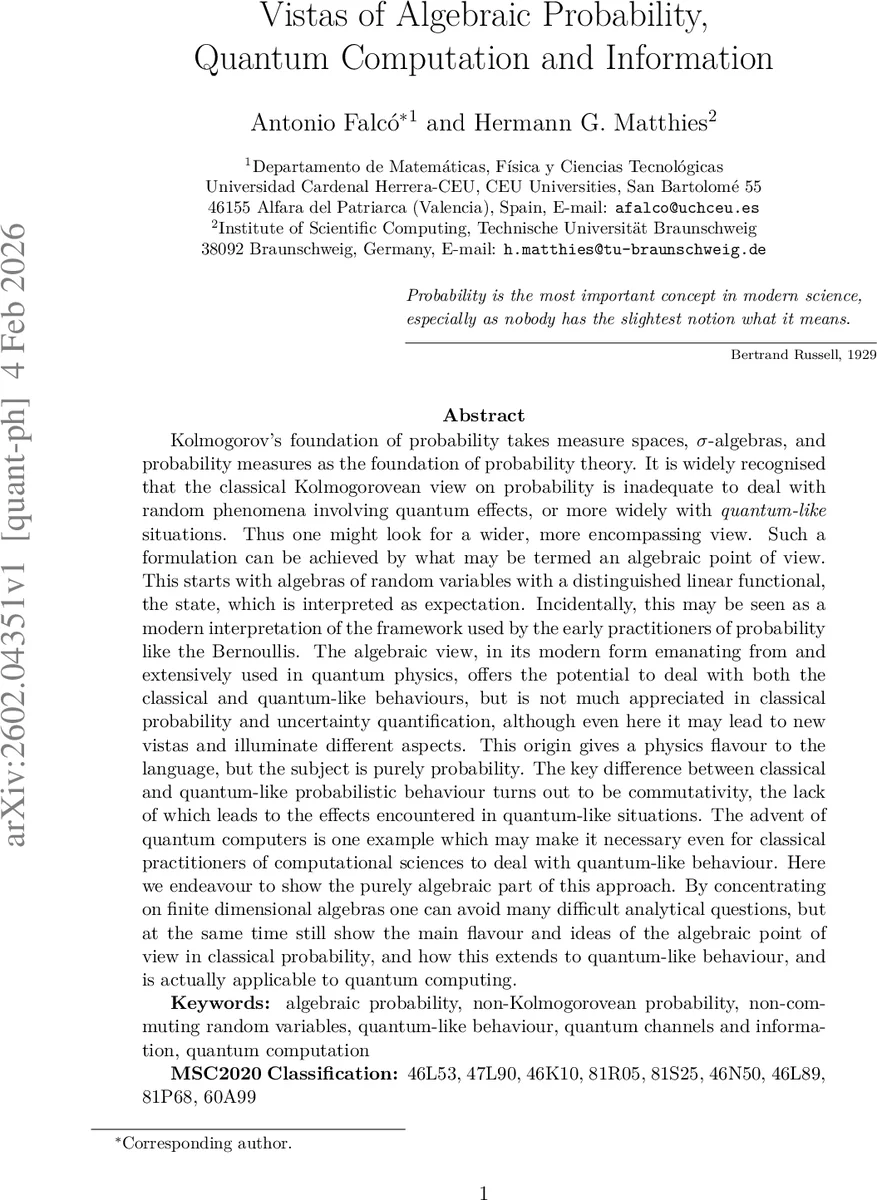
Kolmogorov’s foundation of probability takes measure spaces, $σ$-algebras, and probability measures as basic objects. It is, however, widely recognized that this classical framework is inadequate for random phenomena involving quantum effects, and more generally for \emph{quantum-like} situations. A broader formulation is provided by an algebraic viewpoint: one starts from an algebra of random variables equipped with a distinguished linear functional – the \emph{state} – interpreted as expectation. In this sense, the approach can also be viewed as a modern reading of ideas already implicit in early probability (e.g., the Bernoullis), while its contemporary form has been developed and used extensively in quantum physics. The algebraic framework accommodates both classical and quantum-like behaviours, yet it remains underused in classical probability and uncertainty quantification, where it can nevertheless open new perspectives and clarify structural features. Although the language carries a physics flavor, the subject is purely probabilistic. The key distinction between classical and quantum-like behaviour is \emph{commutativity}: its failure produces the characteristic effects of quantum-like situations. The rise of quantum computing is a prominent setting in which such behaviour may become relevant even for practitioners in computational science. Here we focus on the purely algebraic core of the approach. By restricting attention to finite-dimensional algebras, we avoid many analytical subtleties while retaining the main ideas, their classical limit, and their applicability to quantum-like models and quantum computation.
💡 Research Summary
**
The paper “Vistas of Algebraic Probability: Quantum Computation and Information” presents a self‑contained exposition of algebraic probability, emphasizing its relevance to quantum‑like phenomena and, in particular, to quantum computing (QC) and quantum information (QI). Classical probability, as formalized by Kolmogorov, rests on a sample space, a σ‑algebra of events, and a probability measure. Random variables are then measurable functions on this space, and expectation is defined as an integral with respect to the measure. This framework works perfectly for purely classical uncertainty but breaks down when the order of observations matters—a hallmark of quantum mechanics and any “quantum‑like” (QLB) situation where observables may be non‑commuting.
The authors adopt the algebraic viewpoint: a finite‑dimensional *‑algebra 𝔄 of observables together with a distinguished positive, normalized linear functional φ (the state) that plays the role of expectation. Self‑adjoint elements of 𝔄 correspond to real‑valued observables; the state assigns each observable its mean value. When 𝔄 is commutative, the Gelfand‑Naimark theorem guarantees that 𝔄 is isomorphic to a function algebra C(X), and φ becomes a classical probability distribution on X. Thus the algebraic framework reduces exactly to Kolmogorov’s theory in the commutative case.
The real power of the approach appears when 𝔄 is non‑commutative. Typical examples are matrix algebras Mₙ(ℂ) or direct sums of such blocks. In this setting, observables cannot be simultaneously measured, and the state’s predictions depend on the “context”—the set of compatible observables measured together. This captures the essence of quantum uncertainty, Bell‑inequality violations, and the Kochen‑Specker theorem, all of which are purely probabilistic statements once the algebraic language is adopted.
A central technical tool is the GNS (Gelfand‑Naimark‑Segal) construction. For any state φ on 𝔄 there exists a Hilbert space ℋ, a *‑representation π:𝔄→B(ℋ), and a cyclic vector |Ω⟩ such that φ(A)=⟨Ω|π(A)|Ω⟩. Consequently, every algebraic probability space can be realized as a conventional quantum system: observables become operators on ℋ, and the state becomes a density operator (or pure vector) in the usual sense. This bridges the abstract algebraic formalism with the familiar Hilbert‑space picture of quantum mechanics.
The paper devotes a substantial portion to the structure theory of finite‑dimensional *‑algebras. By decomposing 𝔄 into its centre (the maximal commutative subalgebra) and simple non‑commutative blocks, the authors show how a hybrid system—part classical, part quantum‑like—can be modeled within a single algebraic object. The centre encodes classical random variables, while each matrix block encodes a quantum subsystem. This decomposition is particularly useful for modeling composite systems such as quantum processors interacting with classical control logic.
Beyond the algebraic foundations, the authors discuss generalized measurements (POVMs) and quantum channels. In the algebraic language, a POVM is a finite family of positive elements {E_i} with ΣE_i=𝟙, and a quantum channel is a completely positive, trace‑preserving linear map Λ:𝔄→𝔄′ between algebras. The paper shows how these concepts arise naturally from the state‑preserving structure of the algebra and how they can be expressed without reference to underlying Hilbert spaces.
The most concrete application is to quantum computing. The authors model a quantum processor unit (QPU) as a finite‑dimensional non‑commutative algebra equipped with a distinguished state (the initial preparation). Quantum gates are implemented as *‑automorphisms (unitary conjugations) of the algebra, while measurement corresponds to applying a POVM and updating the state via the Lüders rule. As a case study, Grover’s search algorithm is re‑derived: the algorithm’s diffusion operator and oracle are described as specific algebra automorphisms; the repeated application of the associated channel amplifies the probability of the marked element by a factor proportional to the square root of the database size. The algebraic proof highlights that the speed‑up originates from the non‑commutative structure, not from any mysterious “quantum magic”.
Throughout, the authors stress that the algebraic framework is a genuine generalization of classical probability, not a replacement. When the algebra is commutative, all results collapse to the familiar Kolmogorov picture; when it is non‑commutative, new phenomena appear, but the same formalism still governs expectation, conditioning, and independence (now expressed via tensor products and conditional expectations in the algebra).
The paper acknowledges its limitation to finite‑dimensional algebras, deliberately avoiding the analytical complications of unbounded operators and infinite‑dimensional Hilbert spaces. Nevertheless, the authors argue that the GNS construction and the theory of C∗‑algebras provide a clear pathway to extend the results to continuous variables, quantum field‑theoretic settings, and infinite‑dimensional stochastic processes.
In summary, the article makes three major contributions:
- Conceptual Unification – It shows that classical and quantum‑like probabilities are two faces of the same algebraic structure, distinguished solely by commutativity.
- Technical Toolkit – It supplies a concise yet rigorous presentation of states, representations, POVMs, channels, and the GNS construction, all within a finite‑dimensional setting accessible to probabilists and computer scientists.
- Application to Quantum Computing – It translates the abstract algebraic language into concrete quantum‑algorithmic terms, exemplified by a full algebraic derivation of Grover’s algorithm, thereby demonstrating that the algebraic viewpoint can illuminate algorithmic speed‑ups and guide the design of hybrid classical‑quantum models.
Overall, the paper argues persuasively that embracing algebraic probability can enrich uncertainty quantification, provide clearer insight into quantum information processing, and open new avenues for interdisciplinary research between probability theory, functional analysis, and quantum computing.
Comments & Academic Discussion
Loading comments...
Leave a Comment