An Enhanced Polar-Domain Dictionary Design for Elevated BSs in Near-Field U-MIMO
Near-field U-MIMO communications require carefully optimized sampling grids in both angular and distance domains. However, most existing grid design methods neglect the influence of base station height, assuming instead that the base station is positioned at ground level - a simplification that rarely reflects real-world deployments. To overcome this limitation, we propose a generalized grid design framework that accommodates arbitrary base station locations. Unlike conventional correlation-based approaches, our method optimizes the grid based on the minimization of the optimal normalized mean squared error, leading to more accurate channel representation. We evaluate the performance of a hybrid U-MIMO system operating at sub-THz frequencies, considering the P-SOMP algorithm for channel estimation. Analytical and numerical results show that the proposed design enhances both channel estimation accuracy and spectral efficiency compared to existing alternatives.
💡 Research Summary
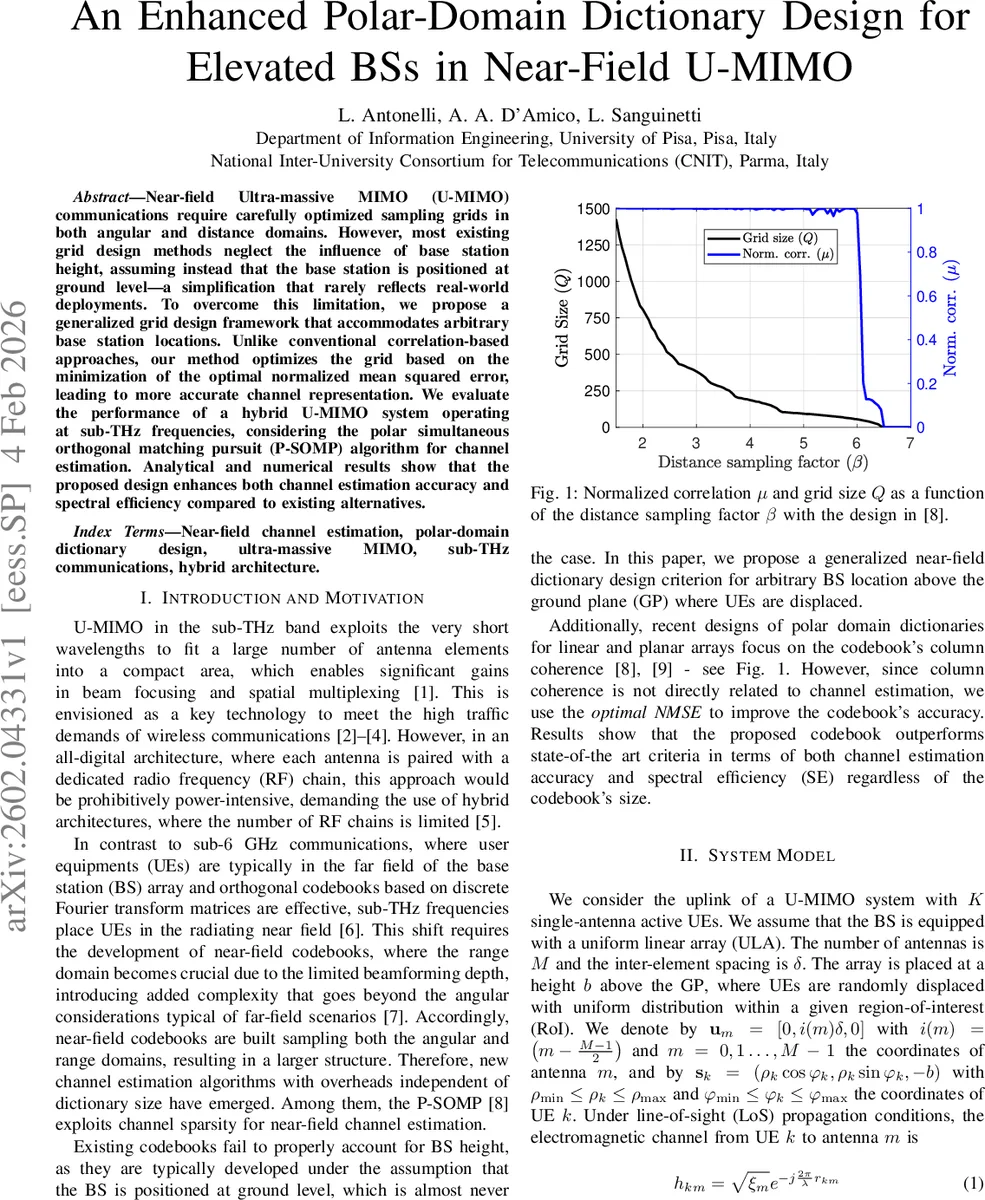
This paper addresses a critical gap in near‑field ultra‑massive MIMO (U‑MIMO) systems: the design of polar‑domain dictionaries (codebooks) that properly account for the base‑station (BS) height. Existing grid‑design methods assume the BS lies on the ground, which is unrealistic for many deployments, especially at sub‑THz frequencies where users are often in the radiating near‑field. The authors propose a generalized framework that incorporates arbitrary BS elevations and optimizes the sampling grid by minimizing the optimal normalized mean‑square error (NMSE), rather than relying on column‑coherence metrics traditionally used in far‑field designs.
The system model considers an uplink with K single‑antenna users and an M‑element uniform linear array (ULA) mounted at height b above the ground plane. The channel follows a line‑of‑sight (LoS) model with spherical wave propagation; each antenna‑user link is characterized by its Euclidean distance and a complex Gaussian small‑scale fading term whose variance follows the free‑space path‑loss law. A hybrid architecture with N_RF ≪ M RF chains and fully‑connected analog combiners is assumed, and channel estimation is performed using the polar‑simultaneous orthogonal matching pursuit (P‑SOMP) algorithm, which requires a dictionary W whose columns are steering vectors evaluated on a discrete grid G of (θ, φ, ρ) points.
The authors first review the state‑of‑the‑art design from
Comments & Academic Discussion
Loading comments...
Leave a Comment