Beyond Static Cropping: Layer-Adaptive Visual Localization and Decoding Enhancement
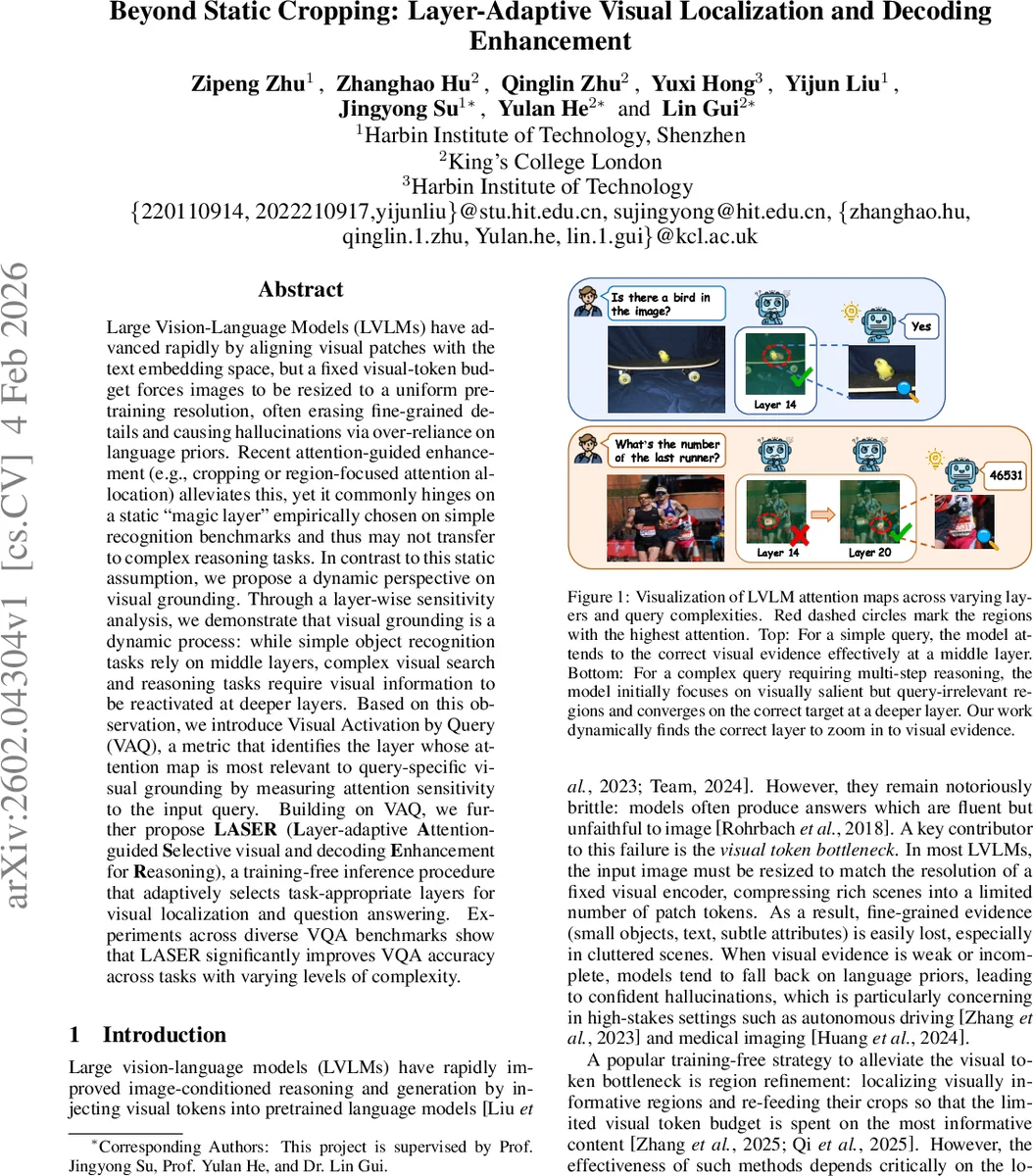
Large Vision-Language Models (LVLMs) have advanced rapidly by aligning visual patches with the text embedding space, but a fixed visual-token budget forces images to be resized to a uniform pretraining resolution, often erasing fine-grained details and causing hallucinations via over-reliance on language priors. Recent attention-guided enhancement (e.g., cropping or region-focused attention allocation) alleviates this, yet it commonly hinges on a static “magic layer” empirically chosen on simple recognition benchmarks and thus may not transfer to complex reasoning tasks. In contrast to this static assumption, we propose a dynamic perspective on visual grounding. Through a layer-wise sensitivity analysis, we demonstrate that visual grounding is a dynamic process: while simple object recognition tasks rely on middle layers, complex visual search and reasoning tasks require visual information to be reactivated at deeper layers. Based on this observation, we introduce Visual Activation by Query (VAQ), a metric that identifies the layer whose attention map is most relevant to query-specific visual grounding by measuring attention sensitivity to the input query. Building on VAQ, we further propose LASER (Layer-adaptive Attention-guided Selective visual and decoding Enhancement for Reasoning), a training-free inference procedure that adaptively selects task-appropriate layers for visual localization and question answering. Experiments across diverse VQA benchmarks show that LASER significantly improves VQA accuracy across tasks with varying levels of complexity.
💡 Research Summary
Large Vision‑Language Models (LVLMs) suffer from a visual‑token bottleneck: images must be resized to a fixed resolution, compressing rich scenes into a limited number of patch tokens. This often erases fine‑grained details (small objects, text, subtle attributes) and forces the model to rely on language priors, leading to hallucinations especially in high‑stakes domains. Recent training‑free strategies mitigate this by cropping or reallocating attention to salient regions, but they typically extract localization cues from a single “magic” transformer layer chosen empirically on simple recognition tasks. Such a static assumption ignores the well‑known layer specialization observed in transformers and may fail on complex visual‑reasoning queries that require deeper processing.
The authors hypothesize that visual grounding is a dynamic, query‑dependent process: simple object‑recognition questions are resolved in middle layers, whereas multi‑step reasoning queries need visual information to be re‑activated in deeper layers. To test this, they introduce Contrastive Attention, which computes cross‑modal attention maps twice—once with the query present and once with the query removed (all other prompt components stay identical). By subtracting the two maps and applying a ReLU, they isolate the portion of visual attention that is truly induced by the query, suppressing query‑invariant “attention sinks”.
From the contrastive maps they define Visual Activation by Query (VAQ). For each transformer layer ℓ and head h, VAQℓ,h is the L2 norm of the contrastive attention at the pre‑fill step (t = 1). Since only a subset of heads are vision‑relevant, they keep the top‑K heads per layer and average their scores across decoding steps, yielding a layer‑wise VAQℓ. The layer with the highest VAQ (ℓ*) is selected dynamically per instance, providing a data‑driven signal of where the model’s visual grounding is strongest for the current question.
Using the contrastive attention map at ℓ*, the method performs VAQ‑guided localization: it crops the original image around the highest‑attention region, optionally masking peripheral areas, thereby concentrating the limited visual‑token budget on the most informative patch set. This “constrained cropping” is query‑specific and avoids the blunt, fixed‑size crops used in prior work.
For decoding, the authors propose Visual Activation by Tokens (VAT). They run the model on two streams: (1) the positive stream with the cropped image (containing the visual evidence) and (2) a negative stream where the identified evidence region is masked out. By comparing the logits of candidate answer tokens between the two streams, VAT quantifies how much each token is supported by visual evidence. Tokens with high VAT are boosted, while those that remain strong even when visual evidence is removed are suppressed. This counterfactual verification step is training‑free and can be bypassed for easy questions where the cropped image already yields a confident answer.
The complete LASER (Layer‑adaptive Attention‑guided Selective visual and decoding Enhancement for Reasoning) pipeline consists of three stages:
- Layer Selection – compute VAQ for all layers, pick ℓ*.
- VAQ‑guided Localization – generate a contrastive attention heatmap at ℓ*, crop/mask the image accordingly.
- VAT‑guided Decoding – perform counterfactual verification and adjust token logits before final answer generation.
Experiments are conducted on two state‑of‑the‑art LVLMs (Qwen‑VL and LLaVA) across four benchmarks:
- RefCOCO (visual grounding): LASER improves IoU by ~5 % over baseline cropping.
- POPE (language bias test): hallucination rate drops by 12 % points.
- TextVQA (text‑in‑image reasoning): accuracy gains of ~4 % points.
- A‑OKVQA (complex multi‑step reasoning): accuracy gains of ~5 % points.
Ablation studies confirm that (a) VAQ correctly identifies deeper layers for harder queries, (b) contrastive attention outperforms raw attention magnitude in isolating true visual evidence, and (c) VAT contributes an additional 1–2 % accuracy boost beyond cropping alone. Qualitative visualizations show that for simple queries the attention peaks early (middle layers), while for “count the number of red cars behind the truck” the peak shifts to later layers, validating the dynamic grounding hypothesis.
In summary, the paper makes three major contributions:
- Contrastive Attention & VAQ – a model‑agnostic, query‑conditioned metric that quantifies layer‑wise visual activation.
- LASER framework – a training‑free inference procedure that adaptively selects the most informative layer, performs query‑aware image refinement, and leverages counterfactual verification to enhance decoding.
- Extensive validation – demonstrating consistent performance improvements across diverse VQA tasks, thereby challenging the prevailing static‑layer paradigm and offering a practical path toward more faithful, detail‑preserving LVLM inference.
Comments & Academic Discussion
Loading comments...
Leave a Comment