Strong Positive recurrence for potential and exponential mixing of equilibrium states of surface diffeomorphisms
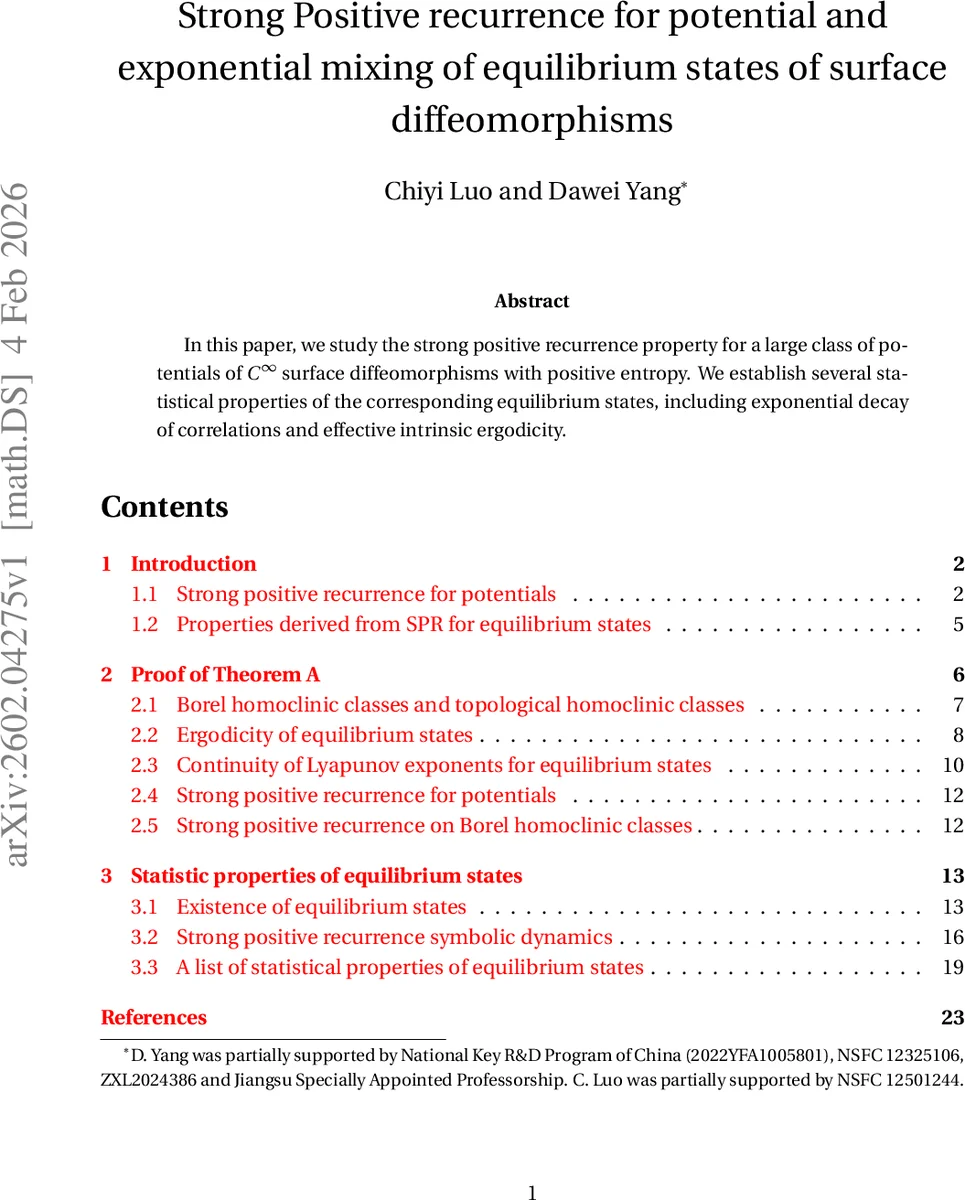
In this paper, we study the strong positive recurrence property for a large class of potentials of $C^{\infty}$ surface diffeomorphisms with positive entropy. We establish several statistical properties of the corresponding equilibrium states, including exponential decay of correlations and effective intrinsic ergodicity.
💡 Research Summary
This paper investigates the strong positive recurrence (SPR) property for a broad class of potentials of C^∞ surface diffeomorphisms with positive topological entropy. The authors prove that any Hölder continuous potential φ whose variation satisfies Var(φ) < h_top(f) enjoys the SPR property: there exists χ > 0 such that for every ε > 0 and every sequence of ergodic measures whose metric pressures converge to the topological pressure, the mass of the Pesin set PES_{χ,ε}^ℓ(f) tends to one as ℓ→∞.
From SPR they derive several fundamental statistical results. First, they show that any limit of such a sequence of measures is ergodic and that the largest Lyapunov exponent varies continuously along the sequence (Theorem B). Consequently, the number of ergodic equilibrium states for φ is finite, each is hyperbolic with all exponents outside (−χ, χ), and any pressure‑convergent sequence of measures converges to one of them (Theorem C).
Using the coding of the SPR Markov shift, they obtain exponential decay of correlations for every ergodic equilibrium state (Theorem D). Moreover, they provide quantitative bounds comparing any invariant measure ν with the equilibrium state µ: the difference of expectations of any β‑Hölder observable is bounded by a constant times the β‑norm of the observable times the pressure gap |P(µ,φ)−P(ν,φ)|, and a similar bound holds for the largest Lyapunov exponents (Theorem E). This yields an effective intrinsic ergodicity statement (Corollary 1.4).
Stability under small Hölder perturbations of the potential is established (Theorem F), together with real‑analyticity of the pressure function. Finally, they prove exponential tails for the complement of the Pesin set (Theorem G), which in turn implies large deviation principles, central limit theorems, and asymptotic variance formulas.
The proofs combine Pesin theory, homoclinic (Borel) classes, and a geometric argument showing that pressure‑convergent sequences of measures must be ergodic. This avoids the need for explicit countable Markov coding in the initial steps, while still leveraging the SPR structure of the associated symbolic dynamics. The results significantly extend the statistical theory of equilibrium states from the uniformly hyperbolic setting to general C^∞ surface diffeomorphisms with positive entropy.
Comments & Academic Discussion
Loading comments...
Leave a Comment