Strong field gravitational lensing of particles by a black-bounce-Schwarzschild black hole
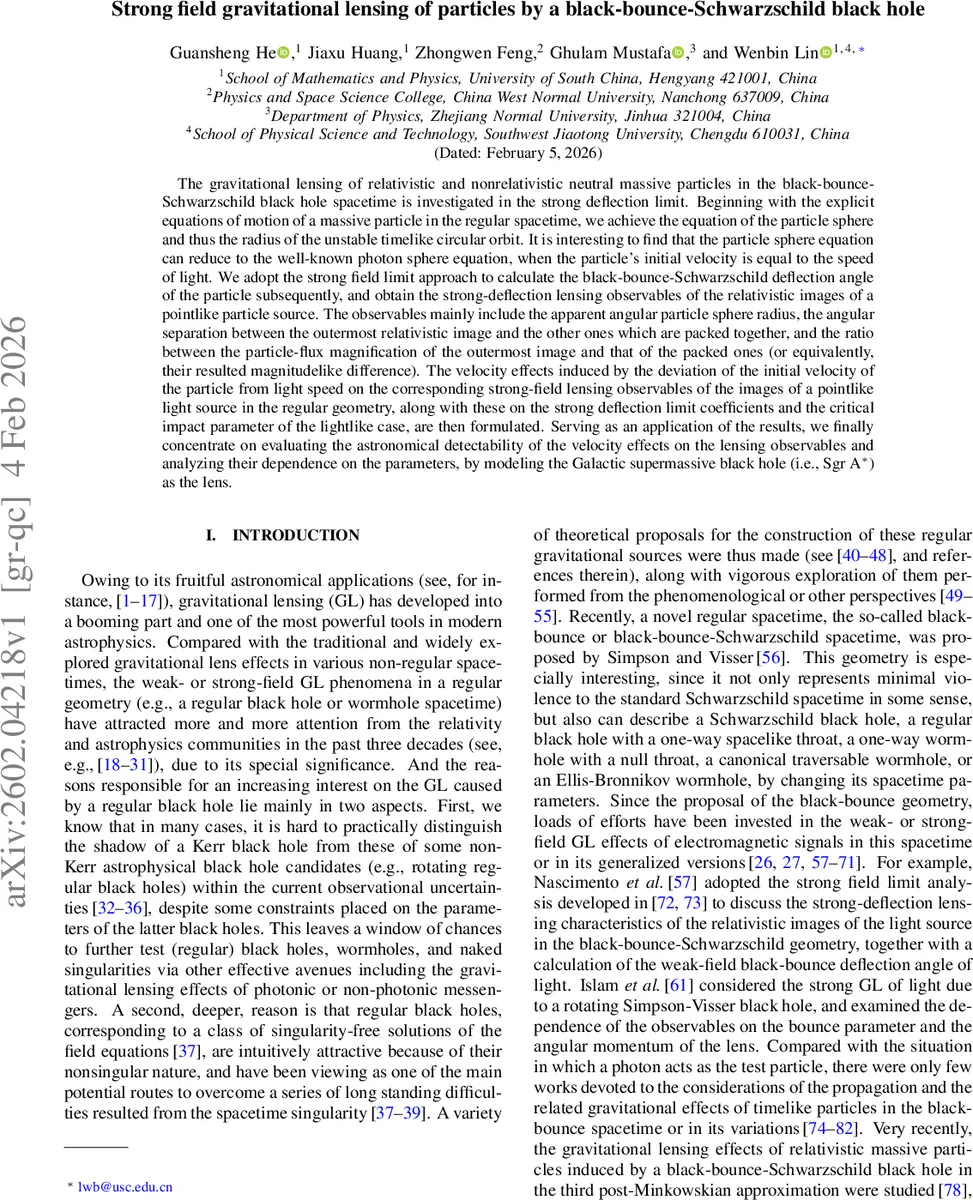
The gravitational lensing of relativistic and nonrelativistic neutral massive particles in the black-bounce-Schwarzschild black hole spacetime is investigated in the strong deflection limit. Beginning with the explicit equations of motion of a massive particle in the regular spacetime, we achieve the equation of the particle sphere and thus the radius of the unstable timelike circular orbit. It is interesting to find that the particle sphere equation can reduce to the well-known photon sphere equation, when the particle’s initial velocity is equal to the speed of light. We adopt the strong field limit approach to calculate the black-bounce-Schwarzschild deflection angle of the particle subsequently, and obtain the strong-deflection lensing observables of the relativistic images of a pointlike particle source. The observables mainly include the apparent angular particle sphere radius, the angular separation between the outermost relativistic image and the other ones which are packed together, and the ratio between the particle-flux magnification of the outermost image and that of the packed ones (or equivalently, their resulted magnitudelike difference). The velocity effects induced by the deviation of the initial velocity of the particle from light speed on the corresponding strong-field lensing observables of the images of a pointlike light source in the regular geometry, along with these on the strong deflection limit coefficients and the critical impact parameter of the lightlike case, are then formulated. Serving as an application of the results, we finally concentrate on evaluating the astronomical detectability of the velocity effects on the lensing observables and analyzing their dependence on the parameters, by modeling the Galactic supermassive black hole (i.e., Sgr A$^{\ast}$) as the lens.
💡 Research Summary
This paper investigates the strong‑deflection gravitational lensing of neutral massive particles (i.e., particles moving slower than light) by a regular black‑bounce‑Schwarzschild black hole, extending previous work on light rays and weak‑field massive‑particle lensing. The authors first introduce the Simpson‑Visser black‑bounce metric, which interpolates between a Schwarzschild black hole, a one‑way wormhole, and a traversable wormhole through the bounce parameter η (0 < η < 2M). In this spacetime the metric functions are
(A(r)=1-\frac{2M}{\sqrt{r^{2}+η^{2}}},; B(r)=A(r)^{-1},; C(r)=r^{2}+η^{2}).
Using the Lagrangian formalism for timelike geodesics in the equatorial plane, the conserved energy E and angular momentum L are expressed in terms of the particle’s asymptotic speed w and impact parameter u as (E=1/\sqrt{1-w^{2}}) and (L=wuE). The effective potential reads
(U(r)=\sqrt{\bigl(1-\frac{2M}{\sqrt{r^{2}+η^{2}}}\bigr)\bigl(1+\frac{L^{2}}{r^{2}+η^{2}}\bigr)}).
A “particle sphere”—the timelike analogue of the photon sphere—is defined by the simultaneous conditions (\dot r=0) and (\ddot r=0). This yields the algebraic equation
(\frac{C’(r_c)}{C(r_c)}-\frac{A’(r_c)}{A(r_c)}\frac{1}{1-A(r_c)E^{2}}=0).
When w→1 the equation reduces to the familiar photon‑sphere condition, confirming consistency. Solving it numerically provides the radius (r_c) and the associated critical impact parameter (u_c=\sqrt{C(r_c)/A(r_c)}), both of which depend on η and w.
The strong‑deflection limit (SDL) method of Bozza is then applied to the bending angle. Near the critical impact parameter the deflection angle diverges logarithmically:
(\alpha(u)= -\bar a \ln!\bigl(\frac{u}{u_c}-1\bigr)+\bar b+O\bigl((u-u_c)\ln(u-u_c)\bigr)).
The coefficients (\bar a) and (\bar b) are analytic functions of the metric functions and of the particle speed w. The authors compute them for a range of η and w, showing that slower particles (smaller w) increase (\bar a) and decrease (\bar b), i.e., the bending becomes stronger and the logarithmic term dominates more prominently.
From the SDL expansion three observable quantities are derived for a point‑like source:
- Angular radius of the particle sphere (\theta_{\infty}=u_c/d_L) (d_L = lens‑observer distance).
- Angular separation between the outermost relativistic image and the packed set of higher‑order images, (\Delta\theta=\theta_1-\theta_{\infty}), which is proportional to (e^{(\bar b-2\pi)/\bar a}).
- Flux (or magnitude) ratio (\mathcal R=\mu_1/ \sum_{n\ge2}\mu_n) (or (\Delta m=-2.5\log_{10}\mathcal R)), where the magnifications (\mu_n) follow the standard SDL scaling (\mu_n\propto e^{-(\bar b+2\pi n)/\bar a}).
The “velocity effect” is then quantified: deviations of w from unity shift (r_c) and (u_c), modify (\bar a) and (\bar b), and consequently alter all three observables. For example, reducing w from 0.99c to 0.9c can change (\theta_{\infty}) by a few percent, increase (\Delta\theta) by tens of micro‑arcseconds, and modify the magnitude difference by several magnitudes, depending on η.
To assess observational relevance, the authors model the Galactic centre black hole Sgr A* as the lens (M≈4.3×10⁶ M⊙, d_L≈8.3 kpc). They explore η values from 0.1 M to 0.5 M and particle speeds ranging from relativistic (w≈0.99) down to moderately relativistic (w≈0.9). The calculations indicate that the angular radius (\theta_{\infty}) (~25 µas) and the separation (\Delta\theta) (~10–30 µas) lie within the anticipated resolution of next‑generation very‑long‑baseline interferometers such as the Event Horizon Telescope and the Square Kilometre Array. However, the flux ratio (\mathcal R) involves the detection of massive particles (e.g., neutrinos or cosmic‑ray nuclei) whose current angular resolution is of order degrees, making direct measurement of the magnitude difference presently infeasible. The paper argues that future high‑sensitivity, high‑resolution multimessenger detectors could, in principle, detect the predicted velocity‑dependent signatures.
In summary, the work provides the first systematic treatment of strong‑field lensing of massive timelike particles in a regular black‑bounce spacetime, derives analytic SDL coefficients that encode the dependence on the bounce parameter and particle speed, and proposes concrete observables that could, with forthcoming instrumentation, be used to test both the regular‑black‑hole paradigm and the velocity‑dependent aspects of gravitational lensing.
Comments & Academic Discussion
Loading comments...
Leave a Comment