Artin twists of Drinfeld modules and Goss L-series
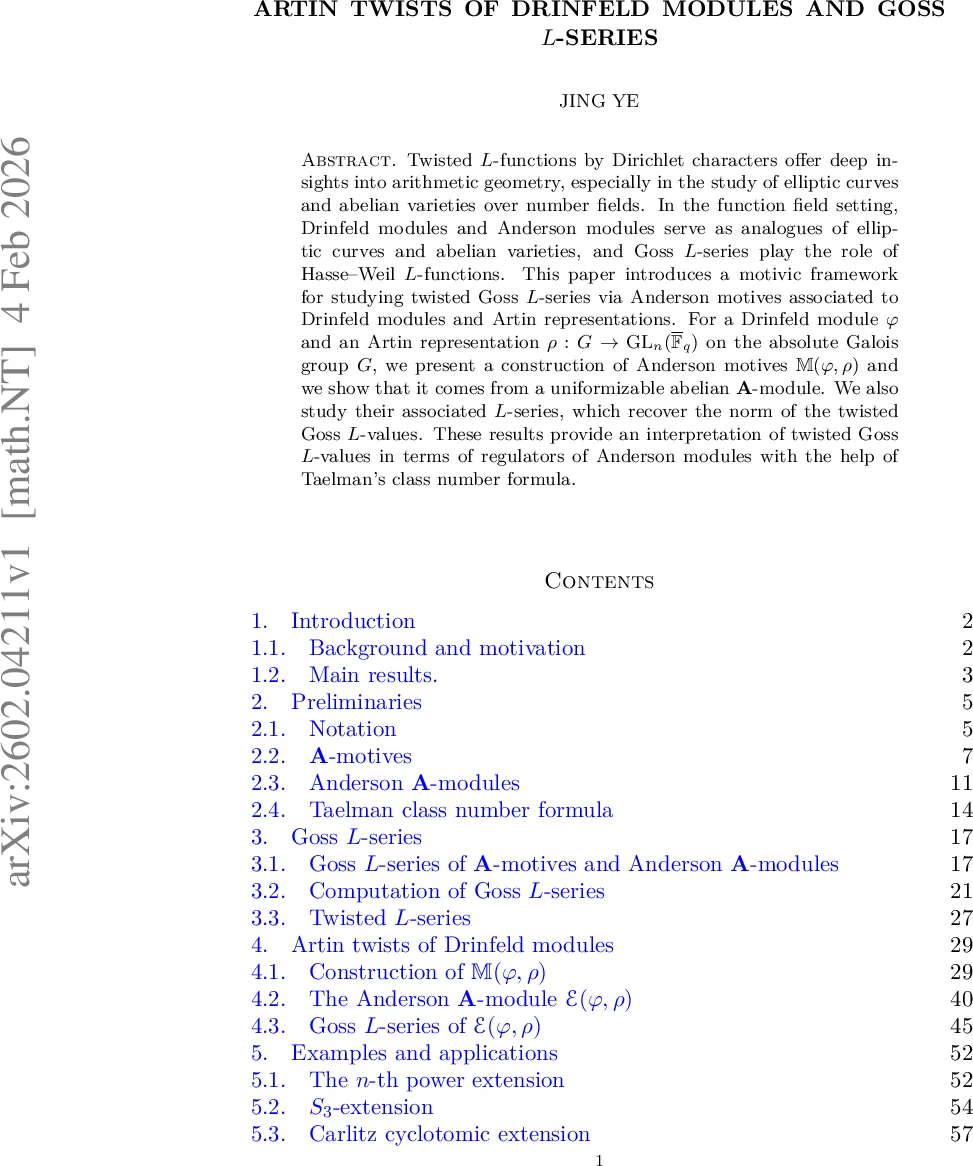
Twisted $L$-functions by Dirichlet characters offer deep insights into arithmetic geometry, especially in the study of elliptic curves and abelian varieties over number fields. In the function field setting, Drinfeld modules and Anderson modules serve as analogues of elliptic curves and abelian varieties, and Goss $L$-series play the role of Hasse-Weil $L$-functions. This paper introduces a motivic framework for studying twisted Goss $L$-series via Anderson motives associated to Drinfeld modules and Artin representations. For a Drinfeld module and an Artin representation on the absolute Galois group, we present a construction of Anderson motives associated to them and we show that it comes from a uniformizable abelian Anderson module. We also study their associated $L$-series, which recover the norm of the twisted Goss $L$-values. These results provide an interpretation of twisted Goss $L$-values in terms of regulators of Anderson modules with the help of Taelman’s class number formula.
💡 Research Summary
The paper develops a motivic framework for studying Artin twists of Drinfeld modules in the setting of positive characteristic function fields. Starting from a Drinfeld module ϕ over a global function field E and an Artin representation ρ of the absolute Galois group G_E, the author constructs an effective Anderson A‑motive M(ϕ, ρ). The construction hinges on the notion of a fundamental solution u∈Mat_{n×d}(E^{sep}) to a system of Galois‑equivariant equations attached to ρ; from u one defines a matrix Ψ=(Φ(u)·T)^{-1} and uses it to build a uniformizable abelian Anderson module E(ϕ, ρ) of dimension N=n·d. The τ‑action on E is given explicitly by a polynomial in τ whose coefficients involve the coefficients of ϕ and the matrix Ψ, providing a concrete model for the Anderson module.
A central result (Theorem 4.35) establishes a precise relation between the Goss L‑series of the motive and the twisted Goss L‑series attached to ϕ and ρ: \
Comments & Academic Discussion
Loading comments...
Leave a Comment