GPINND: A deep-learning-based state of health estimation for Lithium-ion battery
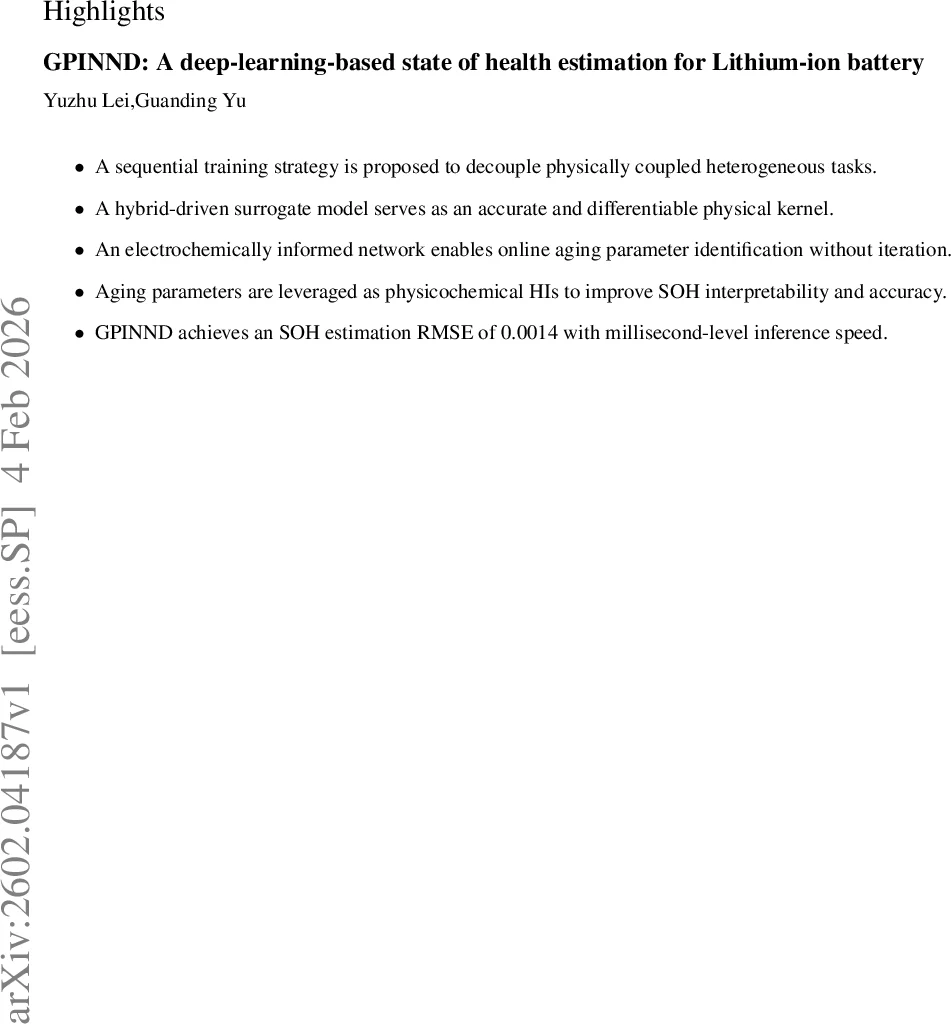
Electrochemical models offer superior interpretability and reliability for battery degradation diagnosis. However, the high computational cost of iterative parameter identification severely hinders the practical implementation of electrochemically informed state of health (SOH) estimation in real-time systems. To address this challenge, this paper proposes an SOH estimation method that integrates deep learning with electrochemical mechanisms and adopts a sequential training strategy. First, we construct a hybrid-driven surrogate model to learn internal electrochemical dynamics by fusing high-fidelity simulation data with physical constraints. This model subsequently serves as an accurate and differentiable physical kernel for voltage reconstruction. Then, we develop a self-supervised framework to train a parameter identification network by minimizing the voltage reconstruction error. The resulting model enables the non-iterative identification of aging parameters from external measurements. Finally, utilizing the identified parameters as physicochemical health indicators, we establish a high-precision SOH estimation network that leverages data-driven residual correction to compensate for identification deviations. Crucially, a sequential training strategy is applied across these modules to effectively mitigate convergence issues and improve the accuracy of each module. Experimental results demonstrate that the proposed method achieves an average voltage reconstruction root mean square error (RMSE) of 0.0198 V and an SOH estimation RMSE of 0.0014.
💡 Research Summary
The paper introduces GPINND, a novel framework for estimating the state of health (SOH) of lithium‑ion batteries by tightly integrating electrochemical modeling with deep learning. Recognizing that high‑fidelity electrochemical models (e.g., pseudo‑two‑dimensional models) provide mechanistic insight but suffer from prohibitive computational cost during iterative parameter identification, the authors propose a hybrid‑driven surrogate that learns internal concentration dynamics from high‑accuracy SPMe simulations while being constrained by ordinary differential equations (ODEs). This surrogate acts as a differentiable physical kernel for voltage reconstruction.
A self‑supervised parameter‑identification network is then trained to minimize the voltage reconstruction error, allowing direct, non‑iterative estimation of key aging parameters such as loss of active material in the positive/negative electrodes (LAM‑PE, LAM‑NE) and loss of lithium inventory (LLI). These parameters serve as physicochemical health indicators (HIs). The identified HIs are fed into a second network that predicts SOH; a data‑driven residual‑correction module compensates for any systematic bias introduced during the identification stage.
A central methodological contribution is the sequential training strategy. Instead of jointly optimizing all heterogeneous loss functions—a process that typically leads to gradient conflicts and poor convergence—the authors train the three modules in order: (1) surrogate model, (2) parameter‑identification network, and (3) SOH estimation network. Each stage is frozen before moving to the next, ensuring stable convergence and allowing task‑specific architecture design.
Experimental validation uses real‑world cycling data covering multiple degradation stages and temperature conditions. The surrogate achieves an average voltage reconstruction RMSE of 0.0198 V, while the overall SOH estimator reaches an RMSE of 0.0014, outperforming conventional model‑driven and pure data‑driven approaches. Inference runs in the millisecond range, demonstrating suitability for real‑time battery management systems (BMS).
The study shows that combining physics‑based constraints with deep learning can retain the interpretability of electrochemical models while achieving the computational efficiency required for online health monitoring. The sequential training paradigm effectively mitigates convergence issues inherent in multi‑task physics‑informed networks. Future work is suggested on extending the approach to other chemistries, high‑rate operation, and adaptive learning under varying temperature and load profiles.
Comments & Academic Discussion
Loading comments...
Leave a Comment