Rate-Optimal Noise Annealing in Semi-Dual Neural Optimal Transport: Tangential Identifiability, Off-Manifold Ambiguity, and Guaranteed Recovery
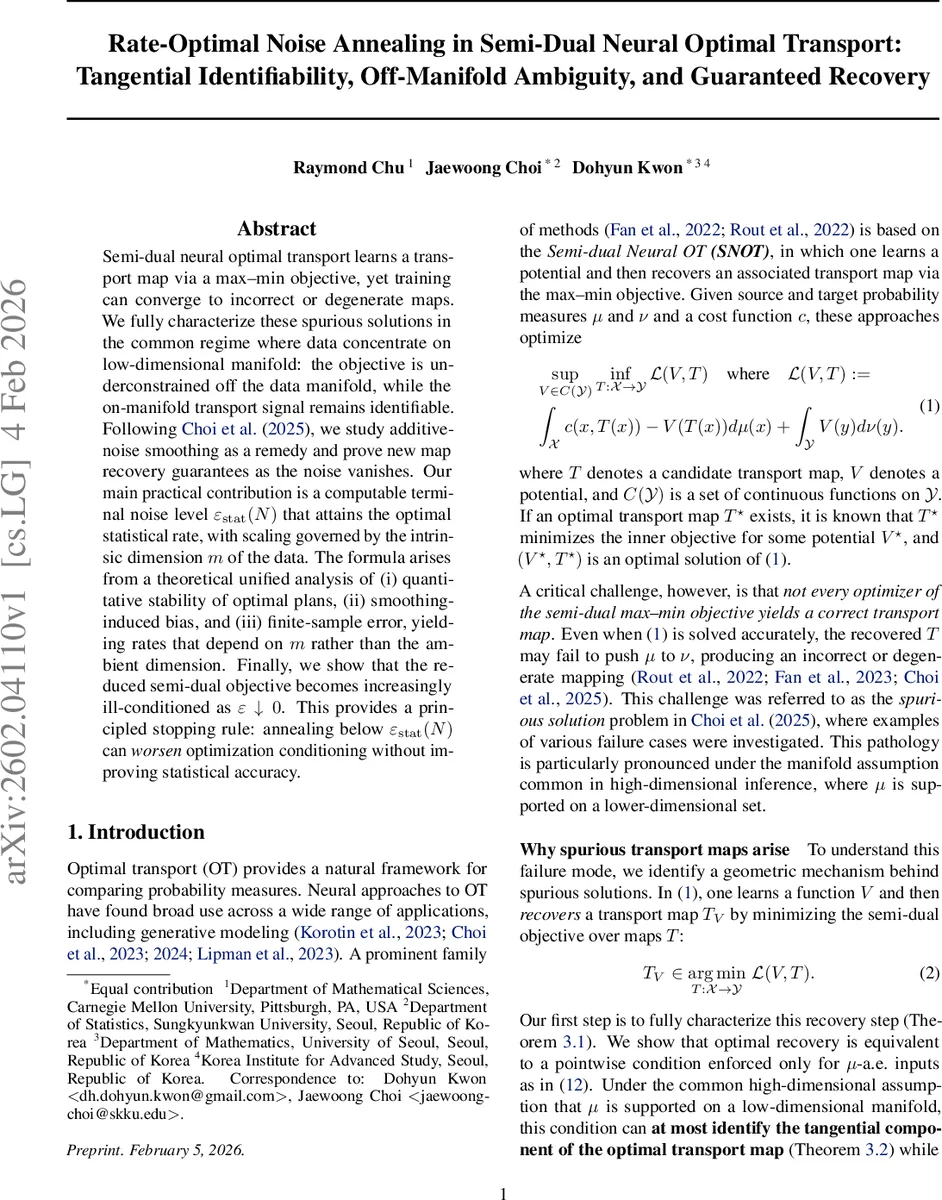
Semi-dual neural optimal transport learns a transport map via a max-min objective, yet training can converge to incorrect or degenerate maps. We fully characterize these spurious solutions in the common regime where data concentrate on low-dimensional manifold: the objective is underconstrained off the data manifold, while the on-manifold transport signal remains identifiable. Following Choi, Choi, and Kwon (2025), we study additive-noise smoothing as a remedy and prove new map recovery guarantees as the noise vanishes. Our main practical contribution is a computable terminal noise level $\varepsilon_{\mathrm{stat}}(N)$ that attains the optimal statistical rate, with scaling governed by the intrinsic dimension $m$ of the data. The formula arises from a theoretical unified analysis of (i) quantitative stability of optimal plans, (ii) smoothing-induced bias, and (iii) finite-sample error, yielding rates that depend on $m$ rather than the ambient dimension. Finally, we show that the reduced semi-dual objective becomes increasingly ill-conditioned as $\varepsilon \downarrow 0$. This provides a principled stopping rule: annealing below $\varepsilon_{\mathrm{stat}}(N)$ can $\textit{worsen}$ optimization conditioning without improving statistical accuracy.
💡 Research Summary
The paper investigates a fundamental failure mode of semi‑dual neural optimal transport (SNOT), namely that the learned transport map can be spurious or degenerate when the source distribution μ lives on a low‑dimensional manifold. By analyzing the max‑min objective
\
Comments & Academic Discussion
Loading comments...
Leave a Comment